
Closing the loop between artificial intelligence and robotic experiments

The powers of artificial intelligence (AI) and robotic experiment systems have come together in pioneering proof-of-concept work at the National Institute for Materials Science (NIMS) in Japan. The researchers describe the development and demonstration of their “closed loop” automation software in the journal Science and Technology of Advanced Materials: Methods.

“The overall aim of our work is to allow experiments exploring materials science to be designed and then proceed automatically, with no human intervention,” says physicist and software engineer Ryo Tamura at the NIMS Center for Basic Research on Materials. The AI first performs the information gathering and experimental design tasks normally done by humans, and then controls the robotic systems that can execute the required physical tasks.

The team demonstrated the potential of their system by using it to identify electrolytes that would be suitable for mediating the movement of ions in lithium-metal batteries.

The software, called the NIMS Orchestration System (NIMS-OS), contains two basic types of modules. The first uses AI algorithms to explore archived data on the properties of materials. It selects promising materials and proposes experimental procedures that would allow them to achieve a desired aim. The second type of module generates the instructions needed to control a robotic system that will put the instructions into practice.

To make the whole process as easy to use as possible for a wide range of researchers the team also designed an easy-to-use graphical user interface to control it.

“The results of initial work by the robotic system via NIMS-OS can be fed back to refine the AI algorithms that control it, through several cycles of test and improvement,” says Tamura.

In the proof-of-concept task that explored options for making electrolytes that maximize the performance of an electrode in a lithium-metal battery, NIMS-OS utilized systems that were robotically assembled into electrochemical cells and subjected to charging and discharging cycles to analyze their performance. The results clearly identified the better electrolyte composition and indicated there is room for improvement on the electrolytes that are currently widely used commercially.

“Our NIMS-OS is now publicly available as open-source software at the widely used GitHub website,” says Tamura. “We now plan to develop it further to allow it to work together with many different types of robotic experiment systems.”

Further information
Ryo Tamura
National Institute for Materials Science (NIMS)
Email: tamura.ryo@nims.go.jp
Paper: https://doi.org/10.1080/27660400.2023.2232297

About Science and Technology of Advanced Materials: Methods (STAM-M)

STAM Methods is an open access sister journal of Science and Technology of Advanced Materials (STAM), and focuses on emergent methods and tools for improving and/or accelerating materials developments, such as methodology, apparatus, instrumentation, modeling, high-throughput data collection, materials/process informatics, databases, and programming. https://www.tandfonline.com/STAM-M

Dr Yasufumi Nakamichi
STAM Publishing Director
Email: NAKAMICHI.Yasufumi@nims.go.jp

Press release distributed by Asia Research News for Science and Technology of Advanced Materials.


Moolec Science Presents Third Quarter FY 2023 Business Update

Moolec Science SA (NASDAQ: MLEC) a science-based food ingredient company focused on producing animal proteins in plants through Molecular Farming, today reported its business update for the third quarter of Fiscal Year 2023 ended March 31, 2023.

The main highlights of the Company’s business update are as follows:
– On January 3, the Company started trading on Nasdaq under tickers “MLEC” for the common shares, and “MLECW” for the Company’s warrants.

– Progress in the company’s R&D and Regulatory front is on track:
— Meat replacement (YEEA) scaled-up in R&D stages and new meat proteins were successfully expressed.
— Meat replacement product pipeline made significant scientific progress to produce animal proteins in plant hosts.
— Regulatory clearance from USDA-APHIS for Molecular GLA safflower plants was achieved.
— Molecular Safflower seed multiplication progress is on track based on the company’s internal schedule. Expression levels in GLA were approximately 60%, 10% above expectations.

– Integration of downstream and upstream capabilities:
— Moolec acquired plant-based ingredient capabilities to consolidate Molecular Farming Technology.
— The company has recently signed a Memorandum of Understanding (MOU) with Bioceres Crop Solutions (NASDAQ: BIOX) for up to 20.000 tons of Sustainable HB4(R) soybean as working capital, payable with common shares or cash in 3 years.

“We are very pleased to update the market for the first time as a public company, as the pioneer Molecular Farming Food-Biotech company in public markets. I want to thank our entire team for their unwavering commitment in building a category creator in the food industry. We look forward to continuing our journey in building a more resilient and sustainable food system for the good of the planet,” stated Gaston Paladini, Chief Executive Officer, Chairman, and Co-Founder of Moolec Science. “We have been able to deliver very important scientific, operational, and regulatory milestones, as well as business and financial progress, in a very short period of time. Proud of Moolec?s Team, the Moolers!” also added.

“Having completed our business combination on December 30, 2022, and commenced the trading on Nasdaq, as of January 3, 2023, we are confident that access to the public markets will provide Moolec the flexibility and exposure to continue growing the Company. We also commend our team’s progress and momentum in research and development. Our continued efforts have positioned Moolec at the forefront of plant-based animal protein development. We are pleased with our progress thus far as we continue to deliver results in multiple areas simultaneously,” added Jos? Lopez Lecube, Chief Financial Officer and Director of Moolec Science.

For a full version of Moolec Third Quarter Fiscal Year 2023 Business Update, click here. http://ir.moolecscience.com/wp-content/uploads/2023/05/Moolec-Science-3rd-Quarter-FY-2023-Business-Update-May-30-2023.pdf

Moolec’s Management will host a Conference Call and question-and-answer session, which will be accompanied by a presentation available during the webinar.

To access the call, please use the following information:
– Date: Wednesday, May 31, 2023
– Time: 8:00 a.m. ET
– Registration link: https://zoom.us/webinar/register/WN_-247lVcTSjG8O-cdXAt4FQ#/registration

Please connect 5-10 minutes prior to the start time to register and join. A replay and the PDF version of the presentation will be available approximately two hours after the conclusion of the live event via the company’s Investor Relations website. https://ir.moolecscience.com/

About Moolec Science SA
Moolec Science is a science-based food ingredient company focused on producing animal proteins in plants through Molecular Farming, a disruptive technology in the alternative protein landscape. Its purpose is to upgrade the taste, nutrition, and affordability of alternative protein products while building a more sustainable and equitable food system. The company’s technological approach aims to have the cost structure of plant-based solutions with the organoleptic properties and functionality of animal-based ones. Moolec Science’s technology has been under development for more than a decade and is known for pioneering the production of a bovine protein in a crop for the food industry. The company’s product portfolio and pipeline leverages the agronomic efficiency of broadly used target crops, like soybeans and peas and Moolec Science has a growing international patent portfolio (23, both granted and pending) for its Molecular Farming technology. The company is run by a diverse team of Ph.Ds and Food Insiders, and operates in the United States, Europe, and South America. For more information, visit www.moolecscience.com.

Forward-Looking Statements
This press release contains “forward-looking statements.” Forward-looking statements may be identified by the use of words such as “forecast,” “intend,” “seek,” “target,” “anticipate,” “believe,” “expect,” “estimate,” “plan,” “outlook,” and “project” and other similar expressions that predict or indicate future events or trends or that are not statements of historical matters. Such forward-looking statements with respect to performance, prospects, revenues, and other aspects of the business of Moolec Science S.A. (“Moolec”) are predictions, projections and other statements about future events that are based on current expectations and assumptions and, as a result, are subject to risks and uncertainties. Although we believe that we have a reasonable basis for each forward-looking statement contained in this press release, we caution you that these statements are based on a combination of facts and factors, about which we cannot be certain. We cannot assure you that the forward-looking statements in this press release will prove accurate. These forward-looking statements are subject to a number of significant risks and uncertainties that could cause actual results to differ materially from expected results, including, among others, changes in applicable laws or regulations, the possibility that Moolec may be adversely affected by economic, business and/or other competitive factors, costs related to the scaling up of Moolec’s business and other risks and uncertainties, including those included under the header “Risk Factors” in the Form F-1 Registration Statement filed with the U.S. Securities and Exchange Commission (“SEC”), as well as Moolec’s other filings with the SEC. Should one or more of these risks or uncertainties materialize, or should any of our assumptions prove incorrect, actual results may vary in material respects from those projected in these forward-looking statements. We undertake no obligation to update or revise any forward-looking statements, whether as a result of new information, future events or otherwise, except as may be required under applicable securities laws. Accordingly, you should not put undue reliance on these statements.

Contact Information
Catalina Jones
Chief of Staff & Sustainability
comms@moolecscience.com

Mart?n Taraciuk
Investor Relations
ir@moolecscience.com

Michael Bowen
ICR, LLC
moolecir@icrinc.com

Machine intelligence for designing molecules and reaction pathways

Two key challenges in chemistry innovation are solved simultaneously by exploring chemical opportunities with artificial intelligence.

Researchers in Japan have developed a machine learning process that simultaneously designs new molecules and suggests the chemical reactions to make them. The team, at the Institute of Statistical Mathematics (ISM) in Tokyo, published their results in the journal Science and Technology of Advanced Materials: Methods.

Designing the network of bonds linking atoms into molecules and suggesting chemical routes to make the molecules can now be done simultaneously.

Many research groups are making significant progress in using artificial intelligence (AI) and machine learning methods to design feasible molecular structures with desired properties, but progress in putting the design concepts into practice has been slow. The greatest impediment has been the technical difficulties in finding chemical reactions that can make the designed molecules with efficiencies and costs that could be practicable for real-world uses.

“Our novel machine learning algorithm and associated software system can design molecules with any desired properties and suggest synthetic routes for making them from an extensive list of commercially available compounds,” says statistical mathematician Ryo Yoshida, leader of the research group.

The process uses a statistical approach called Bayesian inference which works with a vast set of data about different options for starting materials and reaction pathways. The possible starting materials are all combinations of the millions of compounds that can be readily purchased. The computer algorithm assesses the huge range of feasible reactions and reaction networks to discover a synthetic route towards a compound with the properties it has been instructed to aim for. Expert chemists can then review the results to test and refine what the AI proposes. AI makes the suggestions while humans decide which is best.

“In a case study for designing drug-like molecules, the method showed overwhelming performance,” says Yoshida. It also designed routes towards industrially useful lubricant molecules.

“We hope that our work will accelerate the process of data-driven discovery of a wide range of new materials,” Yoshida concludes. In support of this aim, the ISM team has made the software implementing their machine learning system available to all researchers on the GitHub website.

The current success focused only on the design of small molecules. The team now plan to investigate adapting the procedure to design polymers. Many of the most important industrial and biological compounds are polymers, but it has proved difficult to make new versions proposed by machine learning due to challenges in finding reactions to build the designs. The simultaneous design and reaction discovery options offered by this new technology might break through that barrier.

Further information
Ryo Yoshida
The Institute of Statistical Mathematics
Email: yoshidar@ism.ac.jp

Paper: https://doi.org/10.1080/27660400.2023.2204994

About Science and Technology of Advanced Materials: Methods (STAM-M)
STAM Methods is an open access sister journal of Science and Technology of Advanced Materials (STAM), and focuses on emergent methods and tools for improving and/or accelerating materials developments, such as methodology, apparatus, instrumentation, modeling, high-through put data collection, materials/process informatics, databases, and programming. https://www.tandfonline.com/STAM-M

Dr Yasufumi Nakamichi
STAM Publishing Director
Email: NAKAMICHI.Yasufumi@nims.go.jp

Press release distributed by Asia Research News for Science and Technology of Advanced Materials.
Face-down: Gravity’s effects on cell movement

  • Specially coated surfaces help scientists investigate what happens when cell clusters are turned upside down.

Researchers at the National Institute for Materials Science (NIMS) and colleagues in Japan have developed a specially coated, light-responsive surface that helps test how the direction of gravity impacts cell movements. The findings, published in the journal Science and Technology of Advanced Materials, could lead to a better understanding of what happens to cells in people who are bedridden for prolonged periods and of the impact of gravity’s direction on cancer cell migration.

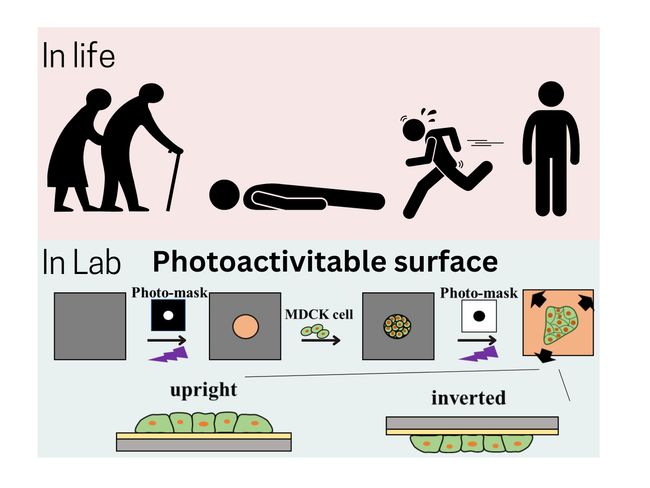
The human body takes many different positions over its lifespan. Scientists wanted to find a way to study how cell movement is impacted when the direction of gravity changes as our body positions change. (Image created using materials from STAM Vol.24, Issue 1, Article 2206525 (2023) and Canva.)

The special surfaces are made by coating glass slides with a combination of molecules that are responsive to light. Shining light on a central, circular area of the slide breaks up the molecules, clearing away a coating-free zone that cells can stick to. Once stabilized in this area, the scientists then use light to clear away an area surrounding the central circle. This encourages the cells to move in an outward direction to fill the square. The team investigated what happens to cell movement when the slide is placed upright, with the cells lying on top and the direction of gravity impacting the cells from top to bottom. They then conducted a similar test with the slide flipped over while supported on either side so that the cells are inverted and the direction of gravity is from the bottom of the cells to their tops.

“We found that the direction of gravity hindered collective cell migration in the inverted position by reducing the number of outward-moving leader cells at cluster edges and by redistributing shape-forming filaments, composed of actin and myosin, so that they kept the cells bundled together,” explains biomaterials researcher, Shimaa Abdellatef, who is a postdoc at NIMS.

The coated, light-responsive surfaces provide an advantage over currently available methods that study the impacts of gravity’s direction, as they require physical contact with the surface to which cells are attached. The new approach enables remote induction of cell migration.

“We plan to apply our approach to analyse the responses of cancer cells to the direction of gravity,” says NIMS nanoscientist, Jun Nakanishi, who led the study. “We expect to find differences between healthy and diseased cells, which could provide important information about cancer progression in bedridden patients.”

Further information
Jun Nakanishi
National Institute for Materials Science (NIMS)
Email:NAKANISHI.Jun@nims.go.jp

Shimaa A. Abdellatef
National Institute for Materials Science (NIMS)
Email: ABDELALEEM.shimaa@nims.go.jp

Paper: https://doi.org/10.1080/14686996.2023.2206525

About Science and Technology of Advanced Materials (STAM)
Open access journal STAM publishes outstanding research articles across all aspects of materials science, including functional and structural materials, theoretical analyses, and properties of materials. https://www.tandfonline.com/STAM

Dr Yasufumi Nakamichi
STAM Publishing Director
Email: NAKAMICHI.Yasufumi@nims.go.jp

Press release distributed by Asia Research News for Science and Technology of Advanced Materials.

Moolec Science Secures Up to $50 Million in Committed Equity Financing With Nomura

Moolec Science SA (NASDAQ:MLEC) (Company; Moolec), a science-based food ingredient company focused on producing animal proteins in plants through Molecular Farming, announced today it has entered into a Share Purchase Agreement (Agreement) with Nomura Securities International, Inc. (Nomura).

The Agreement provides for a committed equity financing facility under which the Company has the option, but not the obligation, to sell up to the equivalent of $50 million in aggregate gross purchase price of its ordinary shares to Nomura over a 36-month period, subject to the terms of the Agreement. The Company intends to use the proceeds from any future sales of securities under the financing facility, if it is utilized, for general corporate purposes.

“We are pleased to partner with Nomura and secure this financing facility,” said Jose Lopez Lecube, Moolec Science’s Chief Financial Officer. “This new understanding provides Moolec with enhanced financial flexibility to continue driving forward our Molecular Farming Platform and portfolio of products,” he concluded.

Further details are contained in a Current Report on Form 6-K that was filed with the Securities and Exchange Commission today.

About Moolec Science SA
Moolec is a science-based food ingredient company focused on producing animal proteins in plants through Molecular Farming, a disruptive technology in the alternative protein landscape. Its purpose is to upgrade the taste, nutrition, and affordability of alternative protein products while building a more sustainable and equitable food system. The Company’s technological approach aims to have the cost structure of plant-based solutions with the organoleptic properties and functionality of animal-based ones. Moolec’s technology has been under development for more than a decade and is known for pioneering the production of a bovine protein in a crop for the food industry. The Company’s product portfolio and pipeline leverages the agronomic efficiency of broadly used target crops, like safflower, soybean, and pea. Moolec has a growing international patent portfolio (23, both granted and pending) for its Molecular Farming technology. The Company is run by a diverse team of Ph.Ds and Food Insiders, and operates in the United States, Europe, and South America. For more information, visit www.moolecscience.com.

Forward-Looking Statements
This press release contains “forward-looking statements.” Forward-looking statements may be identified by the use of words such as “forecast,” “intend,” “seek,” “target,” “anticipate,” “believe,” “expect,” “estimate,” “plan,” “outlook,” and “project” and other similar expressions that predict or indicate future events or trends or that are not statements of historical matters. Such forward-looking statements with respect to performance, prospects, revenues, and other aspects of the business of Moolec Science S.A. (“Moolec”) are predictions, projections and other statements about future events that are based on current expectations and assumptions and, as a result, are subject to risks and uncertainties. Although we believe that we have a reasonable basis for each forward-looking statement contained in this press release, we caution you that these statements are based on a combination of facts and factors, about which we cannot be certain. We cannot assure you that the forward-looking statements in this press release will prove accurate. These forward-looking statements are subject to a number of significant risks and uncertainties that could cause actual results to differ materially from expected results, including, among others, changes in applicable laws or regulations, the possibility that Moolec may be adversely affected by economic, business and/or other competitive factors, costs related to the scaling up of Moolec’s business and other risks and uncertainties, including those included under the header “Risk Factors” in the Form F-1 Registration Statement filed with the U.S. Securities and Exchange Commission (“SEC”), as well as Moolec’s other filings with the SEC. Should one or more of these risks or uncertainties materialize, or should any of our assumptions prove incorrect, actual results may vary in material respects from those projected in these forward-looking statements. We undertake no obligation to update or revise any forward-looking statements, whether as a result of new information, future events or otherwise, except as may be required under applicable securities laws. Accordingly, you should not put undue reliance on these statements.

Contact Information
Catalina Jones
Chief of Staff & Sustainability
comms@moolecscience.com

Martin Taraciuk
Investor Relations
ir@moolecscience.com

Michael Bowen
ICR, LLC
moolecir@icrinc.com

Related Files
Moolec Science Secures up to $50 Million Dollars in Committed Equity Financing with Nomura – 2023.04.17.pdf
https://cdn.newswire.com/files/x/a8/e1/bf62a363bcdd61ad9685397e5d2a.pdf

SOURCE: Moolec Science

Optica Publishing Group Announces Launch of Optica Quantum

  • New, online-only Gold Open Access journal to rapidly disseminate high-impact research results across many sectors of quantum information science and technology.

On World Quantum Day, Optica Publishing Group announced it will begin publishing a new journal in September 2023 dedicated to highly selective results in quantum information science and technology (QIST). The new journal, Optica Quantum, joins the Society’s portfolio of the most-cited journals in optics and photonics and will provide the community with articles of the same exceptional standards for quality, novelty, and significance as its parent journal, Optica.

Dr. Michael G. Raymer, Knight Professor of Liberal Arts and Sciences, Founding Director of the Oregon Center for Optical Molecular and Quantum Science, University of Oregon, USA, will serve as the inaugural editor-in-chief of the Optica Quantum

The concept of quantum light serves as a foundation for many quantum technologies and ongoing research areas involving security, communications, computing, machine learning, sensing, and more. To support this rapidly growing field, Optica Quantum will be dedicated to QIST as enabled by optics and photonics, publishing theoretical and experimental research as well as technological advances and applications of quantum optics.

Dr. Michael G. Raymer, Knight Professor of Liberal Arts and Sciences, Founding Director of the Oregon Center for Optical Molecular and Quantum Science, University of Oregon, USA, will serve as the inaugural editor-in-chief of the Journal. Raymer has been on the forefront of the quantum information revolution and has been instrumental in a number of key initiatives that have advanced the field. He successfully lobbied the US Government to approve the US National Quantum Initiative Act in 2018, which greatly boosted research and development in this area. A few years later, in 2020, Raymer launched Optica’s Quantum 2.0 topical meeting to help scientists and engineers focus on and resolve key challenges facing the QIST community today.

“I am honored to be entrusted with the founding editor-in-chief position for Optica Quantum,” said Raymer. “Through my volunteer work with and support from Optica, I’ve been part of and witnessed the major impact that a professional society can have in advancing quantum science and technology. With the help of a distinguished editorial board, I intend for Optica Quantum to become a one-of-kind journal that provides top-caliber articles and mini-reviews from a Society publisher that’s been in the field for more than 100 years.”

Optica Quantum will rapidly publish original peer-reviewed, high-impact research results, provide state-of-the art reviews of both emerging and established subareas of optics- and photonics-related QIST, and share opinions from recognized authorities on new directions for this critical field.

“Optica Publishing Group continually seeks ways to better serve the global optics and photonics community. With the acceleration of quantum research across the globe, there’s an increasing need to curate, publish and perpetually archive the latest and most significant research from the leaders in the field. Optica Quantum will not only achieve this, but it will also foster increased synergies among academia, industry, and government agencies interested in QIST developments,” said Elizabeth Nolan, Optica Deputy Executive Director and Chief Publishing Officer.

Optica Quantum will open for submissions in June 2023. Article Processing Charges for this Gold Open-Access journal will be waived for all articles published this year.

About Optica Publishing Group (formerly OSA)
Optica Publishing Group is a division of the society, Optica (formerly OSA), Advancing Optics and Photonics Worldwide. It publishes the largest collection of peer-reviewed and most-cited content in optics and photonics, including 18 prestigious journals, the society’s flagship member magazine, and papers and videos from more than 835 conferences. With over 400,000 journal articles, conference papers and videos to search, discover and access, our publications portfolio represents the full range of research in the field from around the globe.

Contact Information:
Leah Poffenberger
Corporate Communications Manager
lpoffenberger@optica.org

SOURCE: Optica Publishing Group

Moolec Science Acquires Food Ingredient Capabilities to Consolidate Molecular Farming Technology

Moolec Science SA (NASDAQ:MLEC; Company; Moolec), a science-based food ingredient company focused on producing animal proteins in plants through Molecular Farming, announced today the acquisition of plant-based food ingredient capabilities dedicated to the production and commercialization of functional soy proteins. This will help to accelerate Moolec’s growth in the food ingredients industry by expanding its commercial network with a top-notch sales team and complementing its Molecular Farming Platform with industrial capacity, downstream operations, and a highly experienced team of professionals.

“This strategic decision accelerates our business plan’s execution by combining existing commercial and manufacturing capabilities in different geographies, with the deep-science approach of our Molecular Farming Platform. As a result, Moolec is well-positioned to accelerate its sales ramp ahead of schedule starting in the 2023/2024 period with estimated revenues in the range of $6 million,” said Jose Lopez Lecube, Moolec Science’s Chief Financial Officer.

These Food Ingredient Capabilities resulting from the integration of ValoraSoy include state-of-the-art industrial facilities with a processing capacity of 10,000 tons strategically located in one of the main Argentine soybean corridors; a team of technicians, engineers, agronomists, and plant-based professionals; and commercial channels in more than 14 countries on three different continents. Soy-based protein ingredients are manufactured using several extrusion technologies and processes which yield ingredients with texture and fibrousness similar to meat. These solutions are utilized in several end products such as hamburgers, sausages, and other plant-based products in the traditional and alternative food industries, industrially and commercially complementary with Moolec’s Molecular Farming pipeline.

Henk Hoogenkamp, Chief Product Officer and co-founder of Moolec, declared, “We believe plant-based technologies and Molecular Farming taken together have the power to contribute towards global food security. Moolec is developing the plant-proteins of the future by using highly efficient high-protein crops, in this case soybeans, to produce a wide variety of proteins naturally found in animals. Combining these crops with ValoraSoy’s capabilities, we can accelerate our technology rollout but also specifically target certain solutions by incorporating real-time feedback from existing customers around the globe. Leveraging this position, we can consolidate our Molecular Farming platform and lower the cost of protein-rich foods as we drive functionality, nutrition, and affordability for the up-and-coming economies of the world,” he finished.

The transaction contemplates acquiring 100% of ValoraSoy in exchange for $6 million, of which ~$2.5 million is paid in cash, and the rest is paid with Moolec’s shares in three years based on vesting and business metrics. Pursuant to the share purchase agreement, the Company will retain a portion of the purchase price for a period of 12 months after signing of the transaction documents. The payment in shares is subject to vesting and the achievement of business milestones over a period of three years.

Moolec will give a Business Update in Mid-May to review the overall progress of the Company and the most recent events. For more information on ValoraSoy, click here. https://pr.report/vDljhCca

About Moolec Science SA
Moolec is a science-based food ingredient company focused on producing animal proteins in plants through Molecular Farming, a disruptive technology in the alternative protein landscape. Its purpose is to upgrade the taste, nutrition, and affordability of alternative protein products while building a more sustainable and equitable food system. The Company’s technological approach aims to have the cost structure of plant-based solutions with the organoleptic properties and functionality of animal-based ones. Moolec’s technology has been under development for more than a decade and is known for pioneering the production of a bovine protein in a crop for the food industry. The Company’s product portfolio and pipeline leverages the agronomic efficiency of broadly used target crops, like safflower, soybean, and pea. Moolec has a growing international patent portfolio (23, both granted and pending) for its Molecular Farming technology. The Company is run by a diverse team of Ph.Ds and Food Insiders, and operates in the United States, Europe, and South America. For more information, visit www.moolecscience.com.

Forward-Looking Statements
This press release contains “forward-looking statements.” Forward-looking statements may be identified by the use of words such as “forecast,” “intend,” “seek,” “target,” “anticipate,” “believe,” “expect,” “estimate,” “plan,” “outlook,” and “project” and other similar expressions that predict or indicate future events or trends or that are not statements of historical matters. Such forward-looking statements with respect to performance, prospects, revenues, and other aspects of the business of Moolec Science S.A. (“Moolec”) are predictions, projections and other statements about future events that are based on current expectations and assumptions and, as a result, are subject to risks and uncertainties. Although we believe that we have a reasonable basis for each forward-looking statement contained in this press release, we caution you that these statements are based on a combination of facts and factors, about which we cannot be certain. We cannot assure you that the forward-looking statements in this press release will prove accurate. These forward-looking statements are subject to a number of significant risks and uncertainties that could cause actual results to differ materially from expected results, including, among others, changes in applicable laws or regulations, the possibility that Moolec may be adversely affected by economic, business and/or other competitive factors, costs related to the scaling up of Moolec’s business and other risks and uncertainties, including those included under the header “Risk Factors” in the Form F-1 Registration Statement filed with the U.S. Securities and Exchange Commission (“SEC”), as well as Moolec’s other filings with the SEC. Should one or more of these risks or uncertainties materialize, or should any of our assumptions prove incorrect, actual results may vary in material respects from those projected in these forward-looking statements. We undertake no obligation to update or revise any forward-looking statements, whether as a result of new information, future events or otherwise, except as may be required under applicable securities laws. Accordingly, you should not put undue reliance on these statements.

Contact Information
Catalina Jones
Chief of Staff & Sustainability
comms@moolecscience.com

Martin Taraciuk
Investor Relations
ir@moolecscience.com

Michael Bowen
ICR, LLC
moolecir@icrinc.com

Related Files
https://cdn.newswire.com/files/x/2e/4f/a161cc02bf67fbb809ea3bc328f3.pdf

Polymer protection for vaccines and drugs

A biocompatible polymer could help deliver vaccines and drugs with reduced risk of the rare dangerous adverse reaction called anaphylaxis. Researchers at the National Institute of Advanced Industrial Science and Technology (AIST) in Japan have developed the polymer and performed preliminary tests, which they report in the journal Science and Technology of Advanced Materials.

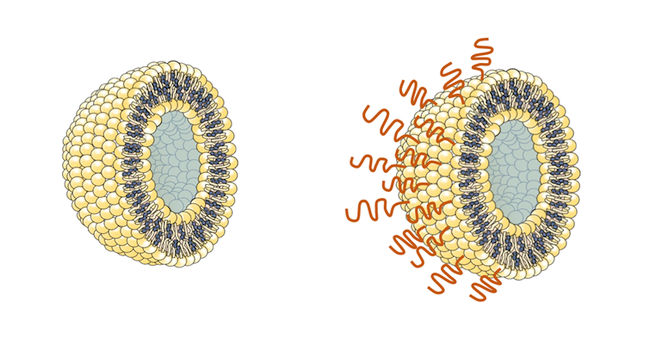
Until now, the polymer of choice for encasing and delivering vaccines has been poly(ethylene glycol) (PEG). This synthetic, flexible, water-soluble material has been used to surround some COVID-19 vaccines carried within the tiny spherical packages known as liposomes.

Unfortunately, some recipients have suffered an anaphylactic reaction to PEG, in which the immune system mounts an allergic response to the foreign material. Symptoms of anaphylaxis range from minor skin irritations, to breathing difficulty, nausea and, in the worst cases, unconsciousness and sudden death.

The alternative polymer is a form of fatty biomolecule called a lipid, and is conjugated to 2-methacryloyloxyethyl phosphorylcholine (MPC) polymer.

This new substance spontaneously binds to the outside of liposome particles when mixed with them in water. Crucially, the polymer is not recognized by the antibodies that the body can generate in response to PEG, and tests suggest it does not stimulate any other antibodies that could cause an allergic reaction. This should allow coated liposomes containing a vaccine to be retained in the body for a longer time without being cleared by the immune system, in addition to avoiding anaphylaxis.

“We have also found that the polymer avoids other interactions with proteins in the blood that might otherwise interfere with its effects, and it also prevents liposomes from aggregating together,” says molecular engineer Yuji Teramura of the AIST team.

Tests confirm the coated liposomes can remain stable in storage for 14 days, sufficient for real clinical applications.

“All the indications suggest that our technology should be suitable for delivering vaccines into patients who develop anaphylaxis in response to PEG,” Teramura concludes.

The polymer must now be thoroughly tested in various real vaccine applications. The team is moving into this next crucial phase of the development process, prior to eventual clinical trials in humans.

Provided the animal and subsequent clinical trials go well, the technology should offer opportunities for delivering drugs into the body, in addition to vaccines. Delivery systems such as liposomes are sometimes needed to protect drugs from biochemical processes that might degrade them. This can ensure that they reach the target disease tissues while remaining in their active form.

Further information
Yuji Teramura
National Institute of Advanced Industrial Science and Technology (AIST)
Email: y.teramura@aist.go.jp

About Science and Technology of Advanced Materials (STAM)

Open access journal STAM publishes outstanding research articles across all aspects of materials science, including functional and structural materials, theoretical analyses, and properties of materials. https://www.tandfonline.com/STAM

Dr Yasufumi Nakamichi
STAM Publishing Director
Email: NAKAMICHI.Yasufumi@nims.go.jp

Press release distributed by Asia Research News for Science and Technology of Advanced Materials.

Revealing crystal structures robotically

  • Machine learning and robotic process automation combine to speed up and simplify a process used to determine crystal structures.

Researchers at the National Institute for Materials Science (NIMS) in Japan have automated a complex and labour-intensive process for analysing the results of X-ray diffraction studies, which are used to determine the structure of crystalline materials. The team described the development and application of their technique in the journal Science and Technology of Advanced Materials: Methods.

By combining machine learning with robotic process automation, researchers automated a mathematical procedure that determines the structure of crystalline materials. (Credit: ktsdesign/123rf)

X-rays fired at a crystal interact with the geometric arrangement of its particles and are diffracted in many directions in a complex pattern of rays that depends on the crystal’s precise structure. Experts analyse the pattern and intensity of the diffracted X-rays to determine the crystal’s internal arrangement. This is a powerful and widely used process for revealing the three-dimensional atomic structure of new materials.

A well-established mathematical procedure, called Rietveld analysis, is used for interpreting X-ray diffraction data, but it is time-consuming and requires manual trial-and-error refinement of the results.

“To reduce human costs and resources, we have developed a robotic process automation (RPA) system that we apply to an existing Rietveld analysis program called RIETAN-FP,” says Ryo Tamura of the NIMS team. “By using our new procedure, with the help of machine learning, we have succeeded in performing Rietveld analysis automatically,” Tamura adds.

The automation can be run on a personal computer and can reduce human error as well as greatly speed up the data analysis.

Tamura explains that the field of materials science already relies on numerous graphical user interface (GUI) applications to calculate a material’s properties, control experimental equipment, or analyse material data. He says that combining this new RPA and machine learning ability with these applications achieves a “closed loop” to automatically design and analyse materials with minimal human intervention.

The researchers verified the accuracy of their procedure by analysing samples of powdered compounds whose crystal structures are already known. The ability to determine the structures from powdered samples is one of the great strengths of Rietveld analysis. It avoids the need to grow large single crystals, which can be extremely difficult to obtain for some materials.

“Automating Rietveld analysis brings a very powerful new tool into the entire field of materials science,” Tamura concludes.

The researchers are now working to further refine their procedure to make it suitable for more complex crystal structures. Another aim is to explore the use of their machine learning RPA strategy for more general applications in materials science. The possibilities include numerous simulation methods used for calculating material properties, and also applications for controlling experimental equipment. The success achieved thus far with X-ray diffraction could just be the start for Rietveld robotics.

Further information
Ryo Tamura
National Institute for Materials Science
Email: tamura.ryo@nims.go.jp

About Science and Technology of Advanced Materials: Methods (STAM Methods)
STAM Methods is an open access sister journal of Science and Technology of Advanced Materials (STAM), and focuses on emergent methods and tools for improving and/or accelerating materials developments, such as methodology, apparatus, instrumentation, modeling, high-through put data collection, materials/process informatics, databases, and programming. https://www.tandfonline.com/STAM-M

Dr. Yasufumi Nakamichi
STAM Methods Publishing Director
Email: NAKAMICHI.Yasufumi@nims.go.jp

Press release distributed by Asia Research News for Science and Technology of Advanced Materials.
JE Cleantech (JCSE) Announces Strong Growth in Q3 2022

JE Cleantech Holdings Limited (Nasdaq: JCSE), (“the Company”) a Singapore-based cleantech company, today announced encouraging Q3 financial results, for the three months period ended 30 September 2022 (the “reporting period”). During the reporting period, the Company has maintained strong growth in its overall business performance with revenue that more than doubled and a strong turnaround in net income.

For the three months period ended September 30, 2022, the Company’s total revenue increased by approximately S$3.5 million or 141.8% to approximately S$5.9 million from approximately S$2.4 million in the quarter ended September 30, 2021. The increase was mainly derived from the increase in revenue generated from the Company’s sale of cleaning systems and other equipment business of approximately S$3.2 million and the provision of centralized dishwashing and ancillary services business of approximately S$0.3 million, attributable to the post COVID-19 recovery of business.

Net income of the Company for the reporting period amounted to approximately S$0.6 million, compared to a net loss of approximately S$0.2 million in the same period last year, indicating a significant turnaround for its business performance.

During the reporting period, the Company recorded a gross profit margin of approximately 26.0%, an increase of 63.5% year-over-year. Diluted Earnings Per Share was approximately S$0.05, compared to the basic losses per share of approximately S$0.01 during the same period in 2021.

Ms. Bee Yin Hong, CEO and Founder, JE Cleantech said, “We are excited to announce that JE Cleantech has performed well during Q3 2022. Our Q3 results reflect our strong focus on exploiting the rapid recovery of the electronic manufacturing and F&B sectors. As a leading manufacturer of precision cleaning systems and provider of centralized dishwashing and ancillary services in Singapore, we will continue to drive our long-term expansion plans”.

JE Cleantech has been providing centralized dishwashing services in Singapore since 2013, for customers in various industries, including HDD manufacturing, semiconductor manufacturing, food and beverage, and public transportation. The Company’s revenue contributes approximately 15 per cent market share in 2020 in terms of revenue (source: Euromonitor estimates from desk research and trade interviews with leading centralized dishwashing services providers and the relevant trade associations in Singapore). Moving forward, the Company will persistently spare no efforts in further expanding its business, widening its product offerings to more industries, growing its market share, and generating long-term and sustainable returns for its shareholders and investors.

About JE Cleantech Holdings Limited

JE Cleantech Holdings Limited is based in Singapore and is principally engaged in (i) the sale of cleaning systems and other equipment; and (ii) the provision of centralized dishwashing and ancillary services. Through its subsidiary, JCS-Echigo Pte Ltd, the company designs, develops, manufactures, and sells cleaning systems for various industrial end-use applications primarily to customers in Singapore and Malaysia. Its cleaning systems are mainly designed for precision cleaning, with features such as particle filtration, ultrasonic or megasonic rinses with a wide range of frequencies, high pressure drying technology, high flow rate spray, and deionized water rinses, which are designed for effective removal of contaminants and to minimize particle generation and entrapment. The Company also has provided centralized dishwashing services, through its subsidiary, Hygieia Warewashing Pte Ltd, since 2013 and general cleaning services since 2015, both mainly for food and beverage establishments in Singapore. http://www.jecleantech.sg/

[1] These financial and other data for the three months and nine months periods ended September 30, 2021 and 2022 have not been audited or reviewed by the Auditors.

Disclaimer: Forward looking statements

This news release includes forward-looking statements within the meaning of Section 27A of the Securities Act of 1933, as amended, and Section 21E of the Securities and Exchange Act of 1934, as amended. Forward-looking statements may be identified by such words or phrases as “should,” “intends,” “is subject to,” “expects,” “will,” “continue,” “anticipate,” “estimated,” “projected,” “may,” “I or we believe,” “future prospects,” “our strategy,” or similar expressions. Forward-looking statements made in this press release that relate to our future contract revenues among other things involve known and unknown risks and uncertainties that may cause the actual results to differ materially from those expected and stated in this announcement. We undertake no obligation to update “forward-looking” statements.

For Media Enquiries and Investor Relations, please contact:
jcse@preciouscomms.com