
Machine learning used to optimise polymer production

By identifying the ideal manufacturing conditions, machine learning reduces the need for expensive and time-consuming experimentation.

Polymers, such as plastics, are essential in many aspects of life and industry, from packaging and cars to medical devices and optic fibres. Their value comes from diverse properties that are largely determined by their monomers – the single chemical units – that make up a polymer. Unfortunately, it can be challenging to control the chemical behaviour of monomers during manufacture to achieve a desired outcome.

The flow synthesis reactor with two bottles containing a monomer, initiator and solvent mixed using a micromixer. The synthesis is controlled with AI-based design of experimental conditions such as the temperature and a flow rate.

Now, a team of researchers led by Professor Mikiya Fujii of the Nara Institute of Science and Technology in Japan have used machine learning to mathematically model the polymerization process and reduce the need for time-consuming and expensive experimentation. Their results have been published in the journal Science and Technology of Advanced Materials: Methods.

Machine learning algorithms need data, so the researchers designed a polymerization process that would quickly and efficiently generate experimental data to feed into the mathematical model. The target molecule was a styrene-methyl methacrylate co-polymer, which was made by mixing styrene and methyl methacrylate monomers, both already dissolved in a solvent with an added initiator substance, then heating them in a water bath.

The team also used a method called flow synthesis, in which the two monomer solutions are mixed and heated in a constant flow. This allows for better mixing, more efficient heating, and more precise control of heating time and flow rate, which makes it ideal for use with machine learning.

The modelling evaluated the effect of five key variables in the polymerization process: the concentration of the initiator, the ratio of solvent to monomer, the proportion of styrene, the temperature of the reaction, and the time spent in the water bath. The goal was to have an end product with as close to 50% styrene as possible.

Once enough experimental data was available, the machine learning process took only five cycles of calculation to achieve the ideal proportion of styrene to methyl methacrylate. The results showed that the key was a lower temperature and longer time in the water bath, as well as lowering the relative concentration of the monomer in the solvent. The researchers were surprised to discover that the solvent concentration was just as important as the proportion of monomers going into the mix.

“Our results demonstrate that machine learning not only can explicitly reveal what humans may have implicitly taken for granted but can also provide new insights that weren’t recognized before,” Professor Mikiya Fujii says. “The use of machine learning in chemistry could open the door for smarter, greener manufacturing processes with reduced waste and energy consumption.”

Further information
Mikiya Fujii
Nara Institute of Science and Technology
Email: fujii.mikiya@ms.naist.jp 

Paper: https://doi.org/10.1080/27660400.2024.2425178

About Science and Technology of Advanced Materials: Methods (STAM-M)

STAM Methods is an open access sister journal of Science and Technology of Advanced Materials (STAM), and focuses on emergent methods and tools for improving and/or accelerating materials developments, such as methodology, apparatus, instrumentation, modeling, high-through put data collection, materials/process informatics, databases, and programming. https://www.tandfonline.com/STAM-M 

Dr Yasufumi Nakamichi
STAM Publishing Director
Email: NAKAMICHI.Yasufumi@nims.go.jp 

Press release distributed by Asia Research News for Science and Technology of Advanced Materials.
A bio-inspired twist on robotic handling

The subtle adhesive forces that allow geckos to seemingly defy gravity, cling to walls and walk across ceilings have inspired a team of researchers in South Korea to build a robotic device that can pick up and release delicate materials without damage. The team, based at Kyungpook National University and Dong-A University, has published their research work in Science and Technology of Advanced Materials, an international science journal. The researchers are hoping it can be applied to the transfer of objects by robotic systems.

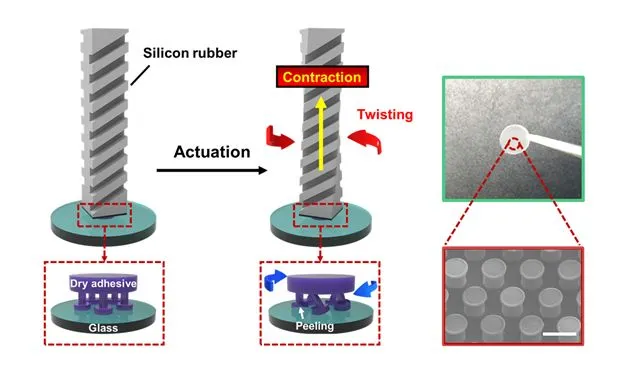
The structure and operation of the soft robotic device with dry adhesive.

The dry but sticky secret of a gecko’s foot lies in its coating of tiny hairs- made of protein- called micro setae. These hairs are around 100 micrometers long and 5 micrometers in diameter. Each hair divides into a number of branches that end in flat triangular pads called spatulae. The spatulae are so small that their molecules interact with those of the surface the gecko is climbing. This creates weak forces of attraction between these molecules, known as van der Waals force. This force is strong enough to hold the gecko in place.

The gecko’s innate adhesive ability has drawn the attention of many researchers and has inspired the use of its adhesion mechanism in robotics. An artificial, mushroom-shaped dry adhesive, that mimics this mechanism, has been used to robotically pick up materials. However, the force needed to detach the adhesive from the material’s surface can lead to its damage, especially if the material is fragile, such as glass. “There have been problems in getting the adhesive to detach easily,” explained Seung Hoon Yoo, first author of the research article. “In order to exploit these adhesive powers in robotic systems, it is imperative that the robot can not only pick up an object, but also readily detach from it to leave the object in its desired location”.

In their study, the team resolved this detachment problem by using a vacuum-powered device, made of soft silicon rubber. In order to detach the dry adhesive without damaging the fragile object being moved, a new detachment method was introduced. This method involves a twisting and lifting motion that pulls the dry adhesive off of the glass surface without causing any damage to it. The researchers found that the addition of this twisting motion caused a ten-fold reduction in the force required for detachment, which could be vital when handling delicate materials.

On conducting tests in which their transfer system was attached to a robotic arm, the researchers demonstrated that it could pick up a delicate glass disc from a sloping surface, move it to a different location and gently set it down without causing any damage to it.

“We expect our research will garner significant interest from the industry, since many companies are very interested in using dry adhesives for temporary attachment and movement of components, especially in robotic applications,” said Sung Ho Lee, one of the study’s authors. He added that his team hopes to serve as a bridge between research and industry by applying it to real industrial applications and developing more advanced models.

About Science and Technology of Advanced Materials (STAM)

Open access journal STAM publishes outstanding research articles across all aspects of materials science, including functional and structural materials, theoretical analyses, and properties of materials. https://www.tandfonline.com/STAM

Press release distributed by Asia Research News for Science and Technology of Advanced Materials.
Spinning electricity from heat and cold

A new device harvests two types of energy during the daytime, making it cool on one end and hot on the other, to generate electricity around the clock. With further improvements, the device could be used in off-grid Internet-of-things sensors. The details were published in the journal Science and Technology of Advanced Materials.

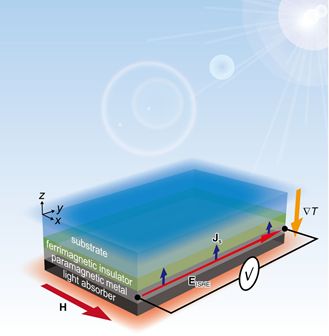
Thermal emission is radiated from the top of the device, keeping it cool, while sunlight is absorbed at the bottom, keeping that part warm. The temperature gradient and types of materials used lead to the generation of a spin current that is converted to thermoelectric voltage.

Scientists have known for at least 200 years that electricity can be generated from a temperature gradient, a phenomenon called thermoelectric generation. Recently, researchers have developed thermoelectric conversion technologies by changing material parameters and introducing new principles. For example, researchers have found that magnetic materials can generate thermoelectric voltage by inducing a flow of electron spins along a temperature gradient, called the spin Seebeck effect, and that increasing a device’s length perpendicular to the gradient boosts voltage. Scientists would like to fabricate more efficient, thin thermoelectric devices based on the spin Seebeck effect. However, the thinner the device, the more difficult it is to maintain a temperature gradient between its top and bottom.

Satoshi Ishii and Ken-ichi Uchida of Japan’s National Institute for Materials Science and colleagues have solved this problem by making a device with magnetic layers that continuously cools at the top and absorbs heat from the sun at the bottom. In this way, the device harvests two types of energy. Radiative cooling occurs at the top, as heat is lost from material in the form of infrared radiation, while solar radiation is absorbed in the bottom.

“It is really important to take full advantage of renewable energy in order to achieve a more sustainable society,” explains Ishii. “Daytime radiative cooling and solar heating have both been used to improve a variety of thermoelectric applications. Our device uses both types of energy simultaneously to generate a thermoelectric voltage.”

Here’s how it works:

The device has four layers. The top layer is a weak paramagnet made of gadolinium gallium garnet. This layer is transparent to sunlight and emits thermal radiation to the universe, getting cooler. Sunlight passes through to the following ferrimagnetic layer made of yttrium iron garnet. This layer is also transparent, so light continues to travel down into the bottom two light-absorbing layers, made of paramagnetic platinum and blackbody paint. The bottom section stays warm due to sunlight absorption. The spin current is generated in the ferromagnetic layer owing to the temperature gradient between the top and bottom of the device and is converted to electric voltage in the paramagnetic platinum layer.

The device works best on clear days, as clouds reduce the achievable temperature gradient by blocking the emitted infrared radiation from passing through the atmosphere and reducing the solar heating.

While promising, the device’s thermoelectric generation efficiency was still quite low. The team plans to boost its efficiency by improving the design, experimenting with different material combinations, and developing even more novel strategies for thermoelectric generation.

Further information
Satoshi Ishii
National Institute for Materials Science
E: sishii@nims.go.jp

Ken-ichi Uchida
National Institute for Materials Science
E: UCHIDA.Kenichi@nims.go.jp

About Science and Technology of Advanced Materials Journal

Open access journal STAM publishes outstanding research articles across all aspects of materials science, including functional and structural materials, theoretical analyses, and properties of materials. Website: https://www.tandfonline.com/toc/tsta20/current

Dr. Yoshikazu Shinohara
STAM Publishing Director
E: SHINOHARA.Yoshikazu@nims.go.jp

Press release distributed by ResearchSEA for Science and Technology of Advanced Materials.

Size matters: Bimodal imaging receives nanoparticle enhancement

Scientists have found a way to control the size of special nanoparticles to optimize their use for both magnetic resonance and near-infrared imaging. Their approach could help surgeons use the same nanoparticles to visualize tumours just before and then during surgery using the two different imaging techniques. Their findings were published in the journal Science and Technology of Advanced Materials.

“Magnetic resonance imaging is routinely used in pre-operative diagnosis, while surgeons have started using near-infrared fluorescence imaging during surgical procedures,” says nanobiotechnologist Kyohei Okubo of Tokyo University of Science. “Our nanoparticle probes could provide a bimodality that will be clinically appealing to medical device researchers and doctors.”

Ceramic nanoparticles made with the rare earth metals ytterbium (Yb) and erbium (Er) have demonstrated low toxicity and prolonged near-infrared luminescence, showing promise as a contrast agent in MRI scans and a fluorescing agent for near-infrared fluorescence imaging. Images of blood vessels and organs in live bodies can be obtained with the two imaging techniques by further modifying the nanoparticle surfaces with polyethylene glycol (PEG)-based polymers. But to improve image resolution, scientists need to have more control over nanoparticle size during the fabrication process.

Okubo and his colleagues used a step-by-step fabrication process that starts with mixing rare earth oxides in water and trifluoracetic acid. The mixture is heated to form a solid. Then it is dissolved in solution, oleic acid is added and gas is removed. So-called rare-earth-doped ceramic nanoparticles form when this solution is cooled.

A few more steps lead to the coating of the nanoparticle surfaces with PEG. The scientists found they could slow the growth rate of the nanoparticles by increasing their concentration before the coating process. This allowed them to form nanoparticles 15 and 45 nanometres in diameter.

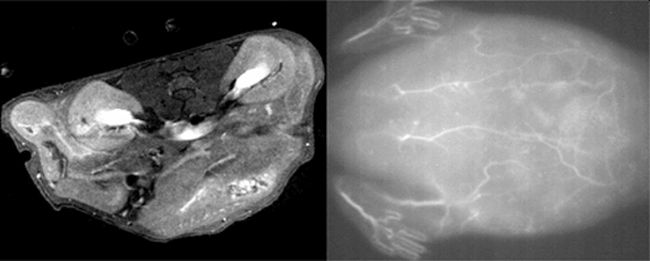
The team conducted a series of tests to examine the properties of their nanoparticles. They found that they could be used for obtaining high-quality images of blood vessels in live mice using MRI and near-infrared fluorescence imaging techniques. Further tests showed the nanoparticles exhibited minimal toxicity on mouse fibroblast cells when used in low concentrations. They also have a short half-life, meaning they would be cleared relatively quickly from the body, making them safe for clinical use.

The team next aims to investigate how different distributions of paramagnetic ions on the nanoparticles affect their magnetic properties. They also aim to study whether modifications made to the nanoparticles could make them applicable for use in light-based ‘photodynamic’ therapies for treating skin cancers and acne, for example.

Further information
Kyohei Okubo
Tokyo University of Science
Email: kyohei.okubo@rs.tus.ac.jp

About Science and Technology of Advanced Materials Journal

Open access journal STAM publishes outstanding research articles across all aspects of materials science, including functional and structural materials, theoretical analyses, and properties of materials.

Chikashi Nishimura
STAM Publishing Director
Email: NISHIMURA.Chikashi@nims.go.jp

Press release distributed by ResearchSEA for Science and Technology of Advanced Materials.

Let the robot swarms begin!

Scientists are looking for ways to make millions of molecule-sized robots swarm together so they can perform multiple tasks simultaneously.

Scientists have devised a new method of using DNA to control molecular robots. Molecules swarm like a flock of birds, showing different patterns of movement when this method is applied. (Copyright: Hokkaido University)

Multi-disciplinary research has led to the innovative fabrication of molecule-sized robots. Scientists are now advancing their efforts to make these robots interact and work together in the millions, explains a review in the journal Science and Technology of Advanced Materials.

“Molecular robots are expected to greatly contribute to the emergence of a new dimension in chemical synthesis, molecular manufacturing, and artificial intelligence,” writes Hokkaido University physical chemist Dr. Akira Kakugo and his colleagues in their review.

Rapid progress has been made in recent years to build these tiny machines, thanks to supramolecular chemists, chemical and biomolecular engineers, and nanotechnologies, among others, working closely together. But one area that still needs improvement is controlling the movements of swarms of molecular robots, so they can perform multiple tasks simultaneously.

Towards this end, researchers have made molecular robots with three key components: microtubules, single-stranded DNA, and a light-sensing chemical compound. The microtubules act as the molecular robot’s motor, converting chemical energy into mechanical work. The DNA strands act as the information processor due to its incredible ability to store data and perform multiple functions simultaneously. The chemical compound, azobenzene derivative, is able to sense light, acting as the molecular robot’s on/off switch.

Scientists have made huge moving ‘swarms’ of these molecular robots by utilizing DNA’s ability to transmit and receive information to coordinate interactions between individual robots. See the video below.

Scientists have successfully controlled the shape of those swarms by tuning the length and rigidity of the microtubules. Relatively stiff robots swarm in uni-directional, linear bundles, while more flexible ones form rotating, ring-shaped swarms.

A continuing challenge, though, is making separate groups of robots swarm at the same time, but in different patterns. This is needed to perform multiple tasks simultaneously. One group of scientists achieved this by designing one DNA signal for rigid robots, sending them into a unidirectional bundle-shaped swarm, and another DNA signal for flexible robots, which simultaneously rotated together in a ring-shaped swarm.

Light-sensing azobenzene has also been used to turn swarms off and on. DNA translates information from azobenzene when it senses ultraviolet light, turning a swarm off. When the azobenzene senses visible light, the swarm is switched back to on state.

“Robot sizes have been scaled down from centimeters to nanometers, and the number of robots participating in a swarm has increased from 1,000 to millions,” write the researchers. Further optimization is still necessary, however, to improve the processing, storing and transmitting of information. Also, issues related to energy efficiency and reusability, in addition to improving the lifetime of molecular robots, still need to be addressed.

Further information

Akira Kakugo
Hokkaido University
kakugo@sci.hokudai.ac.jp
Paper: https://doi.org/10.1080/14686996.2020.1761761

About Science and Technology of Advanced Materials Journal

Open access journal STAM publishes outstanding research articles across all aspects of materials science, including functional and structural materials, theoretical analyses, and properties of materials.

Chikashi Nishimura
STAM Publishing Director
NISHIMURA.Chikashi@nims.go.jp
Image and caption:

A molecular robot, which is typically between 100 nanometers to 100 micrometers long, requires an actuator, processor and sensor to function properly. By fine-tuning their mutual interactions, millions of robots can move together in swarms that are much bigger in size than a single robot, offering several advantages. Scale bar: 20 μm. (Copyright: Akira Kakugo)

Press release distributed by ResearchSEA for Science and Technology of Advanced Materials.