
Spinning electricity from heat and cold

A new device harvests two types of energy during the daytime, making it cool on one end and hot on the other, to generate electricity around the clock. With further improvements, the device could be used in off-grid Internet-of-things sensors. The details were published in the journal Science and Technology of Advanced Materials.
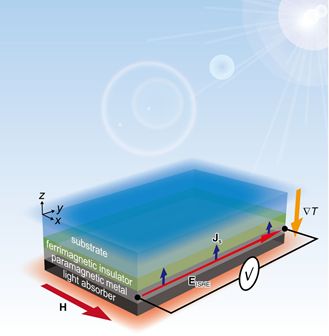
Thermal emission is radiated from the top of the device, keeping it cool, while sunlight is absorbed at the bottom, keeping that part warm. The temperature gradient and types of materials used lead to the generation of a spin current that is converted to thermoelectric voltage.

Scientists have known for at least 200 years that electricity can be generated from a temperature gradient, a phenomenon called thermoelectric generation. Recently, researchers have developed thermoelectric conversion technologies by changing material parameters and introducing new principles. For example, researchers have found that magnetic materials can generate thermoelectric voltage by inducing a flow of electron spins along a temperature gradient, called the spin Seebeck effect, and that increasing a device’s length perpendicular to the gradient boosts voltage. Scientists would like to fabricate more efficient, thin thermoelectric devices based on the spin Seebeck effect. However, the thinner the device, the more difficult it is to maintain a temperature gradient between its top and bottom.

Satoshi Ishii and Ken-ichi Uchida of Japan’s National Institute for Materials Science and colleagues have solved this problem by making a device with magnetic layers that continuously cools at the top and absorbs heat from the sun at the bottom. In this way, the device harvests two types of energy. Radiative cooling occurs at the top, as heat is lost from material in the form of infrared radiation, while solar radiation is absorbed in the bottom.

“It is really important to take full advantage of renewable energy in order to achieve a more sustainable society,” explains Ishii. “Daytime radiative cooling and solar heating have both been used to improve a variety of thermoelectric applications. Our device uses both types of energy simultaneously to generate a thermoelectric voltage.”

Here’s how it works:

The device has four layers. The top layer is a weak paramagnet made of gadolinium gallium garnet. This layer is transparent to sunlight and emits thermal radiation to the universe, getting cooler. Sunlight passes through to the following ferrimagnetic layer made of yttrium iron garnet. This layer is also transparent, so light continues to travel down into the bottom two light-absorbing layers, made of paramagnetic platinum and blackbody paint. The bottom section stays warm due to sunlight absorption. The spin current is generated in the ferromagnetic layer owing to the temperature gradient between the top and bottom of the device and is converted to electric voltage in the paramagnetic platinum layer.

The device works best on clear days, as clouds reduce the achievable temperature gradient by blocking the emitted infrared radiation from passing through the atmosphere and reducing the solar heating.

While promising, the device’s thermoelectric generation efficiency was still quite low. The team plans to boost its efficiency by improving the design, experimenting with different material combinations, and developing even more novel strategies for thermoelectric generation.

Further information
Satoshi Ishii
National Institute for Materials Science
E: sishii@nims.go.jp

Ken-ichi Uchida
National Institute for Materials Science
E: UCHIDA.Kenichi@nims.go.jp

About Science and Technology of Advanced Materials Journal

Open access journal STAM publishes outstanding research articles across all aspects of materials science, including functional and structural materials, theoretical analyses, and properties of materials. Website: https://www.tandfonline.com/toc/tsta20/current

Dr. Yoshikazu Shinohara
STAM Publishing Director
E: SHINOHARA.Yoshikazu@nims.go.jp

Press release distributed by ResearchSEA for Science and Technology of Advanced Materials.

Better memristors for brain-like computing

Scientists are getting better at making neurone-like junctions for computers that mimic the human brain’s random information processing, storage and recall. Fei Zhuge of the Chinese Academy of Sciences and colleagues reviewed the latest developments in the design of these ‘memristors’ for the journal Science and Technology of Advanced Materials.

Researchers are developing computer hardware for artificial intelligence that allows for more random and simultaneous information transfer and storage, much like the human brain.

Computers apply artificial intelligence programs to recall previously learned information and make predictions. These programs are extremely energy- and time-intensive: typically, vast volumes of data must be transferred between separate memory and processing units. To solve this issue, researchers have been developing computer hardware that allows for more random and simultaneous information transfer and storage, much like the human brain.

Electronic circuits in these ‘neuromorphic’ computers include memristors that resemble the junctions between neurones called synapses. Energy flows through material from one electrode to another, much like a neurone firing a signal across the synapse to the next neurone. Scientists are now finding ways to better tune this intermediate material so the information flow is more stable and reliable.

“Oxides are the most widely used materials in memristors,” says Zhuge. “But oxide memristors have unsatisfactory stability and reliability. Oxide-based hybrid structures can effectively improve this.”

Memristors are usually made of an oxide-based material sandwiched between two electrodes. Researchers are getting better results when they combine two or more layers of different oxide-based materials between the electrodes. When an electrical current flows through the network, it induces ions to drift within the layers. The ions’ movements ultimately change the memristor’s resistance, which is necessary to send or stop a signal through the junction.

Memristors can be tuned further by changing the compounds used for electrodes or by adjusting the intermediate oxide-based materials. Zhuge and his team are currently developing optoelectronic neuromorphic computers based on optically-controlled oxide memristors. Compared to electronic memristors, photonic ones are expected to have higher operating speeds and lower energy consumption. They could be used to construct next generation artificial visual systems with high computing efficiency.

Further information
Fei Zhuge
Chinese Academy of Sciences
Email: zhugefei@nimte.ac.cn

About Science and Technology of Advanced Materials Journal (STAM)
Open access journal STAM publishes outstanding research articles across all aspects of materials science, including functional and structural materials, theoretical analyses, and properties of materials.

Dr. Yoshikazu Shinohara
STAM Publishing Director
Email: SHINOHARA.Yoshikazu@nims.go.jp

Press release distributed by ResearchSEA for Science and Technology of Advanced Materials.

NPCI launches RuPay JCB Global Card

National Payments Corporation of India (NPCI) and JCB International Co., Ltd. (JCBI), the international operations subsidiary of JCB Co., Ltd., together with Indian banks, announced the launch of RuPay JCB Global Cards, which can be used at RuPay card accepting points in India and JCB card accepting points outside India for both POS and ATM. This is the first ever JCB brand card issued in India.

State Bank of India, Punjab National Bank, Axis Bank, Union Bank of India, Central Bank of India, Andhra Bank, City Union Bank, TJSB Bank, and many more banks will issue RuPay JCB Global Cards.

Following the enablement of POS terminals and ATMs in India for incoming foreign JCB card members in 2017, both parties have entered into the second phase of the strategic partnership with this launch to serve the needs of increasing outbound Indian travellers.

As a launch campaign, NPCI and JCBI jointly offer a special cashback program where the card members can get cashback of 15% for POS transactions outside India and additional 15% (total 30%) in selected popular destinations for Indian travellers: Thailand, Singapore and the UAE. *Terms and conditions apply. Additionally, JCB provides international services such as in-city card member lounges, called JCB Plaza Lounge, in the USA, France, Taiwan, Korea, Hong Kong, Thailand and Singapore as well as JCB Plaza in Japan and round the year merchant promotions all over the world.

In the launch ceremony held today, Mr. Dilip Asbe, MD & CEO, NPCI said, “The NPCI-JCB collaboration is one of the most valued alliances for our home-grown card network, RuPay. Our relationship allows RuPay JCB Global Card holders to use their cards at tens of millions of locations around the world. The cardholder will enjoy facilities like JCB Lounges in the airports of China, Japan, Hawaii, Dubai, Singapore, Hong Kong, Bangkok and Korea. With this initiative, both companies will continue to provide high value service to our customers, especially outbound Indian travellers.”

Mr. Ichiro Hamakawa, Chairman and CEO, JCB Co., Ltd. and, JCB International Co., Ltd. said, “We very much appreciate our valuable partnership with NPCI who continues to make massive strides in moving India towards a truly digital payment state. I am sure that the RuPay JCB Global Card will enrich the customers’ payment experience immensely, with the rapid growth of Indian outbound travellers.

About NPCI 

National Payments Corporation of India (NPCI) was incorporated in 2008 as an umbrella organization for operating retail payments and settlement systems in India. An initiative of RBI and IBA under the provisions of the Payment and Settlement Systems Act, 2007, NPCI was initiated for creating a robust payment and settlement infrastructure in the country. It has changed the way payments are made in India through a bouquet of retail payment products such as RuPay card, Immediate Payment Service (IMPS), Unified Payments Interface (UPI), Bharat Interface for Money (BHIM), BHIM Aadhaar, National Electronic Toll Collection (NETC) and Bharat BillPay. NPCI also launched UPI 2.0 to offer more secure and comprehensive services to consumers and merchants.

NPCI is focused on bringing innovations in the retail payment systems through the use of technology and is relentlessly working to transform India into a digital economy. It is facilitating secure payments solutions with nationwide accessibility at minimal cost in furtherance of India’s aspiration to be a fully digital society. For more information, visit: https://www.npci.org.in/

NPCI
Zeba Mirajkar / Swagata Gupta
zeba.mirajkar@npci.org.in / swagata.gupta@npci.org.in

Adfactors PR
Sumeet Chhabra / Sinoj Sadanandan
9619437559 / 9619375635
Sumeet.Chhabra@adfactorspr.com / Sinoj.sadanandan@adfactorspr.com

About JCB 

JCB is a global payment brand and a leading credit card issuer and acquirer in Japan. JCB launched its card business in Japan in 1961 and began expanding worldwide in 1981. Its acceptance network includes about 30 million merchants as well as cash advance locations around the world. JCB cards are now issued in 23 countries and territories, with more than 130 million cardmembers. As a comprehensive payment solution provider, JCB commits to providing responsive and high-quality service and products to all customers worldwide. www.jcbcorporate.com For more information, please visit: www.global.jcb/en/

Contact
JCB Co., Ltd.
Kumiko Kida
Corporate Communications Department
Tel: 81-3-5778-8353
Email: kumiko.kida@jcb.co.jp

Goldman Sachs Backs $55m Series C in Japanese Fintech Startup Paidy

Japanese financial technology (fintech) startup Paidy Inc has announced raising $55 million in a Series C funding round backed by Goldman Sachs. The latest round raised the startup’s total capital to $80 million.

In a statement, Paidy said the Series C was led by Japanese firm ITOCHU Corporation. It will use the fresh capital to launch large merchants, expand into the offline market, and offer additional financial services.

The fintech firm expects to grow its customer base to 11,000,000 accounts by 2020.

Paidy started Japan’s first instant post-pay credit service for ecommerce consumers in October 2014. It requires no pre-registration or credit card to use; Paidy consumers purchase products online using only a mobile phone number and email address (verification is established through a four-digit code via SMS or voice pin-code) and settle a single monthly bill for all their purchases, either at a convenience store, by bank transfer or auto debit.

The startup also also supports multi-pay installments and subscriptions. There are currently over 1,400,000 Paidy accounts in use (June 2018).

“We are extremely honored that Paidy’s business concept was highly valued by one of Japan’s most prestigious business conglomerates, ITOCHU. Through this tie-up, we expect to launch new merchants in order to deliver Paidy’s frictionless and intuitive financial solution to a much broader audience,” said Russell Cummer, Founder and Executive Chairman of Paidy.

Cummer added that Paidy now aims to promote its vision of removing barriers and creating unique consumer experiences to as many people as possible.

Also Read: 
On-demand Logistics Platform GoGoVan Raises $250m
South Korea’s ProtoPie Raises $3.5m in KIP-led Series A

Paidy has proved a powerful means of persuading first time buyers to transact online. Its proprietary models and machine learning mean that transactions are underwritten in seconds, with guaranteed payment to merchants.

Paidy increases merchant revenues by reducing incomplete transactions, increasing conversion rates, boosting average order values, and facilitating easy repeat buying.