New Study Shows Threat to Philippine Consumers From Piracy Sites Remains Greater Than Ever

The Asia Video Industry Association (AVIA), with Dr Paul Watters of Cyberstronomy, have released a new report, “Consumer Risks from Piracy in the Philippines”, that once again highlights the possible dangers Filipino consumers face when accessing pirate sites.
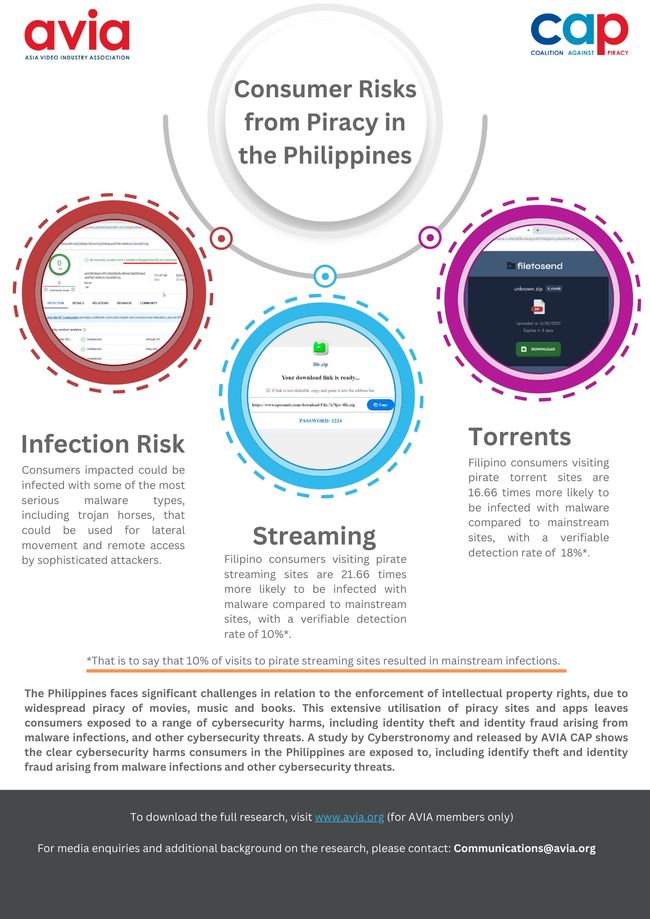
The report found that Filipino consumers visiting pirate streaming sites are 21.66 times more likely to be infected with malware compared to mainstream sites (with a verifiable detection rate of 10%(1)). When visiting pirate torrent sites, Filipino consumers are 16.66 times more likely than mainstream sites to be infected with malware (with a verifiable infection rate of 18%). Those consumers impacted can be infected with some of the most serious malware types, such as trojan horses that could be used for lateral movement and remote access by sophisticated attackers.

The “Consumer Risks from Piracy in the Philippines” report builds off a 2022 report by Cyberstronomy, “Time to Compromise”, which looked at malware risks in Asia-Pacific and found that a typical user visiting a pirate site could be infected by ransomware, several trojan horses, and other Advanced Persistent Threats (APTs) within 42 seconds on a Windows machine and within 1 minute and 18 seconds on an Android device. The results of the 2022 report supported the hypothesis that there is a nexus between piracy and malware infections, where site operators generate significant revenue from allowing malicious ads to be placed on their sites. Malware can in turn gain access to consumer PCs and mobile devices, and all of the data held in storage, but also access to banking login details and other sensitive logins(2).

Matt Cheetham, General Manager of CAP, noted, “Evidence continues to mount that far from being a victimless crime, piracy can victimize consumers.” Cheetham also noted that it is more timely than ever that the site blocking legislation recently introduced into the Senate by Senators Estrada and Villar passes quickly. “We look forward to the successful passage of site blocking legislation in the Senate that will allow the Philippines to both protect its consumers from online harm posed by pirate sites and grow its economy,” said Cheetham.

(1) In addition to the relative risk calculations, researchers verified that 10% of visits to pirate streaming sites resulted in malware infection.
(2] Some malware infetions are also relatively benign for consumers, and during any particular sampling period the malware detection rate and relative risk may fluctuate due to random variation.

About the Asia Video Industry Association

The Asia Video Industry Association (AVIA) is the trade association for the video industry and ecosystem in Asia Pacific. It serves to make the video industry stronger and healthier through promoting the common interests of its members. AVIA is the interlocutor for the industry with governments across the region, leads the fight against video piracy through its Coalition Against Piracy (CAP) and provides insight into the video industry through reports and conferences aimed to support a vibrant video industry.

Researcher Biography
Professor Paul A. Watters is Honorary Professor in Criminology and Security Studies at Macquarie University, Adjunct Professor of Cybersecurity at La Trobe University, and CEO of Cyberstronomy Pty Ltd, a Melbourne-based startup that develops Governance, Risk and Compliance software for cybersecurity. Professor Watters is a Fellow of the British Computer Society and Chartered IT Professional, a Senior Member of the IEEE, and a Member of the Australian Psychological Society. Professor Watters has published more than 200 peer-reviewed research papers in cybersecurity, data mining, and cognate fields, which have been cited more than 4,832 times by his peers. He is consistently in the top 10% of all researchers by paper downloads on the Social Sciences Research Network (SSRN).

For media enquiries and additional background please contact:
Charmaine Kwan
Head of Marketing and Communications
Email: charmaine@avia.org
Website: www.avia.org
LinkedIn: www.linkedin.com/company/asiavideoia
Twitter: @AsiaVideoIA

Philippine Industry Body Launched for Stronger Content Protection and Anti-Piracy Efforts

Today, leading Philippine industry players including, Globe, GMA Network, Inc., Cignal TV, Inc, KROMA Entertainment and Smart Communications, Inc, joined hands with the Asia Video Industry Association’s (AVIA) Coalition Against Piracy (CAP) to announce the formation of the Video Coalition of the Philippines (VCP).

The VCP aims to push for stronger intellectual property protection in the Philippines that will protect both original content and users, as well as promote the Philippines creative and media industries, not only in the Philippines but around the world.

VCP convenors will build on the momentum of the presentation of the proposed Revised Intellectual Property Code in the Philippines’ 19th Congress in July and the recent Protection of Online Content Summit held on September 2 in Manila.

House Bill No. 0799, filed by Albay 2nd District Rep. Joey Salceda, aims to update the Philippines’ patent application system and make it “more attuned to the digital age.” It also “provides for technologies and media that were not anticipated” at the time the intellectual property code was enacted.

Proposed revisions also give regulators greater authority to combat IP violations, including the power to issue “permanent blocking orders, takedown orders, cease-and-desist, or disable access orders” against websites, service providers, and online platforms, including social media. The current IP code does not cover electronic or online content in its definition of pirated goods and lacks clear provisions that would allow for efficient and effective site blocking, and other interventions against online IP violations.

CAP General Manager Matt Cheetham said, “With the presentation of Bill No. 0799, “An Act Establishing for the Revised Intellectual Property Code of the Philippines” to the House, the Philippines has a golden opportunity to not only update and future proof its intellectual property regime, but to act as a launching pad for intellectual property to protect consumers and advance the overall Philippine economy.”

Cheetham further noted CAP’s recent YouGov survey showed Philippine consumers believe a government regulation for Internet Service Providers (ISPs) to block pirated content would be the most effective measure to reduce piracy in the Philippines.

Globe, the Philippines’ leading digital solutions platform, has been an advocate of anti-piracy through its #PlayItRight advocacy. Globe hopes to rally consumers and stakeholders behind original content creators by making online content affordable and accessible via content subscription.

“Revising the Intellectual Property Code will go a long way in protecting Filipino consumers from the dangers that lurk in pirate sites and improving cybersecurity in the country, especially as Filipinos now rely heavily on digital platforms,” said Globe Chief Information Security Officer Anton Bonifacio.

Yoly Crisanto, Globe Group Chief Sustainability and Corporate Communications Officer, said revising the IP Code is necessary to improve the country’s regulatory environment just as the government aims for greater digitalization.

“The use of digital technologies and platforms is expected to further expand in the years to come, whether it be for education, finance, health or recreation. It is, therefore, urgent that we provide better protection for the creative industry and give them a secure environment conducive to creativity and innovation,” said Crisanto.

“Upholding intellectual property rights in the Philippines enables the creative industry to grow and thrive. KROMA, through the Video Coalition of the Philippines, is committed to collaborate with stakeholders to ensure that this is observed, for the industry’s success and sustainability,” said Jil Go, KROMA’s Head of Broadcast and Publishing.

“GMA’s participation in the Video Coalition of the Philippines presents an opportunity to further strengthen our existing anti-piracy initiatives by working with other players in the industry to push for the implementation of site blocking mechanisms and help protect our viewers and GMA content against unauthorized uploaders,” said Joseph T. Francia, First Vice President and Head of Operations, GMA International.

Pointing to the impact of site blocking in Indonesia, where traffic to pirate sites has dropped by more than 75% since the government implemented their rolling site blocking procedures in 2019, Cheetham further noted, “The effectiveness of site blocking is backed up by CAP’s most recent YouGov consumer surveys in which more than 50% of Indonesian consumers say that they have stopped or rarely access pirate services as a result of the highly efficient and effective blocking measures in place there.”

“Perhaps more importantly, 76% of Indonesian consumers say they are accessing more legal content and pirating less, and 26% have subscribed to legitimate sources as a result of illegal streaming sites being blocked. Blocking as an educational tool may also be evident in 95% of Indonesian consumers agreeing that online piracy does have negative consequences – the highest in the region,” said Cheetham.

When done efficiently and effectively, site blocking has a massive impact on combating piracy, changing attitudes and protecting consumers.

About the Asia Video Industry Association

The Asia Video Industry Association (AVIA) is the trade association for the video industry and ecosystem in Asia Pacific. It serves to make the video industry stronger and healthier through promoting the common interests of its members. AVIA is the interlocutor for the industry with governments across the region, leads the fight against video piracy through its Coalition Against Piracy (CAP) and provides insight into the video industry through reports and conferences aimed to support a vibrant video industry.

For media enquiries and additional background please contact:
Charmaine Kwan
Head of Marketing and Communications
Email: charmaine@avia.org
Website: www.avia.org

First In-Person Satellite Industry Forum After COVID Sees the Industry in Strong Shape and Geared for Growth

The Asia Video Industry Association was finally able to host its annual Satellite Industry Forum in-person in Singapore on 31st May 2022 after a two-year hiatus, bringing together over 120 delegates from around the world and some of the satellite industry’s most foremost leaders.

Opening the Forum this year was keynote speaker, Steve Collar, Chief Executive Officer, SES, to address the issue of where future growth was coming from and kicked off the session with his views on demand and supply in the market. As platforms were getting longer to get built and become operational, it showed how difficult it was to get launches done, and how much the industry overestimated supply. Collar added that SES had always been a champion of multi-orbit, and not just having both MEO and GEO satellites, but also constructing a global network for customers to move seamlessly from one to the other to maximize the benefits of both. Collar also shared his excitement on demand, and the new applications and new services that could be run, with a sweet spot being the high throughput and high connectivity services which represented a significant market for SES.

Access to space was also what made the industry exciting, as technology continued to develop both in space and on the ground. However, he also highlighted that space sustainability was critical, with the industry having a duty and moral obligation to treat space in a sustainable way. “Our job is to make sure that space will be used by future generations, and the access to space is equivalent to what we enjoy today and hopefully more in the future,” said Collar.

COVID also saw the resurgence of the linear broadcast, with video having done very well over the last two years. Collar remained committed and excited on the long-term aspects of the video business, particularly in Asia. And while it was not going to be the source of growth, it was still overwhelmingly the source of cashflow.

This sentiment was also shared by some of the largest satellite operators in the region during the Satellite Operators’ Roundtable. Terry Bleakley, Regional Vice President, Asia Pacific, Intelsat, talked about the importance of satellite to video and how long-term agreements were still being signed with satellite operators. In terms of advertising in Asia Pacific, by 2024, $43.5 billion would come from broadcast and linear television, whereas OTT was only going to bring in $30 – 33 billion, hence linear was still generating more money. Patrick French, Executive Vice President, Global Business Development and Strategy, ABS, added that video still had a long lifetime ahead, and the core of Asia for the longer term. Software defined satellites were also going to be addressing all market segments and would de-risk the business case going forward.

From the manufacturer’s perspectives, Vaibhav Magow, Vice President, International Division, Hughes Network Systems, also said this was the most exciting time for the satellite industry, as software defined satellites could change and swap the configuration of what was being offered to the customers, and easily adapted to the change of demand. Joe Bogosian, Vice President, Global Sales & Marketing, Boeing Commercial Satellite Systems International, also agreed that software defined satellites were going to drive much higher utilisation of CAPEX that was going up, and multi-orbits were going to enable more efficient use of this CAPEX and were able to serve different applications more efficiently for LEO and GEO.

Closing off the Forum was Bill Carlin, Senior Manager, Global Sales, AWS Aerospace & Satellite Solutions whose interest in space and satellite was on the vast amount of data that was being collected and created from space, and soon in space, with a future view of launching data centers on the moon and even on Mars. “I see the ability of moving the cloud to space. If we move high speed computing to space, we can do all the things that we do on earth that require high volumes of computing, storage or analytics,” said Carlin.

The Satellite Industry Forum is generously sponsored by AsiaSat, AWS Aerospace & Satellite, Gilat, Hughes, Kymeta, Marsh, MEASAT, Milbank, SES, SpaceBridge, SpaceLogistics and Thaicom.

About the Asia Video Industry Association:

The Asia Video Industry Association (AVIA) is the trade association for the video industry and satellite ecosystem in Asia Pacific. It serves to make the video industry stronger and healthier through promoting the common interests of its members. The AVIA is the interlocutor for these industries with governments across the region, leads the fight against video piracy through its Coalition Against Piracy (CAP) and provides insight into the video industry through reports and conferences aimed to support a vibrant video industry.

For media enquiries and additional background, contact:
Charmaine Kwan
Head of Marketing and Communications
Email: charmaine@avia.org
Website: www.avia.org
LinkedIn: www.linkedin.com/company/asiavideoia
Twitter: @AsiaVideoIA

OTT Summit Ends with Much Optimism for Growth in Asia and a Strong Focus on Content and the Consumer

The Asia Video Industry Association (AVIA) hosted over 850 delegates and featured over 80 industry leaders at the recent OTT Summit, with conversations revolving a lot on the subject of growth, from subscriber and revenue growth to increased local content investment and an intense focus on the customer.

In discussing the outlook for the video industry in Asia, Vivek Couto, Executive Director and Co-Founder of Media Partners Asia (MPA), indicated there remained a lot of room for growth. With most markets having an SVOD household penetration of less than 50%, there was certainly an upside for Southeast Asia and some parts of North Asia as well. However, while the region remained bullish on growth, the Average Revenue Per User remained low, particularly in the Philippines, Thailand, Indonesia, and India. As such, some tiers and price increases would be introduced along the way, especially when premium sport started to be added to the platforms.

The adage of “Content is King” was very much heard throughout the summit. In MPA’s review of share of first-title consumption, premium local content was a key driver for customer acquisition, particularly in Indonesia and Thailand, with local content that showed some travelability, and as expected, with Korean content traveling very well, and some Japanese content as well.

This focus on content continued through to the fireside chat with Catherine Park, SVP, Head of Office & Streaming for Asia, Paramount Global, where she reiterated that their “mission is to unleash the power of the content with the belief that content is king.” With different go-to-market strategies to unlock maximum value, Paramount Plus planned to launch first in Korea with CJ ENM, then Japan as the next market followed by Southeast Asia in 2023. Park also shared Paramount’s “glocal” strategy – to have global vision but with local execution.

The importance of being local was also echoed by many panellists, as Asia could not be seen as one homogenous market. Sagar Pandit, Associate Director, Business Development, Asia Pacific, Discovery, Inc., said, “When you gun for growth, especially in Asia, it’s about tailoring your approach for every region but keeping your consumer at the front and centre of whatever you are doing.”

And with increasing fragmentation in Asia, customer obsession became a key part of the strategy, as more platforms leveraged technology to deliver personalised experiences. For Parminder Singh, Chief Commercial and Digital Officer, Mediacorp, the three things a customer looked for were highly personalized and relevant content, and new virtual interactive experiences, all built into one single experience, with the use of technology that would allow you to bring all of this to the customer. “If you are only delivering a straightforward service, you are going to be left behind,” added Akash Saxena, Head of Technology, Disney+ Hotstar India.

However, the challenge to integrate it all into an operator’s platform for a seamless experience very much remained, calling for perhaps greater aggregation and bundling for the OTT industry, as we started to see some fatigue from consumers working with multiple services to meet their content needs.

Closing off the summit with Bold Predictions for the Future of Streaming, Gourav Rakshit, COO, Viacom18 Digital Ventures, remained very optimistic, sharing that a large bet that platforms had not fully capitalised on was the area of media becoming social, with the opportunity to build communities. “We’ve really made rapid strides in the last five years . . . the next five will be focusing a lot more on delivering consumer delight,” said Rakshit.

The OTT Summit is generously supported by Gold Sponsors Brightcove, Lumen Technologies, Synamedia, TV5MONDE, Xandr and Silver Sponsors Akamai, Amagi, Broadpeak, BytePlus, Discovery, Encoding.com, Endeavor Streaming, Irdeto, Magnite, Mediacorp, Mirada, NAGRA, Nielsen, PubMatic and Vindicia.

About the Asia Video Industry Association

The Asia Video Industry Association (AVIA) is the trade association for the video industry and ecosystem in Asia Pacific. It serves to make the video industry stronger and healthier through promoting the common interests of its members. AVIA is the interlocutor for the industry with governments across the region, leads the fight against video piracy through its Coalition Against Piracy (CAP) and provides insight into the video industry through reports and conferences aimed to support a vibrant video industry.

For media enquiries and additional background please contact:
Charmaine Kwan
Head of Marketing and Communications
Email: charmaine@avia.org
Website: www.avia.org
LinkedIn: www.linkedin.com/company/asiavideoia
Twitter: @AsiaVideoIA

Asia Video Summit Wraps Up a Week of Events Highlighting the Resilience of the Industry

The Asia Video Industry Association (AVIA) ended off the year with a series of virtual conferences attended by over 1600 delegates across Asia Pacific, and its first in-person industry conference and dinner in over two years, Resilience 100, at the Grand Hyatt Singapore.

The Asia Video Summit, which was supported by Create Hong Kong of the Government of the Hong Kong Special Administrative Region as the Lead Sponsor, was honoured to have Mr. Edward Yau, GBS, JP, Secretary for Commerce and Economic Development of the Hong Kong Special Administrative Region open the Summit this year. In his opening address, Yau reiterated Hong Kong’s position as a regional hub for uplinking satellite TV services and the Government’s commitment to the long-term development of the creative industries, promoting Hong Kong as Asia’s creative capital. “We look forward to working closely with the industry to ensure its sustained development,” said Yau.

With Asia accounting for 47% of global streaming subscriptions, it is clearly a very significant market, with influence way beyond its borders. The streaming market in Asia is bigger than that of the US, Western and Central Europe put together, with the top 15 Asian streamers boasting over 520 million subscriptions by the end of 2020, reported Guy Bisson, Executive Director and Co-Founder, Ampere Analysis. Ownership of IP has thus become a key battleground for streamers. Commissioning trends are increasingly driven by streaming platforms and having a local voice with international audiences in mind is now an important part of the mix.

Being local is exactly what has set Viu apart from other streamers being based out of Asia, said Felix To, Chief of Viu Original, PCCW Media. This commitment to the region has paid off, with Viu currently Southeast Asia’s second largest streaming service by paid subscribers. Summing up the conversation with To on What’s Next for Viu and the Future of Local Storytelling, Celeste Campbell-Pitt said, “There can be no doubt that an increased focus on original content production that brings together Asian onscreen and offscreen talent to tell Asian stories is the way forward.”

This focus on content, and the consumers, continued to drive a lot of the discussions at the Summit. Avinash Kaul, CEO, Network18, Managing Director, A+E Networks, TV18, shared that the digital ecosystem has democratized content production and dissemination. Echoing similar sentiments, Euan Smith, Group COO and CEO, TV, Astro, said, “We want to be transmission agnostic, technology agnostic. Our job is to put whatever content the consumers want to watch in front of them, in the simplest way possible.”

The consumers of today are no longer just on TV. With OTT and CTV consumption growing globally, subscription video viewers in APAC are expected to hit 1 billion in 2021, and marketers are tapping into this opportunity by accelerating their spend from linear TV to video streaming. “OTT brings the best of TV and digital programmatic in terms of being able to effectively target and optimize,” said Gavin Buxton, MD Asia, Magnite.

And as technology evolves, the media industry continues to be transformed for consumers. However, the industry needs to find what is most relevant to the end users. “We need to put the consumers at the heart of the decision making there is still a lot to be done about creating true relevancy for the consumers so that the consumers stay on the platform,” added Stephane Le Dreau, SVP, Regional General Manager APAC, NAGRA.

Closing off the Summit on What’s Next for Entertainment, Shad Hashmi, APAC Partner Lead, Media and Entertainment, Amazon Web Services, commented, “When you enrich the customer experience, this is the broadest use of convergence.” Relevance in a world of choice, based on data, is key. And throughout the conference, the message was clear. It is the era of convenience for the consumers as platforms, and experiences, converge with digital acceleration.

The Asia Video Summit is proudly brought to you by Lead Sponsor Create Hong Kong (CreateHK) of the Government of the Hong Kong Special Administrative Region, Gold Sponsors Bitmovin, Brightcove, Discovery, Gracenote, InMobi, iWedia, TV5MONDE, Viaccess-Orca, Viu, WarnerMedia, Xandr, YouTube Silver Sponsors AsiaSat, Baker McKenzie, BBC Studios, Broadpeak, Dolby, Intelsat, InvestHK, INVIDI, Irdeto, JW Player, Limelight, Magnite, MEASAT, MediaKind, Netflix, PubMatic, SES, SmartLabs, Synamedia, Zixi.

About the Asia Video Industry Association

The Asia Video Industry Association (AVIA) is the trade association for the video industry and satellite ecosystem in Asia Pacific. It serves to make the video industry stronger and healthier through promoting the common interests of its members. The AVIA is the interlocutor for these industries with governments across the region, leads the fight against video piracy through its Coalition Against Piracy (CAP) and provides insight into the video industry through reports and conferences aimed to support a vibrant video industry. www.avia.org.

About Create Hong Kong

Create Hong Kong (CreateHK) is a dedicated agency set up by the Government of the Hong Kong Special Administrative Region (HKSAR Government) in June 2009. It is under the Communications and Creative Industries Branch of the Commerce and Economic Development Bureau and dedicated to spearheading the development of creative industries in Hong Kong. Its strategic foci are nurturing talent and facilitating start-ups, exploring markets, and promoting Hong Kong as Asia’s creative capital and fostering a creative atmosphere in the community.

For media enquiries and additional background:
Charmaine Kwan
Head of Marketing and Communications
Email: charmaine@avia.org
Website: www.avia.org
LinkedIn: www.linkedin.com/company/asiavideoia
Twitter: @AsiaVideoIA

Disclaimer: Create Hong Kong of the Government of the Hong Kong Special Administrative Region provides funding support to the project only and does not otherwise take part in the project. Any opinions, findings, conclusions, or recommendations expressed in these materials/events (or by members of the project team) are those of the project organizers only and do not reflect the views of the Government of the Hong Kong Special Administrative Region, the Communications and Creative Industries Branch of the Commerce and Economic Development Bureau, Create Hong Kong, the CreateSmart Initiative Secretariat or the CreateSmart Initiative Vetting Committee.

Satellite Remains an Essential Element of Video Distribution Alongside the Growth of OTT

The Asia Video Industry Association (AVIA) hosted its annual Satellite Industry Forum on Thursday, 18 November as a virtual conference, to end off the Asia Video Summit umbrella of events this year.

The Forum opened with a look at Satellite Trends and Forecasts Post-Covid with Caleb Henry, Senior Analyst, Quilty Analytics. The traditional satcom industry continues to be in a state of rapid change, and still in a state of turmoil. While the industry is currently dominated by a handful of major players, this could also change dramatically over the next five years as new technologies and standards reset the competitive landscape. And despite the impact of Covid, there has been no let-up of interest in investment into the space industry with $5.5BN in collective proceeds from all 13 space SPACs.

AVIA was also privileged to host Stephen Spengler for his final keynote before he steps down as CEO of Intelsat. Spengler had spoken at the Satellite Industry Forum for his first keynote as CEO in 2015, hence it was fitting the Forum was his final address as well.

While the industry continues to innovate and push the boundaries of what is possible, it has yet to reach its full potential in fulfilling its essential role in the global telecommunications landscape. With digital video making up 70% of internet traffic, satellite remains the essential and enabling technology, with the ubiquity, reach and economics to serve the networks.

Spengler’s outlook on industry trends for Asia remains positive, with linear and pay TV distribution still a driving application for the Asia Pacific region, with a growth rate of 2.5% per year. Spengler was also excited about 5G being a huge enabler and game changer. With satellite fully integrated into the 5G world, it will make solutions and services more seamless, interconnected, and economical.

Wrapping up his keynote address, Spengler shared Intelsat’s mission to unify the global telecoms ecosystem of the future. The vision requires all satellite and terrestrial technologies, networks and providers, and solutions and services to be unified as one global ecosystem. “If we focus on our customers, the people who benefit from a more connected world, that is success for the next year and beyond,” said Spengler.

Asia Pacific’s leading satellite operators also shared similar positive sentiments despite the move from broadcast to streaming. Yau Chyong Lim, COO, MEASAT, believes that satellite will still be the main platform to deliver video services nationwide in Malaysia, and it is the platforms themselves who are transforming their services to include streaming. Hence broadcast and streaming will complement each other, with linear still having a role to play, and streaming alongside it. Similar in Australia, despite a plethora of streaming services available, Nick Leake, Head of Satellite and Space Systems, Optus, still sees the same requirements for satellite to go out for at least another 10 years. The greatest issue for Asia Pacific remains one of scale, in order to provide reliable networks to serve the customers, added Roger Tong, CEO, AsiaSat. Tong believes that moving forward, creating more partnerships between competing satellite operators is important, especially when regulatory restrictions on consolidation remains a key challenge in the region.

Sunil Bharti Mittal, Founder and Chairman, Bharti Enterprises and Executive Chairman, OneWeb, also joined the Forum this year for a keynote conversation on the space business in India. With the holy grail of low latency, high speed and sufficient capacity resolved by NGSOs, it has become a solution that works for the new world and into the future. 5G too is seen as a game changing technology for Mittal, with its extremely low latency a boom for industry applications. However, Mittal also noted that while NGSOs will have an important role to play in the 5G ecosystem, it will only be at the periphery of supporting 5G ambitions. Mittal also shared OneWeb’s vision to connect all areas of the world, from oceans to aviation. “In 5 years’ time there should not be anybody in the world that is not connected,” said Mittal.

The Satellite Industry Forum is generously sponsored by AsiaSat, Eutelsat, Hughes, Intelsat, Marsh and Maxar.

About the Asia Video Industry Association:

The Asia Video Industry Association (AVIA) is the trade association for the video industry and satellite ecosystem in Asia Pacific. It serves to make the video industry stronger and healthier through promoting the common interests of its members. The AVIA is the interlocutor for these industries with governments across the region, leads the fight against video piracy through its Coalition Against Piracy (CAP) and provides insight into the video industry through reports and conferences aimed to support a vibrant video industry.

For media enquiries and additional background, contact:
Charmaine Kwan
Head of Marketing and Communications
Email: charmaine@avia.org
Website: www.avia.org
LinkedIn: www.linkedin.com/company/asiavideoia
Twitter: @AsiaVideoIA

Resiliency and optimism shine through in Vietnam across the video industry

The Asia Video Industry Association hosted its country-focused virtual conference, Vietnam in View, on 8 September, to over 320 international and local speakers and delegates, sharing great optimism in a country that has arguably proven itself as one of the more resilient economies in Southeast Asia.

The conference opened with a presentation on the State of the TV and Video Industry in Vietnam by Vu Tu Thanh, Consultant, AVIA, and Deputy Regional Managing Director & Representative, US-ASEAN Business Council. Over the last 3 years, Vietnam has seen significant developments with a completion of full digitalisation of its free-to-air (FTA) broadcast infrastructure. Competition was seen to be growing at all levels, between telcos and pay TV operators and between domestic industry and foreign services. Coupled with the fast development of OTT platforms, and with over 26 million television households almost all having access to TV and video, it has become a very promising market for the industry. In terms of revenue share, cable is still dominant, and by far the biggest revenue earner at almost US$300 million in 2020, up 9% from 2019. However, OTT is the biggest winner in terms of both subscriptions and revenue growth. Debate continues about the need for and direction of regulation in the OTT sector, and it was believed that simplicity in licensing and censorship would be key, as well as cross border tax registration and payment.

Nguyen Hanh, President, Q.net, shared similar sentiments during her panel on the Future of Television. Hanh opined that the industry as a whole is converging on streaming as the dominant business model, even though the bulk of revenue is still coming from pay TV, and FTA is very much the leader for local content. And content is what matters at the end of the day, with delivery and device merely being the method by which content is consumed. John Huddle, Director, Market Development, Asia, SES, also believes that the industry needs to pivot and look at a hybrid service and pay TV operators that innovate will continue to be successful. “There is also room for consolidation and partnerships as a pathway to growth going forward,” added Huddle.

This innovation is certainly key if pay TV platforms are to reinvent themselves to take advantage of this explosive demand for content. Pham Thanh Phuong, Vice Director of Value-Added Services Center, Viettel Telecom, said that pay TV platforms are competing not only in terms of content, but also infrastructure and technology, to bring about better customer experience. This use of technology to deliver the best consumer experience with the best content is what drives the strategy for Galaxy Play, shared its Chief Financial Officer, Harini Gopalakrishnan. “If you deliver the right content with great consumer experience, the users will pay,” said Gopalakrishnan.

However along with this increased consumption of content comes another major challenge in Vietnam, which is the pervasiveness of piracy, with Vietnam ranking #1 or close to it in Asia. Mark Mulready, Vice President – Cyber Services, Irdeto, commented that the piracy ecosystem is thriving and with significantly entrenched piracy trends visible, education is a critical component of any anti-piracy strategy. But there has been substantial progress over the last 12 months, added Sean Godfrey, Senior Commercial Solicitor (APAC), Premier League, with nascent site blocking in place having been relatively impactful. Much can also be learnt from other successful strategies in the region such as Indonesia.

Ultimately, while content is king, as operators in the market become more inter-related, there is also a greater sense of mutual responsibility when it comes to taking content risks, with a need to share along the entire spectrum, for both investment and recoupment. Summing up this sentiment, Celeste Campbell-Pitt, Chief Policy Officer, AVIA, said, “The more we can de-risk a production, the better. Collaboration is key to our industry thriving.”

Vietnam In View is generously supported by our Presenting Sponsor TV5MONDE, and our Sponsors Brightcove, Magnite, SES and YouTube.

About the Asia Video Industry Association

The Asia Video Industry Association (AVIA) is the trade association for the video industry and ecosystem in Asia Pacific. It serves to make the video industry stronger and healthier through promoting the common interests of its members. AVIA is the interlocutor for the industry with governments across the region, leads the fight against video piracy through its Coalition Against Piracy (CAP) and provides insight into the video industry through reports and conferences aimed to support a vibrant video industry.

For media enquiries and additional background please contact:
Charmaine Kwan
Head of Marketing and Communications
Email: charmaine@avia.org
Website: www.avia.org
LinkedIn: www.linkedin.com/company/asiavideoia
Twitter: @AsiaVideoIA

Aaron Herps steps up as General Manager of AVIA’s Coalition Against Piracy

The Asia Video Industry Association (AVIA) has appointed Aaron Herps as the General Manager of its Coalition Against Piracy (CAP), following the departure of Neil Gane, who leaves AVIA to take up a position with the Alliance for Creativity and Entertainment.

Herps joined AVIA in 2019 as the Operations Manager for CAP, working alongside Gane on all CAP initiatives from government outreach to criminal investigations and associated enforcement actions against syndicates and streaming website operators in Southeast Asia, Hong Kong and Taiwan.

In his role as General Manager of CAP, Herps will build on the strong legacy that he and Gane have built, maintaining the coalitions and alliances across the industry which have made CAP so effective and continuing to provide expert technical and forensic analysis of the shifting state of the piracy ecosystem to members and government officials.

“Aaron has been instrumental to the success of CAP over the last two years so it gives me great pleasure to see him now taking over the role of General Manager. The fight against piracy never remains static but Aaron has the creativity and skills to lead our industry’s efforts as both the threat and our response to it evolve. I am looking forward to the next chapter of CAP,” said Louis Boswell, CEO, AVIA.

Herps has over 15 years of content protection experience in the sports and entertainment industries across Asia Pacific. Prior to joining AVIA, Herps was Manager of Digital Content Protection for Asia Pacific at beIN Media Group and was the Senior Manager of Global Content Protection at the Motion Picture Association of America for more than a decade.

About the Asia Video Industry Association

The Asia Video Industry Association (AVIA) is the trade association for the video industry and ecosystem in Asia Pacific. It serves to make the video industry stronger and healthier through promoting the common interests of its members. AVIA is the interlocutor for the industry with governments across the region, leads the fight against video piracy through its Coalition Against Piracy (CAP) and provides insight into the video industry through reports and conferences aimed to support a vibrant video industry.

For media enquiries and additional background please contact:
Charmaine Kwan
Head of Marketing and Communications
Email: charmaine@avia.org
Website: www.avia.org
LinkedIn: www.linkedin.com/company/asiavideoia
Twitter: @AsiaVideoIA

Positivity reigns among the Filipino video industry’s top leaders at AVIA’s Philippines In View

The Asia Video Industry Association‘s (AVIA) Philippines In View seminar held on 18th May brought together more than 700 industry delegates to discuss the state of the TV and video industry in the archipelago country with over 7000 islands. Some of the industry luminaries present include Manuel V Pangilinan, Chairman, President and CEO of PLDT, Ernest Cu, President & CEO of Globe and Dennis Anthony Uy, Founder & CEO of Converge ICT Solutions.

The seminar opened with a discussion on Policy and Regulations for the 21st Century in the Philippines with Arnold “ALI” I. Atienza, Undersecretary, Department of Information and Communications Technology (DICT) for Government Digital Broadcast Television and the Digitalization of the Entertainment Industry Sector, Emerging Technologies, Senior Citizens, Persons with Disabilities and Special Needs Sector. Undersecretary Atienza reiterated that the impact of TV could not be overemphasised, being a source of business, shopping, spiritual fulfilment, medical and legal information, among many others, for the average Filipino. While it needs to be regulated without affecting freedom of speech and expression, challenges remain regulating it across the different platforms. Hence the DICT welcomed industry and the private sector, to work closely with the DICT for help and support.

In a country that has been buffeted by major changes in the media industry over the last year, TV continued to remain resilient. According to Leo Jaymar G. Uy, Head of Research, BusinessWorld, despite total tv ad spend shrinking by a slight 4% year on year, digital video ad spend actually rose by 4.8%. And even though viewership has not recovered to pre-pandemic levels, it is showing signs of recovery. Pay TV subscriptions have also increased and the roll-out of digital terrestrial television (DTT) continues to progress. Online is certainly one of the beneficiaries of growth as well, with OTT adoption expected to continue rising even after the effects of the pandemic. Constraints on internet speed and infrastructure also suggests there is still room for growth in this segment, and with the country’s relatively low internet penetration rate, Pay TV can still coexist with OTT.

Robert P. Galang, President and CEO, Cignal TV and TV5, shared these sentiments as well. Galang expects growth for both Free and Pay TV in the next 5 years, as well as with DTT. Even though TV5’s bread and butter will still be subscriptions on DTH, it is also seeing growth in OTT and ad revenue for TV5. While continued consolidation will have an impact on Pay TV, Galang still believes it is a strong proposition and the move to digital will provide an even bigger market for Pay TV.

Indeed, the growth in OTT has made Philippines the most attractive market for OTT advertisers in Southeast Asia, with the highest advertising attractiveness index, according to a recent report by The TradeDesk and Kantar. Marilyn See, SVP and Head for Digital Publishing and Digital Advertising, GMA New Media, also said that spend on YouTube has been moving to OTT inventory, and it was a matter of time before OTT revenues can outpace TV ad spend.

This move to digital has been a large part of Globe’s transformation through the decades. In the keynote conversation with Ernest Cu, President & CEO of Globe, Cu shared that it was part of Globe’s purpose to make people’s lives better and solve everyday problems in a digital way. “It is a journey we have embarked on for many years, it’s just part of what we do now, as part of our DNA at Globe,” said Cu. And while streaming now dominates the entertainment landscape, the pandemic also brought about dramatic changes in consumer habits and a need for new lines of services, from remote health services to online grocery shopping, paving the way for a huge leap in ecommerce and making GCash the largest e-wallet service in the Philippines today. “We live by the adage, if we don’t disrupt ourselves, somebody else will… the other alternative is to go away and be obsolete,” summed up Cu.

Philippines In View is generously supported by Gold Sponsor Globe and Silver Sponsors Brightcove, TV5MONDE, Cignal, PLDT, Smart.

For media enquiries and additional background please contact:
Charmaine Kwan
Head of Marketing and Communications
Email: charmaine@avia.org
Website: www.avia.org
LinkedIn: www.linkedin.com/company/asiavideoia
Twitter: @AsiaVideoIA

New survey shows Vietnam among highest in online piracy in Southeast Asia

A new study of the online content viewing behaviour of Vietnamese consumers has found that 60% access streaming piracy websites or torrent sites. The levels of piracy went as high as 65% within the 18-24 age demographic. The survey, commissioned by the Asia Video Industry Association‘s Coalition Against Piracy (CAP) and conducted by YouGov, found that 59% of consumers who accessed piracy sites cancelled their subscriptions to both local and international content services.

The levels of piracy in Vietnam now dwarfs neighbouring Malaysia and Indonesia, which have both seen substantial reductions in online piracy in the last 18 months. In Indonesia, a similar YouGov survey found a massive 55% reduction in Indonesian consumers accessing piracy services with 28% of consumers admitting to accessing piracy websites in 2020, compared to 63% in 2019. In Malaysia, a YouGov survey found a 64% decline in users accessing piracy sites in 2020 when compared to a similar YouGov survey in 2019. In both countries a key variable for the decline in online piracy levels was the government’s proactive piracy site blocking initiative.

The recent YouGov survey suggests that a regulatory site blocking mechanism would be supported by the majority of Vietnamese consumers. When given choices of what they thought were effective measures of reducing piracy behaviour, 48% of Vietnamese agree that a “government order or law for ISPs to block piracy websites” would be the most effective.

The damage that digital content theft does to the Vietnamese creative industries is without dispute. However, the damage done to Vietnamese consumers because of the nexus between online piracy and malware, also needs to be better understood and actioned by government and stakeholders. When asked by YouGov about the negative consequences of online piracy, Vietnamese consumers placed funding crime groups (58%) , malware risks (55%) and loss of jobs in the creative industry (49%) as their top three concerns. The malware risk was corroborated in a March 2021 study by UK-based White Bullet, which also found that 72% of popular piracy sites in Vietnam contain high risk advertising such as illegal gambling ads and fraud/malware ads. The study tracked advertising on over 800 popular piracy websites in Vietnam for a three-week period.

Of those Vietnamese consumers who admit to accessing streaming piracy websites or torrent sites, 35% said they would stop this behaviour should the government take deterrent action.

Neil Gane, the General Manager of AVIA’s Coalition Against Piracy (CAP) commented, “The wide variety of legal services in Vietnam which provide premium entertainment content are reliable and importantly are legal. The piracy alternatives fund crime groups, put consumers at risk of malware infection and are unreliable. Piracy only benefits the criminal organisations who are behind these illegal websites.

Thomas Jayet, Deputy General Director of Vietnam Digital Satellite Television Company LTD (K+) commented, “In addition to sport content, K+ invests a huge budget in local movies, latest TV series, and Vietnamese box office titles to broadcast on our platforms. Such premium content gives audiences a better choice of quality and safe entertainment at home, as well as contributing to the sustainability of the local economy especially during the current Covid pandemic.

In order to protect this content, K+ applies diverse countermeasures ranging from technical anti-piracy measures. A critical anti-piracy strategy that has proven to be successful in Indonesia, Malaysia and other APAC jurisdictions, is site blocking. Based on an analysis of Vietnamese law, ISPs would seem to have an obligation to block their users from accessing piracy websites, but only upon an order from the competent authorities. What is required is legal clarity and government mandated procedures for rights holders to refer site blocking requests to government.”

Phan Vu Tuan, Director of Phan Law Vietnam commented, “Piracy websites typically have a click-happy user base, and are being used more and more as clickbait to distribute malware. Unfortunately, the appetite for free content hides users from the very real risks of malware infection. The type of malware embedded within piracy websites can include particularly harmful malware such as remote access trojans which allows the hacker to activate and record from the device’s webcam without the victim being aware.”

YouGov is an international research and data analytics group. For further information visit https://hk.yougov.com. Study conducted in March 2021. All data is weighted to be representative of the online population. Sample size: Vietnam n=1,057

About the Asia Video Industry Association

The Asia Video Industry Association (AVIA) is the trade association for the video industry and ecosystem in Asia Pacific. It serves to make the video industry stronger and healthier through promoting the common interests of its members. AVIA is the interlocutor for the industry with governments across the region, leads the fight against video piracy through its Coalition Against Piracy (CAP) programme and provides insight into the industry through reports and conferences aimed to support a vibrant video industry.

Contact AVIA
For media contacts and additional background:
Charmaine Kwan
Head of Marketing and Communications
Email: charmaine@avia.org
Website: www.avia.org
LinkedIn: www.linkedin.com/company/asiavideoia
Twitter: @AsiaVideoIA