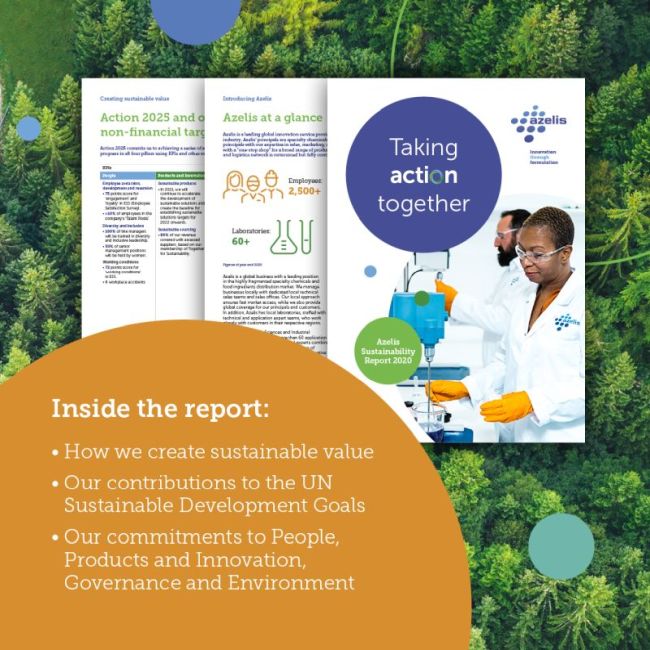
Azelis publishes its 2020 sustainability report, demonstrating progress against ambition to innovate and advance in sustainability

Azelis, a leading innovative service provider in the specialty chemicals and food ingredients industry, is proud to publish its second sustainability report which covers the 2020 group-wide sustainability performance.
Highlights & rationale
– The report showcases Azelis’ environmental, social, and governance (ESG) commitments and reinforces its ambitions to become the world-leading provider of sustainable solutions and services
– Azelis sustainability strategy, Action 2025, is built upon four pillars: People, Products and Innovation, Governance and Environment
– Azelis was awarded a Platinum rating by EcoVadis, the highest distinction in the supplier sustainability rating scheme, a recognition of its sustainability commitments

Azelis’ sustainability journey started in 2015 when the company defined the fundamentals of its sustainability program, following the Paris Agreement on climate change and the release of the 2030 Agenda for Sustainable Development by the United Nations. Based on the United Nations Global Compact (UN GC) initiative, ISO 26000 and the Global Reporting Initiative (GRI), the program consists of four pillars, each with goals and KPIs. Within each pillar, Azelis also contributes to a number of United Nations Sustainable Development Goals (UNSDGs).

In 2020, Azelis laid the grounds for its new sustainability strategy, Action 2025. Rolled out in early 2021, the strategy captures the company’s continued ambitions to innovate and to advance in sustainability. The main 2020 developments across all four pillars of the Azelis sustainability strategy include:

– People – Another edition of the company-wide employee satisfaction survey, which has been in place since 2014, was conducted. Thanks to the extensive improvement actions put in place across the entire organization following the 2018 survey, Azelis succeeded in already reaching the 2025 goals for loyalty and working conditions and is very close to the goal for engagement. As the company aims to continuously improve, it intends to raise the bar of the 2025 goals by the end of 2021.

– Products and Innovation – Azelis continued with the identification of sustainable products and intensified sustainable formulation work. For this, the company specifically focused on products that minimize or eliminate the use and generation of hazardous substances. Progress was also made on the sustainable sourcing due diligence procedure in 2020. This was reinforced by Azelis’ membership to “Together for Sustainability” a joint initiative and global network of 31 chemical companies, which delivers the de facto global standard for environmental, social and governance performance of chemical supply chains.

– Governance – Azelis launched its SpeakUp! Policy and SpeakUp! Line, which are available to employees and any third-party stakeholder for reporting malpractices. This ensures a culture where employees are encouraged to speak up in a safe environment, and where they will not feel victimized or retaliated against.

– Environment – Azelis is committed to a carbon intensity reduction target of 25% by 2025 and 50% by 2030. Furthermore, the company has set targets of using 100% of electricity in its offices and sites from renewable sources as well as decarbonization in its operations and supply chain.

Dr. Hans Joachim Muller, Azelis Chief Executive Officer, comments: “Perhaps the most important lesson of 2020 was that we cannot and must not continue as before the Covid-19 pandemic. It is the responsibility of all of us, as businesses, as consumers, as human beings, to act more sustainably and responsibly. Despite the turmoil 2020 brought, it has been yet another pivotal year of progress for Azelis. More than ever, sustainability is a driver of innovation for Azelis and innovation is a driver of sustainability. Across all market segments, our formulation experts are helping customers reduce their environmental impact by developing innovations that minimize or eliminate the use and generation of hazardous substances. They are also creating formulations and practices that deliver enhanced performance while protecting human health and the environment. Our innovations catalyze sustainability in the market segments we serve and their value chains, and will help realize concepts such as circular economy.”

Maria J. Almenar Martin, Group Safety, Health, Environment and Quality (SHEQ) and Sustainability Director, adds: “As Group Sustainability Director I look back at our 2020 sustainability achievements proudly and with excitement and confidence to the years to come to reach our 2025 sustainability targets. With our recently awarded Platinum rating from EcoVadis and this latest edition of the sustainability report, we confirm to all our partners the proven track record of our sustainability efforts and commitments since we started our journey back in 2015. We are in a resolute course of action to be catalyst of change when it comes to sustainable business models and become the benchmark for the industry.”

To become a world-leading innovation service provider in the specialty chemicals and food ingredients distribution industry, Azelis has identified digitalization, innovation and sustainability as its growth drivers. Through Azelis’ connected solutions, the company is leading the way in customer engagement, whilst providing the digital insight that will drive new levels of chemical innovation. With its redefined sustainability strategy, Action 2025, Azelis is building a resilient, thriving and responsible business. Through these commitments, the company will meet the needs of its stakeholders, whilst also creating a positive and widespread impact on the environment and communities around the world.

Contact information
Azelis
Marina Kaptein
Group Communications Director
T: +32 3 613 0125
E: marina.kaptein@azelis.com

About Azelis

Azelis is a leading global innovation service provider in the specialty chemical and food ingredients industry present in over 50 countries across the globe with around 2,500 employees. Our knowledgeable teams of industry, market and technical experts are each dedicated to a specific market within Life Sciences and Industrial Chemicals. We offer a lateral value chain of complementary products to more than 45,000 customers, supported by ~2,200 principal relationships, creating a turnover of EUR 2.22 billion (2020).

Across our extensive network of more than 60 application laboratories, our award-winning staff help develop formulations and provide technical guidance throughout the customers’ product development process. We combine a global market reach with a local footprint to offer a reliable, integrated and unique digital service to local customers and attractive business opportunities to principals. EcoVadis Platinum rated, Azelis is a leader in sustainability. We believe in building and nurturing solid, honest and transparent relationships with our people and partners.

Impact through ideas. Innovation through formulation.

www.azelis.com

Azelis releases ‘Action 2025’, confirming sustainability as a key driver in growth strategy

Azelis, an innovation service provider, is excited to release its sustainability strategy, ‘Action 2025’, reinforcing its commitment to become the world-leading provider of sustainable solutions and services in the specialty chemicals and food ingredients distribution industry. Through its sustainability program and strategy, Azelis wants to turn the sustainability aspirations of its principals and customers into innovative sustainable solutions.

Highlights & rationale

  • Azelis’ sustainability commitments and efforts have further matured and are now crystalized into ‘Action 2025’, its new sustainability strategy.
  • With its strategy, Azelis aspires to become the world-leading distributor of sustainable solutions and services in the specialty chemicals and food ingredients distribution industry.
  • Together with digitalization and innovation, sustainability is a key strategic driver for Azelis’ future growth.

Azelis’ sustainability journey started in 2015 when the company defined the fundamentals of its sustainability program, following the Paris Agreement on climate change and the release of the 2030 Agenda for Sustainable Development by the United Nations.

The Azelis sustainability program is based on the United Nations Global Compact (UN GC) initiative, ISO 26000 and the Global Reporting Initiative (GRI). The program consists of four pillars – each with goals and KPIs – and with every pillar Azelis also contributes to the selected United Nation’s Sustainable Development Goals (SDGs).

– People – we will be recognized as a global employer of choice for our industry
– Products and innovation – we will be the leader in distribution of sustainable, innovative and safe chemicals
– Governance – we will be fair in business practices and compliant with all laws and regulations, embedding trust and ethics in the foundation of our operations
– Environment – we will continually reduce the environmental impact of our operations

‘Action 2025’
In its ongoing transition to an even more sustainable business model, the company has redefined its sustainability strategy – based on the four pillars set out above – and set targets for 2025. To reach these 2025 targets, Azelis will both be launching several new initiatives in the coming years and intensifying other initiatives which are already being implemented.

One very important target for Azelis is to continue to identify sustainable products within its extensive product portfolio to bring additional value to customers, helping them to achieve their sustainability goals with more environmentally-friendly products. This identification of the sustainable product portfolio is done in close collaboration with Azelis’ principals who are equally dedicated to contributing to a sustainable future. Being a proud member of Together for Sustainability (TfS) and measuring and reporting on sustainability efforts within the EcoVadis framework, Azelis will continue with sustainability assessments to help its suppliers in developing sustainability practices, improve the sustainability standards in the value chain and work on the reputation of the chemical industry.

‘Action 2025’ is based on learnings the company gathered from in-depth interviews with suppliers and customers, results and improvement suggestions from its EcoVadis assessment, input from Azelis business representatives, and the materiality assessment exercise Azelis performed last year in the context of its first sustainability report. Azelis is committed to publishing sustainability reports annually, communicating on progress and provide further information in this important area.

Dr. Hans Joachim Muller, Azelis Chief Executive Officer, states: “We are part of a global industry that plays a significant role in the economy of the world and we have an obligation to utilize the world’s resources in a sustainable manner. Aligned with our brand promise ‘Innovation through formulation’, it is our aspiration to contribute to a more sustainable future by connecting and empowering both principals and customers to work on the development of sustainable chemical solutions through innovation. Our innovations catalyze sustainability in the market segments we serve and their value chains, and will help realize concepts such as circular economy. Our sustainability reputation and our EcoVadis Gold ratings have already positively influenced commercial decisions of some our partners. It remains crucial to our sustainability ambitions that we continue to work with the best partners who equally respect human rights, environment and fair business practices.”

Maria J. Almenar Martin, Group SHEQ & Sustainability Director, adds: “Our sustainability ambitions have been captured in a more formalized way since the creation of our sustainability program back in 2015 and have now entered a new phase with the launch of our 2025 sustainability strategy. In an ever-changing industry and world, Azelis’ ambitions for a sustainable future will never stop. We want to engage our current and potential partners to contribute to our sustainable cause, next to converting the sustainability aspirations of our principals and customers into innovative sustainable solutions. We also wish to set an example for our peers and motivate them to also embark on the journey to a sustainable business model.”

To become a world-leading innovation service provider in the specialty chemicals and food ingredients distribution industry, Azelis has identified digitalization, innovation and sustainability as its growth drivers. Through Azelis’ connected solutions, the company is leading the way in customer engagement, whilst providing the digital insight that will drive new levels of chemical innovation. With its redefined sustainability strategy, Azelis is building a resilient, thriving and responsible business. Through these commitments, the company will meet the needs of its stakeholders, whilst also creating a positive and widespread impact on the environment and communities around the world. ‘Innovation through formulation’ is Azelis’ passion and promise to every colleague, customer and partner, as the company combines products, ingredients and ideas – providing the expertise that will always matter in our changing world.

Learn more about ‘Action 2025’ with this animation video. https://www.youtube.com/watch?v=JzUGfxubX5o

Contact information
Azelis
Sarah Van Alsenoy
Corporate Communications Business Partner
T: +32 499 22 36 62
E: sarah.vanalsenoy@azelis.com

About Azelis
Azelis is a leading distributor of specialty chemicals and food ingredients present in over 50 countries across the globe with around 2,500 employees. Our knowledgeable teams of industry, market and technical experts are each dedicated to a specific market within Life Sciences and Industrial Chemicals. We offer a lateral value chain of complementary products to about 43,000 customers, creating a turnover of EUR2.22 billion (2020).

Throughout our extensive network of more than 60 application laboratories, our award-winning technical staff help customers develop formulations. We combine a global reach with a local focus to offer a reliable, integrated service to local customers and attractive business opportunities to principals. And we believe in building and nurturing solid, honest and transparent relationships with our people and partners.

Impact through ideas. Innovation through formulation.

www.azelis.com

ZC Rubber Focuses on Innovation and Growth at Global Online Dealer Conference

ZC Rubber hosted its first Global Online Dealer Conference on March 19, 2021, with the theme “Innovate Into The Great Future”.

The conference offered a series of presentations outlining the company’s strategic vision and plans for continued growth in 2021 and introduced its latest products, technologies and services to provide distributors and customers with resourceful information for better collaboration in the future.

Mr. Shen Jinrong, the Chairman of ZC Rubber Group, said the company would continue to strengthen its position through further global expansion and technological innovation after achieving a historic performance in 2020 as its sales revenue reached RMB 28.22 billion, increased by 2.25%.

“We have been pursuing a strategy of Technological Innovation and have realized the overall improvement in product quality, production efficiency, and quality control since last year,” Mr. Shen said. In 2020, ZC Rubber brought forward a new generation truck and bus tire based on the latest PSCT design theory and the state-of-the-art Flagship Series passenger car tires.

He also shared the company’s vision towards a full digitalization, focusing on smart manufacturing, Future Factory, and sustainable development. ZC Rubber’s first Future Factory, equipped with top facilities and digital technologies, is expected to be completed by the middle of the year.

Mr. Shen noted that the company is eyeing a new overseas plant in America, Europe, or the Middle East.

Mr. Ge Guorong, Vice President of ZC Rubber Group, expressed his willingness to spread the Chinese market’s success to the world. He mentioned that the company has benefited from digital marketing and sales in recent years through online-to-offline (O2O) services network expansion and the smart S2B2b platform connecting suppliers, distributors, retailers, and end-users in China.

“ZC Rubber’s successful experience in the Chinese market is not only to be enjoyed in China but also shared globally,” he added. “Our digital development will empower global distributors and retailers in coming years.”

Regarding its growth plan in international markets, Mr. Ge pointed out that “demand in several segments is pretty strong,” targeting a 15% export growth this year. He emphasized ZC Rubber’s focus on brand marketing in 2021 to provide vital support to its distributors and retailers worldwide. He said the company would invest more in advertising and dealer events in various formats.

ZC Rubber also presented its global product lines and its latest leading technologies for both consumer and commercial segments.

As the new top-tier passenger car tire line, the Flagship Series of Westlake, Goodride, Trazano and Chaoyang was officially launched globally. This series made its debut in China last year. With core technologies, the four flagship products aim to strike a perfect balance of quietness, grip, and fuel efficiency. The series will “enrich the high-end product matrix of ZC Rubber’s passenger car tire lineup” and is positioned as “premium tires with leading design, performance and satisfaction” the company stated.

Looking ahead, ZC Rubber is excited to continue its strong commitment to working closely with all distributors and partners. “We expect to thrive with our distributors and partners, to strengthen the channels, retail stores, products and expand market share further. We will move towards a leading global tire company” said Mr. Ge Guorong.

Media contact:
Linch – ZC Rubber
E: sales@zc-rubber.com
W: http://www.zc-rubber.com

Elastomers develop stronger bonds of attachment

Different kinds of bonds can link elastomer chains together, changing how the material behaves. (Credit: Yukikazu Takeoka)

Elastomers are the soft, elastic materials, like gels and rubbers, that are found in automobile and airplane parts, in sports equipment, and are used to protect precision machinery and buildings against vibrations. Scientists now want to make them thinner and tougher, without losing elasticity. Nagoya University materials engineer Yukikazu Takeoka and colleagues reviewed the most recent efforts towards improving elastomers for the journal Science and Technology of Advanced Materials.


Elastomers are made of many, long molecular chains of repeating subunits. They can undergo large deformations when stretched, returning to their original shape when the tension is released. They can do this because their molecular chains have enough mobility to stretch and crunch up.

Elasticity and overall toughness depends on the interactions between the molecular chains inside the material. Scientists have been working on controlling how chains link together and interact in order to change elastomers’ mechanical properties.

Takeoka and his team from Nagoya University’s department of molecular and macromolecular chemistry explain that elastomers can be made tougher by introducing strong hydrogen or ionic bonds that can reversibly link elastomer chains together. These reversible bonds attach and detach from the elastomer chains as the material deforms. Scientists have used hydrogen bonds to fabricate strong hydrogels that can deform up to 600% and return to their original state within three minutes at 37 degrees Celsius or a few seconds at 50 degrees Celsius.

“Our review gives hints about the kind of molecular thinking that needs to go into making elastomers tougher,” says Takeoka.

Elastomer chains can also be linked through ring-like ‘cyclic’ molecules, giving linked chains a large degree of flexibility and improved toughness. A team of scientists fabricated a very flexible elastomer by mixing solutions of polyethylene glycol and cyclic alpha-cyclodextrin in water.

Takeoka and his colleagues suggest that further combining elastomers linked by reversible bonds and moving cyclic molecules could lead to even tougher elastomers with better elongation. “Our review emphasizes the importance of examining molecular behaviour in detail while designing polymer materials,” says Takeoka.

Paper: Improvement of mechanical properties of elastic materials by chemical methods

Further information
Yukikazu Takeoka
Nagoya University
Email: ytakeoka@chembio.nagoya-u.ac.jp

About Science and Technology of Advanced Materials Journal

Open access journal STAM publishes outstanding research articles across all aspects of materials science, including functional and structural materials, theoretical analyses, and properties of materials.

Chikashi Nishimura
STAM Publishing Director
NISHIMURA.Chikashi@nims.go.jp

Press release distributed by ResearchSEA for Science and Technology of Advanced Materials.

Materials coloured like a peacock

Materials inspired by the colour changes in a peacock’s feather could lead to anti-counterfeit and sensing applications.

Melanin-like compounds can be precisely designed and arranged to colour materials using a mechanism similar to that found in a peacock’s feathers. Chemist Michinari Kohri of Chiba University in Japan reviewed the latest research on these ‘melanin-mimetic materials’ and their potential applications for the journal Science and Technology of Advanced Materials.

Scientists are developing materials inspired by the structural colours in a peacock’s feathers. (Credit: Takashi Tsujino)
Melanin and melanin-like compounds absorb some of the light that is scattered from the microstructures within materials. Scientists are finding ways to control this phenomenon to give a variety of iridescent and non-iridescent colours. (Credit: Michinari Kohri)

Melanin is a dark pigment that gives hair and skin its colour. It is also essential for the bright colours we see in some organisms. When light interacts with the structures of feathers, wings and shells of many organisms, like peacocks, butterflies and jewel beetles, it is scattered, appearing white. But when melanin is interspersed within these structures, some of the scattered light is absorbed, producing various colours. Scientists are looking for ways to mimic these so-called ‘structural colour’ changes of living organisms in synthetic materials.

“Vivid structural colours can be obtained by constructing microstructures containing a light-absorbing black material made of natural or artificial melanin,” says Kohri. “Research in this area is progressing rapidly worldwide.”

A leading contender is a compound called polydopamine. It is made of a material naturally found in the body, so it is biocompatible. It is also dark, so it absorbs light like melanin. Scientists found they could control polydopamine’s iridescence – how much the colour changes as the angle of light hitting it shifts, similar to a peacock’s feather. They achieved this by altering the particle size or by adding compounds that react to a magnetic field.

Scientists are also investigating particles formed of a polystyrene core and a polydopamine shell. Changing the diameter of the inner core, for example, leads to different colours. Making the polydopamine shell thicker causes the particles to be less closely packed, leading to non-iridescent structural colour, which remains the same regardless of the light angle.

Scientists have also toyed with controlling colour and angle-dependence by changing the shapes of polystyrene/polydopamine particles, making them hollow on the inside, and adding multiple coatings to the external shell.

Polydopamine particles are showing potential for a variety of applications. For example, they can be used as inks to dye fabrics or in cosmetics. They could help prove a product is real versus counterfeit by shifting colour with strong light, wetting, or temperature changes. Finally, scientists have found that adding these particles to rubber causes it to change colour when stretched or relaxed, which could be useful for sensing local stress and strain in bridges.

Further information
Michinari Kohri
Chiba University
Email: kohri@faculty.chiba-u.jp

About Science and Technology of Advanced Materials Journal
Open access journal STAM publishes outstanding research articles across all aspects of materials science, including functional and structural materials, theoretical analyses, and properties of materials.

Chikashi Nishimura
STAM Publishing Director
NISHIMURA.Chikashi@nims.go.jp

Press release distributed by ResearchSEA for Science and Technology of Advanced Materials.

The Executive Talk: PTT Global Chemical PCL (SET:PTTGC)

PTT Global Chemical PCL (SET:PTTGC) Chief Executive Officer, Dr. Kongkrapan Intarajang discusses the company’s strategy and outlook in The Executive Talk (TET) by ShareInvestor.com.

TET: What are GC’s current business execution strategies? What is the rationale behind the expansion towards the downstream industry?

GC’s strategies are based on 3 major strategies. The first is “Step Change”, emphasizing on strengthening our home base by gearing more towards the downstream businesses to enhance the competitiveness and flexibility, being able to capitalize on diverse feedstock, while at the same time ensuring that our costs are globally competitive, with the notion of horizontal and vertical integration applied to the business.

The horizontal and vertical concepts involve our production lines from upstream all the way to downstream businesses, which can be further developed into different types of chemical products, and can serve as fundamental feedstock for various industries such as packaging, garments, communication and electronics devices, automotive, construction, engineering plastic, and agricultural equipment. This also serves to diversify business risks, expand product offerings, and add values to them.

The next strategy “Step Out” capitalizes on GC’s being the largest petrochemical operator in Southeast Asia, with 12 production sites across the globe. Our purpose is to build a genuinely global business. We have begun to invest in the USA more intensively. The Step Out strategy emphasizes on 2 components; merger and acquisition or M&A and the downstream business to secure global footprint, as well as investing in the petrochemical business; our core business, in Ohio, where polymer feedstock cost is very competitive.

The third strategy “Step Up” focuses on Sustainable Development, or SD; the matter that GC takes as an important part of the business, not just as CSR (Corporate Social Responsibility) activities. In this regard, the Step Up strategy is multi-dimensional. In terms of scale, GC has expanded collaboration with our alliances both domestically and internationally in a larger scope, based on the concept of the circular economy to create awareness, from waste collection, management, sorting, transportation, and recycling, which is different from before when it was purely mechanical recycling, but now we are implementing chemical recycling, as part of the ‘Step Up’ initiative both in terms of scale and scope.

TET: Based upon the determination to operate the business in a sustainable manner, what are the tangible outcomes resulting from such endeavor?

GC has recently been ranked the first in the world in the Dow Jones Sustainability Indices: DJSI for the second consecutive year in the chemicals sector. We are also in the top 10 ranks of DJSI World and Emerging Markets for the eighth consecutive year, reflecting our determination in our ESG intent. This goes to show the Company’s support and alignment with the global Sustainable Development Goals; SDGs that GC has been abiding by and actively executing for a long time.

Not only that, GC is the first and only Thai company that has been granted A level assessment (Leadership Level), which is the highest level in climate change and water security management, under the assessment of the globally trusted sustainability evaluation institute ‘Carbon Disclosure Project (CDP)’ in 2020.

We intend to play a part in solving the problems and alleviate the impact of climate change, transitioning into the low carbon society, following the objective of the Paris Agreement and the United Nations’ Sustainable Development Goals (SDGs), as well as the emphasis on maximum effectiveness on the use of water resources, reflecting the environment-conscious operations.

With our goals to reduce the emission of greenhouse gas (scope 1 and 2) by 20% from normal business operations in 2030, compared to the base year (2012). The organization’s greenhouse gas emission account has been developed, with the plan to expand the operational scope to the value chain (scope 3) in an integrated manner. Furthermore, the water management goals have been developed both internally and externally to ensure measurable outcomes and sustainable leadership position in an international arena.

TET: What are GC’s directions in ensuring the organization’s financial health?

We need to increase the quality of earnings. In the past, our major source of income has been from commodity products. GC has intended to increase high value products, performance products and green chemical portfolios by 2030. It is expected that the profit generation from these products will contribute 20% of the Company’s total profits.

However, sustainability is the significant determinant of the Company’s financial strength. If shareholders look at it on a short-term period, this may not be the key objective. We wish for our shareholders to grow together with us, generating capital gain that can pay out dividend and remain competitive in the market. Hence, quality and stability are more important. In this regard, the downstream business is less volatile with around 10% EBITDA margin, which is less likely to drop to a single digit.

TET: What is the outlook of the petrochemical industry?

If we look at the petrochemical industry from the commodity side, there might be a certain extent of oversupply over the next 2-3 years, depending on each product. But from our projection, the situation should be better than in 2020, when things should have already bottomed out in the second and the third quarters of 2020, caused by missing demand. Now we have begun to see signs of improvement in the fourth quarter and we are of the view that the situation in 2021 should be considerably more improved than in 2020.

TET: What are the strengths that differentiate GC from other players, both in the regional and global levels?

Even though our products are more advanced in many aspects, there are certain points that others are doing better than we are. Nevertheless, our number one strength is our sustainability performance, where we have been ranked the world’s number one in the chemicals sector by DJSI. We have been able to reduce costs resulting from the adjustment of business execution processes that allow for energy saving and reduction of greenhouse gas emission, which will be the key component in the cost structure in the future. It might not have yielded tangible benefits today, but when the law becomes effective in the future, we will always be ready. It will also serve to enhance business opportunities, since global partners all place emphasis on this matter, while many competitors may not have this in place yet or may not be as good at this as we are. Meanwhile, sometimes customers will come to us because we have invested so much in sustainability and investors are also very interested in the matter of sustainability as well.

TET: What is the most significant challenge faced by GC and the petrochemical industry?

The challenge is when people are starting to doubt the viability of this industry. Many people might not notice the tangible difference between petroleum and petrochemical businesses. The petroleum business has been viewed by many that the return on capital is on the downside. The petrochemical business, on the other hand, if the portfolio is well-managed, I think that this industry has a promising future because petrochemicals are always part of many people’s lives.

Therefore, the challenge is how to maintain or build the competitiveness, by way of keeping the cost of the commodity market low, while ensuring that new businesses can accommodate several industries, for instance, EV, construction, electronics, depending on the strategies of each company. In this regard, we believe that the challenge is not different from what we faced in the past, the only difference is the prevalence of the COVID-19 pandemic.

TET: How do you see GC 5 years from now?

Strength must be borne from within, so we emphasize greatly on transformation. We execute organizational and digital transformation alongside one another. Though we have not been affected by the digital disruption today, I believe we must start now for future growth, for instance, cost reduction, modernization of work processes by adopting the technology. Thus, there should be several changes in our organization such as change of the organizational culture, which has progressed quite a lot because we work fast and get serious. We have initiated the work and will have to meet the desired goals. We also need to adjust and strengthen our product portfolio and enhance the quality of earning, as well as overseas investment, whereby our long-term goal is to increase margin contribution from overseas investment from 10% to 30%.

About The Executive Q&A Series

The Executive Q&A Series is presented by ShareInvestor, Asia’s leading financial internet media and technology company and the largest investor relations network in the region. For more information, email admin.th@shareinvestor.com. Website: www.ShareInvestorThailand.com