Habitat for Humanity invests in Cambodian water-access startup TapEffect

Habitat for Humanity‘s Terwilliger Center for Innovation in Shelter announced today a US$300,000 equity investment in TapEffect, a Cambodia-based startup which provides clean and affordable tap water to underserved rural and semi-rural communities. The investment also marks the fifth anniversary of Habitat’s Shelter Venture Fund, launched in 2017 to accelerate innovative startups tackling affordable housing challenges worldwide.
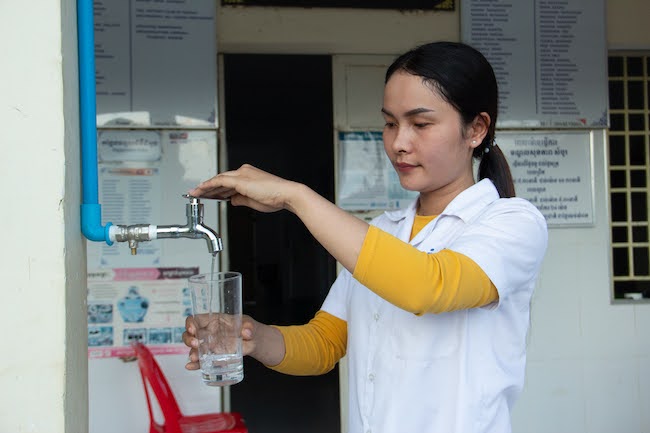
It is estimated that 110 million people in Southeast Asia lack access to safe drinking water. In Cambodia, one third of the population rely on water from impure sources. TapEffect, founded in 2018, started from the desire to bring safe water to rural communities in Cambodia, while addressing the systemic barriers often faced by local providers, such as set-up costs and ongoing maintenance. The company designs, builds and operates self-sustaining piped water systems that can each support more than 10,000 people, and uses Internet of Things technology for remote monitoring and payment management, which reduces cost and increases operational efficiencies.

TapEffect offers a market-based solution where families pay a fraction of the cost for water compared to bottled or truck-in water options. Their initial demonstration system, built in 2020, serves over 14,000 people in 19 villages, and connects 12 schools and two healthcare facilities to clean and safe water.

“TapEffect’s model combines technology, engineering and blended finance to create a holistic approach that can be easily replicated. By employing local contractors and construction teams, we also build capacity within local communities,” said Hourt Vuthy, general manager at TapEffect. “We have been partnering with Habitat for Humanity since joining the ShelterTech Southeast Asia accelerator in 2020. The investment will help to bring the solution to more families across the region who still lack access to clean water and sanitation.” TapEffect is also an investee of World Hope Social Ventures, which supports market-based, community-driven enterprise solutions.

Habitat’s Shelter Venture Fund aims to nurture businesses with solutions that can improve housing conditions for low-income families. “We realized that high-potential enterprises often face a pioneer gap in their early stages of growth, when they are considered too risky by impact investors,” said Luis Noda, Habitat for Humanity’s Asia-Pacific vice president. “Through the Fund, we also send a message to the market that profitable opportunities exist in supporting entrepreneurs that are driving social change through innovation.”

Twelve startups have received investments from the Shelter Venture Fund to date globally, supporting over 5 million people in accessing improved housing-related products and services. The portfolio includes Tvasta – builder of India’s first 3D-printed house; Meridia – which uses mobile-based technology to improve land documentation and tenure security in Africa and Asia; and BURN – which impacts lives and the environment through the design, manufacturing and distribution of clean-burning cook stoves.

Since its launch, Shelter Venture Fund investees have catalyzed over US$34 million in further investments. At present, 40% of the portfolio focuses on solutions that are less damaging to the environment than market alternatives, such as water saving and reduced carbon emission technologies. The 12 ventures are also responsible for the creation of over 600 jobs in the locations where they operate.

About Habitat’s Terwilliger Center for Innovation in Shelter

The Terwilliger Center for Innovation in Shelter, a unit of Habitat for Humanity International, works with housing market systems by supporting local firms and expanding innovative and client-responsive services, products and financing so that households can improve their shelter more effectively and efficiently. The ultimate goal of the Terwilliger Center’s market systems program is to make housing markets work more effectively for people in need of decent, affordable shelter, thereby improving the quality of life for low-income households. To learn more, visit habitat.org/tcis.

About Habitat for Humanity

Driven by the vision that everyone needs a decent place to live, Habitat for Humanity found its earliest inspirations as a grassroots movement on an interracial community farm in South Georgia, U.S.A. Since its founding in 1976, the housing organization has since grown to become a leading global nonprofit working in more than 70 countries. In the Asia-Pacific region since 1983, Habitat for Humanity has supported millions of people to build or improve a place they can call home. Through financial support, volunteering or adding a voice to support affordable housing, everyone can help families achieve the strength, stability and self-reliance they need to build better lives for themselves. Through shelter, we empower. To learn more, donate or volunteer, visit habitat.org/asiapacific.

To set up interviews, receive photos or further information, please contact:
Julia Ferraz
jferraz@habitat.org
+852 61001806

Habitat for Humanity’s youth supporters in Asia-Pacific return to on-site volunteering for the first time in two years

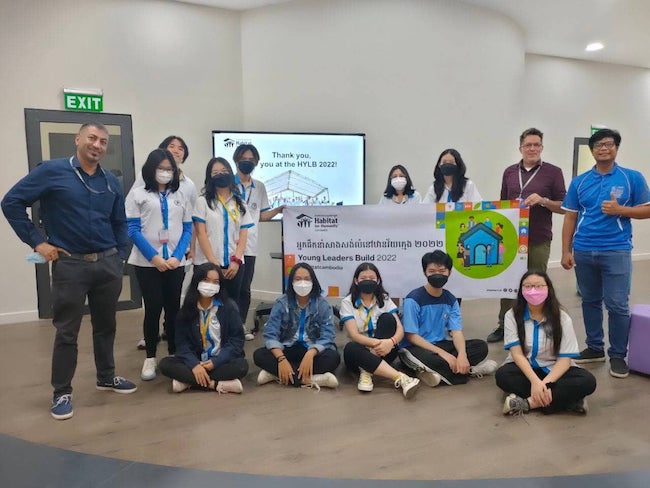
Supporters across the Asia-Pacific region started volunteering over the weekend on Habitat for Humanity sites in their home countries to mark the culmination of its 2022 Young Leaders Build campaign. This marks the first time the housing nonprofit hosted in-person youth volunteers in its build sites since the coronavirus pandemic began.

Cambodia – Young volunteers and Habitat staff take HYLB on a campus tour to raise awareness about the campaign and the need for decent, affordable housing

“Over the last two years, the youth responded creatively as the health and economic fallouts due to the global pandemic took a toll on everyone. Working virtually with Habitat for Humanity, they helped vulnerable families and communities to stay safe in decent shelter. We are excited to welcome young volunteers back on our build sites, following local health protocols in areas where the spread of the pandemic is controlled, to build and repair homes alongside local families in need,” said Luis Noda, Vice-President for Asia-Pacific, Habitat for Humanity International.

In Indonesia and the Philippines, long-term Habitat volunteers trained their peers about the importance of building decent, affordable housing. In Cambodia, volunteers are expected to build and repair at least four houses later this week.

Volunteers in the Asia-Pacific region also used virtual spaces to raise awareness of COVID-19 safety and the links between health and housing. They will continue to raise funds to support Habitat’s mission in the region.

“A house is where all of your basic needs are met. But sadly, a lot of people still don’t have access to adequate housing. This is where we as youth should come together to increase awareness of the situation and work to solve the housing problem in our community, country and all around the world,” said Monica Hartono, a volunteer from Indonesia. Together with fellow students from Wardaya College, she implemented Project: Home, virtual fundraising sessions in support of families in need of decent homes.

In December 2021, young leaders launched the 2022 campaign with the #VolunteeringisViral Challenge, a social media-based activity that aimed to highlight the power of volunteering to inspire action for good.

In the four months since the annual campaign’s launch, thousands of supporters have hosted and attended learning events about the housing needs in Asia-Pacific and their respective countries, supported disaster response efforts, assisted older people in cleaning and repairing homes. They also advocated for more support and funding for the housing sector. In addition, supporters have used crowdfunding sites in support of various Habitat projects in 10 countries and one special administrative region and assisted in fundraising events.

Since 2012, over 17 million supporters have raised US$9.2 million, enabling more than 33,300 families to achieve the strength, stability and self-reliance they need to build better lives for themselves. While the 2022 campaign peaks in end-April, the momentum will continue as youth groups and volunteers are expected to participate in Habitat’s upcoming global advocacy campaign.

About Habitat for Humanity

Driven by the vision that everyone needs a decent place to live, Habitat for Humanity found its earliest inspirations as a grassroots movement on an interracial community farm in U.S.A. Since its founding in 1976, the housing organization has grown to become a leading global nonprofit working in more than 70 countries. In the Asia-Pacific region since 1983, Habitat for Humanity has supported millions of people to build or improve a place they can call home. Through financial support, volunteering or adding a voice to support affordable housing, everyone can help families achieve the strength, stability and self-reliance they need to build better lives for themselves. To learn more, donate or volunteer, visit habitat.org/asiapacific.

About Habitat for Humanity Young Leaders Build

Since 2012, Habitat for Humanity Young Leaders Build brings together youth from across the Asia Pacific region to support people and families in need of decent housing. Every young person volunteering, fundraising, raising awareness and adding their voices in support of affordable housing can help families achieve the strength, stability and self-reliance they need to build better lives for themselves. The movement encourages youth to take the lead and motivate their peers to create societal changes by building homes and communities, on a Habitat build site and/or online through their social networks.

For further information, please contact Ms. Angeli Alba-Pascual, AAlba@habitat.org, +63 920 956 3376, or Ms. Michele Soh, MSoh@habitat.org, +65 9233 1544. Please find a short video on the call for youth volunteers to support Habitat for Humanity’s mission, www.youtube.com/watch?v=FMC8LyQL_Sc.

Sustainable, People-centered Solutions for Affordable Housing to Take Center Stage at Eighth Asia-Pacific Housing Forum

The Asia-Pacific Housing Forum taking place from December 7 to 9 highlights the urgent need to build sustainable, inclusive, and affordable housing, in a region where millions of people live in extreme poverty below the threshold of US$1.90 a day and where communities continue to grapple with the health and economic impact of COVID-19.

Even before the pandemic, there were 1.6 billion people in need of adequate shelter. The global health crisis has put a spotlight on the critical importance of having a home to stay safe and healthy. However, it remains that vulnerable populations, those unable to cope amid the pandemic, are the ones most impacted by the economic shocks, the threat of natural and manmade disasters, and the negative effects of climate change.

“The Asia-Pacific Housing Forum’s main theme of ‘building forward better through inclusive housing’ means that each one of us, especially the most vulnerable families we serve through housing solutions, has a voice in the process and a role to play in increasing access to a decent place to live,” said Luis Noda, Habitat for Humanity’s Asia-Pacific vice president. “We must center our actions on the needs of the people to truly build in a greener, safer, more resilient way.”

The virtual conference will be attended by various stakeholders and actors across the housing ecosystem and serves as a platform for the exchange and sharing of, experiences, technologies, innovations, and solutions.

The forum’s four tracks are Build resilient cities and communities; Innovative housing solutions and technologies; Advance sustainability in the housing sector; and Finance affordable housing. Economic growth, and climate change adaptation remain cross-cutting themes through the tracks.

The resilient cities and communities track looks at how governments and sectoral stakeholders can work together towards a more sustainable urban future. The track on innovative housing solutions and technologies explores the various ways we can achieve affordable housing through innovation and technology.

The track on sustainability in the housing sector looks at the different approaches to advance and harmonize the environmental, social, cultural, and economic dimensions of housing to ensure equitable cities and communities. The last track –finance affordable housing — will focus on the financing instruments of different actors in both public and private sectors that fund affordable housing.

Recently, Habitat for Humanity released a report titled “A Ladder Up: The construction sector’s role in creating jobs and rebuilding emerging market economies” authored by economists at the Universities of Pennsylvania, Southern California, and Washington. The report states that every $1 million in construction output creates an average of 97 jobs across the countries studied, with 165 jobs per $1 million in the Philippines, and 182 jobs per $1 million in India. These findings are relevant for low- and middle-income countries deciding on areas to prioritize as they work to build back economies weakened by the pandemic.

Thailand, being a fast emerging economy, investing in residential construction may represent a potential win because of possible large number of jobs it can create locally. From 2018 to 2019, the poverty rate in Thailand dropped to 6.2%, according to the World Bank. However, in 2020, the poverty rate increased to 8.8% due to the impact of COVID-19.

The Asia-Pacific Housing Forum is organized by Habitat for Humanity, in collaboration with the European Union-funded SWITCH-Asia Sustainable Consumption and Production Facility.
Register for the virtual Asia-Pacific Housing Forum from December 7 to 9 at aphousingforum.org/registration/.

About Habitat for Humanity

Driven by the vision that everyone needs a decent place to live, Habitat for Humanity found its earliest inspirations as a grassroots movement on an interracial community farm in U.S.A. Since its founding in 1976, the housing organization has grown to become a leading global nonprofit working in more than 70 countries. In the Asia-Pacific region since 1983, Habitat for Humanity has supported millions of people to build or improve a place they can call home. Through financial support, volunteering or adding a voice to support affordable housing, everyone can help families achieve the strength, stability and self-reliance they need to build better lives for themselves. To learn more, donate or volunteer, visit habitat.org/asiapacific.

About EU SWITCH-Asia Programme

Launched in 2007, the SWITCH-Asia programme is the largest European Union-funded programme promoting Sustainable Consumption and Production (SCP) supporting 24 countries in Asia and Central Asia. The programme has funded around 130 projects, supporting over 500 Asian and European non-for-profit partners, about 100 private sector associations and 80.000 Asian MSMEs. The SCP Facility, one of SWITCH-Asia Components, aims at strengthening the implementation of SCP policies at the national level, facilitating the coordination of all components of the programme through information sharing. In addition, it carries out analyses on the results of the pilot projects and supports dialogue with stakeholders.

Media contact:
Maetavarin Maneekulpan
+66-2260-5820
mae@tqpr.com

Habitat for Humanity: Innovation Awards at the Virtual Asia-Pacific Housing Forum to Promote Winning Sustainable Solutions for Affordable Housing

The Asia-Pacific Housing Forum‘s Innovation Awards recognize and celebrate innovators and disruptors in the affordable housing sector. Startup and scaleup companies, policymakers and advocates, architects and engineers are invited to submit sustainable and practical solutions for affordable housing.

“The Asia-Pacific region faces complex housing challenges, compounded by rapid urbanization, natural and human-made disasters, the negative effects of climate change, and persistent poverty and inequality,” said Luis Noda, Asia-Pacific vice president of Habitat for Humanity. “We need everyone working together and every possible creative solution that is locally adapted to address the housing deficit.”

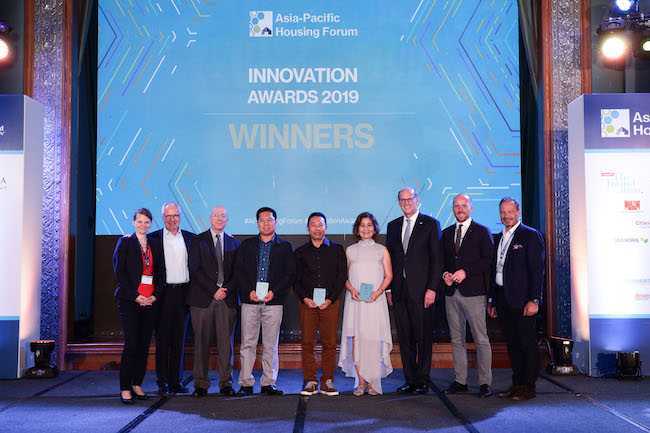
“The recognition allowed us to expand our circle of influence, created more awareness about our advocacy in the community and open more opportunities to help others,” said Paulette Liu, president of SKILLS and a 2019 Innovation Awards winner.

The Innovation Awards (visit aphousingforum.org/innovation-awards) underscores the importance of strategic collaboration, specifically by multiple sector partnerships that foster innovations. The Awards are organized by Habitat for Humanity in collaboration with the Hilti Foundation, Whirlpool and the European Union-funded SWITCH-Asia SCP Facility.

There are three award categories: ShelterTech, Public Policies, and Inspirational Practices. The ShelterTech category seeks technology innovations (product & services) led by the private sector; while the Policies category promotes innovative public policies across all government levels to help reduce the housing deficit while taking into consideration specific needs of minorities, vulnerable and marginalized populations. The third category recognizes practices from public or public-private partnerships that contribute to improved communities and settlements and increased access to affordable housing for the most disadvantaged segments of society.

A special Sustainability Award, sponsored by the SWITCH-Asia SCP Facility, will be given to the innovator who will score highest in showcasing scalable solutions for sustainable housing, regardless of the category. The EU and its SWITCH-Asia Programme recognize the critical importance of the housing sector to sustainable consumption and production, and promote sustainable housing and buildings as part of their support for green, circular economies in its 24 target countries in Asia.

“For Asian countries to achieve more sustainable consumption and production in the housing and building sector, it is vital that we heed diverse experiences and adapt these to local realities. The SCP Award will showcase one solution that is particularly inspiring, and we are looking forward to supporting its winner in connecting with EU SWITCH-Asia stakeholders,” said Zaida Fadeeva, Team Leader of the SCP Facility.

The top 12 finalists will get to present their ideas in front of a jury panel and the public during the virtual Innovation Awards Grand Premiere on December 1. Winners will be announced on December 8, 2021 during the Asia-Pacific Housing Forum. Each winner will receive a trophy and a US$ 5,000 cash prize. Deadline for submission is September 12, 2021.

The Forum, with the theme “Building forward better for inclusive housing,” includes program tracks on resilient cities and communities, innovative housing solutions and technologies, sustainability in the housing sector, and financing affordable housing. It includes a training course on land tenure and markets and a youth congress that will highlight the need for decent, affordable housing and the ways in which the youth can contribute to addressing the housing challenge.

Register for complimentary access to the fully virtual Asia-Pacific Housing Forum at aphousingforum.org.

About Habitat for Humanity

Driven by the vision that everyone needs a decent place to live, Habitat for Humanity began in 1976 as a grassroots effort and has since grown to become a leading global nonprofit working in more than 70 countries. In the Asia Pacific region since 1983, Habitat for Humanity has supported millions of people to build or improve a place they can call home. Through financial support, volunteering or adding a voice to support affordable housing, everyone can help families achieve the strength, stability and self-reliance they need to build better lives for themselves. To learn more, donate or volunteer, visit habitat.org/asiapacific

About EU SWITCH-Asia Programme

Launched in 2007, the SWITCH-Asia programme is the largest European Union-funded programme promoting Sustainable Consumption and Production (SCP) supporting 24 countries in Asia and Central Asia. The programme has funded around 130 projects, supporting over 500 Asian and European non-for-profit partners, about 100 private sector associations and 80.000 Asian MSMEs. The SCP Facility, one of SWITCH-Asia Components, aims at strengthening the implementation of SCP policies at the national level, facilitating the coordination of all components of the programme through information sharing. In addition, it carries out analyses on the results of the pilot projects and supports dialogue with stakeholders.

The EU and its SWITCH-Asia programme have recognised the critical importance of the housing sector to sustainable consumption and production or SCP, and the construction, housing and buildings cluster is a major pillar of EU policy and SWITCH-Asia activities. It is highlighted as part of the green transition in the flagship EU Green Deal (2019) and the Circular Economy Action Plan (2020). To stimulate further green innovations, the EU has also put forward legislation including its Construction Products Regulation. As the housing and building stock in Europe is not expected to grow as dynamically as in Asia, one of the focus areas for the EU is the renovation of existing buildings for increased energy efficiency, through its “Renovation Wave” strategy (2020), which prioritises social housing. In the SWITCH-Asia programme, several national assignments focus on implementing SCP principles in the buildings sector, including in Pakistan, Bangladesh and Kyrgyzstan.

Media contact:
Maetavarin Maneekulpan
+66-2260-5820
mae@tqpr.com

Habitat for Humanity’s ShelterTech accelerator ends with bold vision for affordable housing

A Global Summit held on July 14 topped off Habitat for Humanity‘s ShelterTech accelerator in Southeast Asia, the 10 startups pitched their work and progress to date, while investors and ecosystem partners wrapped with a critical reflection on innovation in affordable housing markets today. Launched in 2017 with accelerator programs in Mexico, India and Kenya, ShelterTech has grown into a global platform connecting ideas, products and services in affordable housing, with a special focus on solutions that work in a COVID-19 context. ShelterTech aims to make affordable housing a top impact investment category.

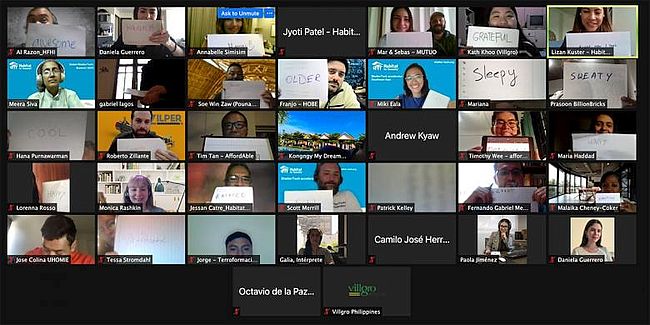
Ten SE Asian startups pitched their housing solutions following seven months of support and mentorship by leaders in the technology and impact investment sectors. Hosted by Villgro Philippines & Global Urban Village, 7/14/21. (Habitat.org)

Startups from Cambodia, Indonesia, Malaysia, Myanmar, the Philippines and Singapore were selected for the program in late-2020. In addition to an initial catalytic grant of US$10,000, the ventures completed a seven-month acceleration process, which included learning laboratories, masterclasses on housing and business topics, dialogues with regional investors and one-on-one mentorship with experts from global corporations including Hilti, Dow and Autodesk.

During the pitches, the startups recounted their growth journey since joining ShelterTech and their plans to bring affordable housing products and services to millions of low-income families in the region.

CUBO Modular, which is based in the Philippines and manufactures modular homes out of bamboo, has sold out units of their award-winning homes for the remainder of the year. Sampangan’s proprietary “magic box” turns waste into activated carbon which is used to create building materials. This Indonesian startup secured new contracts with the government and is now the largest startup in Indonesia to create more long-lasting products out of waste materials.

“ShelterTech works across sectors, industries and geographies to bring together the most impactful and cutting-edge innovations, to improve housing conditions for low-income families across the globe. We chose 10 startups in the Southeast Asia cohort because we believe they will make significant contributions to addressing the global housing deficit,” said Jonathan Reckford, CEO of Habitat for Humanity, at the opening of the Summit. Launched in Southeast Asia in July 2020, the accelerator attracted more than 100 ventures, vying for a chance to be part of the world’s leading platform for affordable housing innovation.

Reckford’s message was echoed by Marco Meyrat, chairman of the Hilti Foundation board of directors, who said “ShelterTech puts housing entrepreneurs at the centre of a highly connected ecosystem, and collaborators who share a passion for revolutionary solutions in affordable housing. This is well-aligned with the Hilti Foundation’s commitment to helping identify and catalyze innovative technologies for housing that lay the groundwork for a better future.”

Following the Global Summit on July 14, ShelterTech will continue to provide recognition and growth opportunities to startups, while developing its close-knit ecosystem of ventures and partners including national and regional accelerators, in fields including PropTech and smart cities, integrating affordable housing tracks into these programs. To date, ShelterTech has supported more than 60 startups and scaleups worldwide.

ShelterTech is supported by a network of key partners, including Autodesk Foundation, Dow, the Hilti Foundation and the Keith V. Kiernan Foundation, while the Southeast Asian accelerator was run from Manila in partnership with Villgro Philippines and Global Urban Village.

About ShelterTech
ShelterTech is a global innovation platform advancing entrepreneurial housing solutions that radically improve the lives of low-income families. Supported by Habitat’s Terwilliger Center for Innovation in Shelter and its partners, ShelterTech puts entrepreneurs at the center of a highly connected ecosystem of mentors, investors, peers, alumni and technical experts who share a passion for revolutionary ideas in affordable housing. For more information and opportunities, visit www.habitat.org/sheltertech.

About Terwilliger Center for Innovation in Shelter
The Terwilliger Center for Innovation in Shelter, a unit of Habitat for Humanity International, works with housing market actors to expand innovative and client-responsive services, products and financing, so that households can improve their shelter more effectively and efficiently. The goal of the Terwilliger Center is making housing markets work more effectively for people in need of decent, affordable shelter, thereby improving the quality of life for low-income households. To learn more, visit www.habitat.org/tcis.

About Habitat for Humanity
Driven by the vision that everyone needs a decent place to live, Habitat for Humanity began in 1976 as a grassroots effort on an interracial community farm in the U.S.A., and has grown to become a leading global nonprofit, working across 70 countries. In Asia-Pacific since 1983, Habitat for Humanity has supported millions of people to build or improve a place they can call home. Through financial support, volunteering or adding a voice to support affordable housing, everyone can help families achieve the strength, stability and self-reliance they need to build better lives for themselves. To learn more, donate or volunteer, visit www.habitat.org/asiapacific.

Notes to Editors:
For interviews, photos or additional information, contact Rutuja Powle, +91 7718089122, rpowle@habitat.org or Michele Soh, +65 92331544, msoh@habitat.org.

Habitat for Humanity’s regional ShelterTech accelerator concludes with a bold vision for the affordable housing sector

A Global Summit celebrated the conclusion of Habitat for Humanity‘s ShelterTech accelerator in Southeast Asia, where the ten startups presented their work and progress to date, followed reflection by investors and ecosystem partners on why innovation in affordable housing market is critical. First launched in 2017 with accelerator programs in Mexico, India and Kenya, ShelterTech has grown into a global platform to connect innovating ideas, products and services in affordable housing, with special focus on solutions that work in the context of the COVID-19 pandemic. ShelterTech aims to make housing a top impact investment category.

“ShelterTech works across sectors, industries and geographies to bring together the most impactful and cutting-edge innovations improving housing conditions for low-income families across the globe. We chose the ten startups in the Southeast Asia cohort because we believe they will make significant contributions to addressing the global housing deficit,” said Jonathan Reckford, CEO of Habitat for Humanity, at the opening of the Summit. Launched in Southeast Asia in July 2020, the accelerator attracted more than 100 ventures, vying for a chance to be part of the world’s leading platform for affordable housing innovation.

Startups from Cambodia, Indonesia, Malaysia, Myanmar, Philippines and Singapore were selected for the program in late-2020. In addition to an initial catalytic grant of US$10,000, the ventures completed a seven-month acceleration process, which included learning laboratories, masterclasses on housing and business topics, dialogues with regional investors and one-on-one mentorship with seasoned experts from global corporations including Hilti, Dow and Autodesk.

During the pitches, startups recounted their growth journey since joining ShelterTech and their plans to bring affordable housing products and services to millions of low-income families in the region. CUBO Modular, which is based in the Philippines and manufactures modular homes out of bamboo, has sold out all units of their award-winning homes for the remainder of the year. Sampangan’s proprietary “magic box” turns waste into activated carbon, which is used to create building materials. The Indonesian startup recently secured new contracts with governments and the largest startup in Indonesia to create more long-lasting products out of waste materials.

Following the Global Summit, ShelterTech will continue to provide recognition and growth opportunities to startups, while developing its close-knit ecosystem of ventures and partners. The platform will also partner with other national and regional accelerators, in fields such as PropTech and smart cities, to integrate an affordable housing track to their programs.

A corresponding accelerator and Summit also took place in the Andean region of South America. In total, ShelterTech has supported over 60 startups and scaleups worldwide to date. In Southeast Asia, the accelerator was run in partnership with Villgro Philippines and Global Urban Village.

About ShelterTech

ShelterTech is a global innovation platform advancing entrepreneurial housing solutions that radically improve the lives of low-income families. Supported by Habitat’s Terwilliger Center for Innovation in Shelter and its partners, ShelterTech puts entrepreneurs at the center of a highly connected ecosystem of mentors, investors, peers, alumni and technical experts who share a passion for revolutionary ideas in affordable housing. For more information and opportunities, visit shelter-tech.org.

About Habitat’s Terwilliger Center for Innovation in Shelter

The Terwilliger Center for Innovation in Shelter, a unit of Habitat for Humanity International, works with housing market actors to expand innovative and client-responsive services, products and financing so that households can improve their shelter more effectively and efficiently. The goal of the Terwilliger Center is to make housing markets work more effectively for people in need of decent, affordable shelter, thereby improving the quality of life for low-income households. To learn more, visit habitat.org/tcis

About Habitat for Humanity

Driven by the vision that everyone needs a decent place to live, Habitat for Humanity began in 1976 as a grassroots effort on an interracial community farm in the U.S.A. and has since grown to become a leading global nonprofit working in more than 70 countries. In the Asia-Pacific region since 1983, Habitat for Humanity has supported millions of people to build or improve a place they can call home. Through financial support, volunteering or adding a voice to support affordable housing, everyone can help families achieve the strength, stability and self-reliance they need to build better lives for themselves. To learn more, donate or volunteer, visit habitat.org/asiapacific.

Notes to Editors:
To set up interviews, receive photos or gain additional information, please contact Rutuja Powle, Tel: +91 7718089122, rpowle@habitat.org or Michele Soh, +65 92331544, msoh@habitat.org.

UN youth envoy to open volunteer conference supporting Habitat for Humanity’s COVID-19 response

The United Nations Secretary-General’s Envoy for Youth, Jayathma Wickramanayake, will deliver the opening remarks during the “Youth from Home for Homes” virtual conference, the peak of the 2021 Habitat for Humanity Young Leaders Build campaign. Over a hundred youth from the Asia-Pacific region have registered for the event, which also marks a decade of youth volunteerism for the cause of safe, affordable housing.

“Young people are the backbone of society, and our only hope in creating a better world and a better future for all. But youth cannot do it alone. It is pivotal that young people be included as full-fledged partners in all decision and policy-making that affects their lives and futures, including SDG 11, target 1 on access for all to adequate, safe and affordable housing and basic services,” said Wickramanayake.

Joining the UN youth envoy for the conference on April 24 are young leaders who will present highlights from their community-based projects in support of Habitat’s work during the pandemic. These include raising funds to build core houses in Sri Lanka and advocating for affordable housing among local government officials in the Philippines.

“Many in our community lost their jobs and livelihoods but we want to support our community and keep it healthy during the pandemic,” said Kim Claire Darugo, a Filipino volunteer. A member of Pasig 1 Community Youth Group, which is active in a neighborhood that Habitat helped build, she and her fellow volunteers are raising funds for hygiene kits to be donated to families in vulnerable situations in the Philippines.

Almost seventy volunteers from ten countries have started to implement multi-month projects under the Young Leaders Build campaign. The volunteers comprise of university students, young professionals and youth with vocations.

“We see young people negatively impacted by Covid-19 especially in the areas of education, opportunities and social contacts. In these unprecedented times of economic and social distress, I am inspired by the resilience of these 70 young leaders who have responded to the challenge to support Habitat’s vision of a world where everyone has a decent place to live,” said Luis Noda, Vice-President for Asia-Pacific, Habitat for Humanity International.

Other volunteer-led projects include providing cash and in-kind assistance for families in need to repair or build safe, healthy homes and the construction of community facilities such as handwash stations, solar lighting and urban gardens. Volunteers also plan to train other youth and their families on ways to protect their household from the coronavirus, promote mental health, and facilitate learning from home.

Since 2012, more than 17 million Habitat Young Leaders Build supporters have raised almost US$9 million to help more than 33,000 families achieve the strength, stability and self-reliance they need to build better lives for themselves. While the 2021 campaign peaks in April, the momentum will continue as youth groups and volunteers will continue their projects until 2022.

About Habitat for Humanity Young Leaders Build

Habitat for Humanity Young Leaders Build brings together youth from across the Asia Pacific region to support people and families in need of decent housing. Every young person volunteering, fundraising, raising awareness and adding their voices in support of affordable housing can help families achieve the strength, stability and self-reliance they need to build better lives for themselves. The movement encourages youth to take the lead and motivate their peers to create societal changes by building homes and communities, on a Habitat build site and/or online through their social networks.

About Habitat for Humanity

Driven by the vision that everyone needs a decent place to live, Habitat for Humanity began in 1976 as a grassroots effort. The Christian housing organization has since grown to become a leading global nonprofit working in more than 70 countries. In the Asia-Pacific region since 1983, Habitat for Humanity has supported millions of people to build or improve a place they can call home. Through financial support, volunteering or adding a voice to support affordable housing, everyone can help families achieve the strength, stability and self-reliance they need to build better lives for themselves. Through shelter, we empower. To learn more, donate or volunteer, visit habitat.org/ap.

For further information, please contact Ms. Angeli Alba-Pascual, AAlba@habitat.org, +63 920 956 3376, or Ms. Rona Azucena, RAzucena@habitat.org, +63 916 545 8310.

Register for the virtual conference on Aug 24, 11:30 a.m. SGT at https://bit.ly/YouthfromHome.

At a time when a safe and healthy home has never been more important, Habitat for Humanity serves 5.9 million more people through new or improved housing

A safe, decent, and healthy home has been the first line of defense for families around the globe during the COVID-19 pandemic. Thanks to the work of Habitat for Humanity, more than 5.9 million people accessed better housing in the last year, according to the global nonprofit’s fiscal year 2020 annual report released today. In Asia and the Pacific region, Habitat has helped more than 1.9 million people have access to better housing.

The report highlights how the organization addressed the need for safe, decent and affordable shelter worldwide, under mounting headwinds from the pandemic that restricted some of the ways Habitat traditionally executes its mission.

With many of the organization’s usual activities affected by the spread of COVID-19 over the course of the fiscal year (July 1, 2019 – June 30, 2020), its affiliated organizations in more than 70 countries and 1,100 communities across the United States found ways to adapt and continue serving.

“While this year has brought many challenges and heartaches to communities we serve across the world, I’m grateful that Habitat has had an opportunity to serve so many families when they needed it most,” said Jonathan T.M. Reckford, CEO of Habitat for Humanity International. “At Habitat, we are religious about our principles, but not about our tactics. I’ve been inspired by the ingenuity and flexibility of Habitat organizations around the world who quickly adapted to the crisis and built new strategies to carry out our mission. We are clear-eyed that the future will bring more headwinds, but I know that the people who enable our mission — our donors, staff, volunteers, advocates and the people we serve — are as dedicated as ever to our vision of a world where everyone has a decent place to live.”

While the COVID-19 pandemic greatly curtailed traditional volunteer experiences, with build sites largely closed to general volunteers since February, Habitat still benefited from the hands and hearts of nearly 1 million volunteers before the shutdowns began.

In the fiscal year 2020, Habitat for Humanity International reported US$287 million in revenue, along with an estimated US$2.3 billion in total revenue through the organization’s federated network in the U.S. and around the world. Program spending at Habitat for Humanity International accounted for 74% of total expenses, including the distribution of US$193 million in cash and donated product to Habitat organizations.

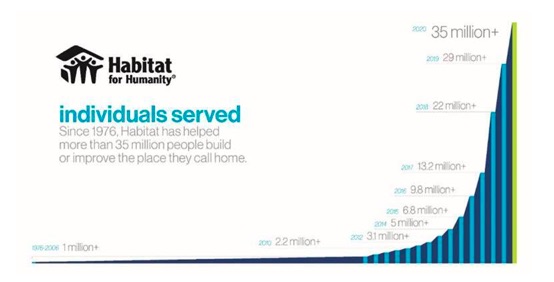
The 5.9 million people who accessed new or improved housing through new home construction, rehabilitation, incremental improvements and repairs helped the organization reach the milestone of 35 million people served since its founding in 1976.

Description automatically generated

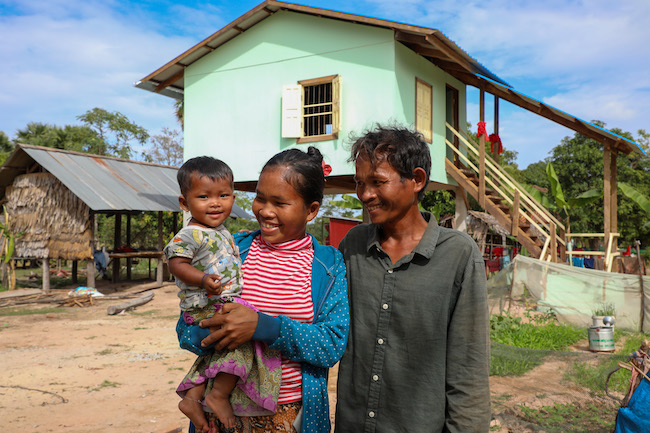
Habitat views access to safe, decent, and affordable housing as the cornerstone of strong, thriving communities. Senghouch, Cheat, and their two young children are among the many families served by Habitat’s global network. Senghouch’s family built a new home with the help of Habitat for Humanity Cambodia. Living in a small village in Khsach Kandal district, Cambodia, Senghouch is now able to work comfortably on her weaving loom inside her home to earn more income for the family’s daily expenses. The training in water, sanitation, and hygiene practices conducted by Habitat has also helped to improve the children’s overall health.

In fiscal year 2020, Habitat continued to enable access to better housing for millions through its Terwilliger Center for Innovation in Shelter. To address the impacts of COVID-19, the Center developed nearly 40 activities, from issuing small grants to shelter-related innovators to prototyping temporary shelter concepts.

Habitat’s impact is felt well beyond the individuals that it serves. Habitat’s work promotes and drives social and economic outcomes by stimulating other sectors of the economy through spending and job creation associated with home construction, renovation, and repair.

Findings from a recent Habitat report determined that emerging economies that have been struggling to recover from the COVID-19 pandemic may be significantly underestimating their housing sector’s contribution to the gross domestic product of a country. The report, titled Cornerstone of Recovery: How Housing Can Help Emerging Market Economies Rebound from COVID-19, found that inclusive financial interventions in the housing sector can stimulate economies while also improving the wellbeing of families through healthier housing conditions.

Habitat is continuing its work in the face of growing need. Even before the pandemic, more than 1.6 billion people globally lack adequate shelter. The economic impact of COVID-19 has substantially increased the number of people struggling with the impossible choice of covering the cost of housing and other basic needs, like food, water, heat, and health care.

“These are our friends, our family and our neighbors, who now more than ever, could use the hand up that we can offer,” Reckford said. “The pandemic may have spread us apart physically, but we have never been more united it our work to build strength through shelter.”

To learn more and to read the full 2020 annual report, visit habitat.org/multimedia/annual-report-2020.

Note to Editor:
To set up an interview, receive photos or for further information, contact Michele Soh MSoh@habitat.org, +65 9233 1544 or Rona Azucena, RAzucena@habitat.org.

About Habitat for Humanity

Driven by the vision that everyone needs a decent place to live, Habitat for Humanity began in 1976 as a grassroots effort and has since grown to become a leading global nonprofit working in more than 70 countries. In the Asia-Pacific region since 1983, Habitat for Humanity has supported millions of people to build or improve a place they can call home. Through financial support, volunteering or adding a voice to support affordable housing, everyone can help families achieve the strength, stability and self-reliance they need to build better lives for themselves. To learn more, donate or volunteer, visit habitat.org/asiapacific.