
Let the robot swarms begin!

Scientists are looking for ways to make millions of molecule-sized robots swarm together so they can perform multiple tasks simultaneously.

Scientists have devised a new method of using DNA to control molecular robots. Molecules swarm like a flock of birds, showing different patterns of movement when this method is applied. (Copyright: Hokkaido University)

Multi-disciplinary research has led to the innovative fabrication of molecule-sized robots. Scientists are now advancing their efforts to make these robots interact and work together in the millions, explains a review in the journal Science and Technology of Advanced Materials.

“Molecular robots are expected to greatly contribute to the emergence of a new dimension in chemical synthesis, molecular manufacturing, and artificial intelligence,” writes Hokkaido University physical chemist Dr. Akira Kakugo and his colleagues in their review.

Rapid progress has been made in recent years to build these tiny machines, thanks to supramolecular chemists, chemical and biomolecular engineers, and nanotechnologies, among others, working closely together. But one area that still needs improvement is controlling the movements of swarms of molecular robots, so they can perform multiple tasks simultaneously.

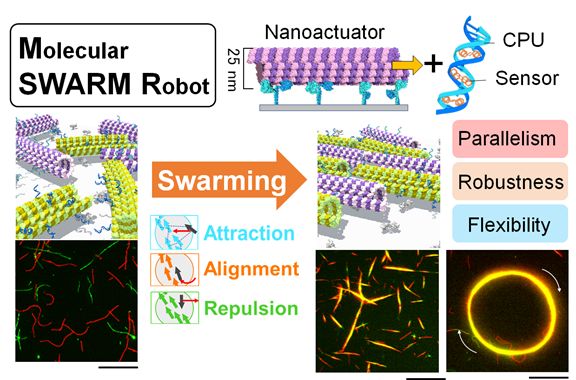
Towards this end, researchers have made molecular robots with three key components: microtubules, single-stranded DNA, and a light-sensing chemical compound. The microtubules act as the molecular robot’s motor, converting chemical energy into mechanical work. The DNA strands act as the information processor due to its incredible ability to store data and perform multiple functions simultaneously. The chemical compound, azobenzene derivative, is able to sense light, acting as the molecular robot’s on/off switch.

Scientists have made huge moving ‘swarms’ of these molecular robots by utilizing DNA’s ability to transmit and receive information to coordinate interactions between individual robots. See the video below.

Scientists have successfully controlled the shape of those swarms by tuning the length and rigidity of the microtubules. Relatively stiff robots swarm in uni-directional, linear bundles, while more flexible ones form rotating, ring-shaped swarms.

A continuing challenge, though, is making separate groups of robots swarm at the same time, but in different patterns. This is needed to perform multiple tasks simultaneously. One group of scientists achieved this by designing one DNA signal for rigid robots, sending them into a unidirectional bundle-shaped swarm, and another DNA signal for flexible robots, which simultaneously rotated together in a ring-shaped swarm.

Light-sensing azobenzene has also been used to turn swarms off and on. DNA translates information from azobenzene when it senses ultraviolet light, turning a swarm off. When the azobenzene senses visible light, the swarm is switched back to on state.

“Robot sizes have been scaled down from centimeters to nanometers, and the number of robots participating in a swarm has increased from 1,000 to millions,” write the researchers. Further optimization is still necessary, however, to improve the processing, storing and transmitting of information. Also, issues related to energy efficiency and reusability, in addition to improving the lifetime of molecular robots, still need to be addressed.

Further information

Akira Kakugo
Hokkaido University
kakugo@sci.hokudai.ac.jp
Paper: https://doi.org/10.1080/14686996.2020.1761761

About Science and Technology of Advanced Materials Journal

Open access journal STAM publishes outstanding research articles across all aspects of materials science, including functional and structural materials, theoretical analyses, and properties of materials.
Chikashi Nishimura
STAM Publishing Director
NISHIMURA.Chikashi@nims.go.jp
Image and caption:

A molecular robot, which is typically between 100 nanometers to 100 micrometers long, requires an actuator, processor and sensor to function properly. By fine-tuning their mutual interactions, millions of robots can move together in swarms that are much bigger in size than a single robot, offering several advantages. Scale bar: 20 μm. (Copyright: Akira Kakugo)

Press release distributed by ResearchSEA for Science and Technology of Advanced Materials.

Nili Method and APP helping Couples Choose Baby Gender Naturally

Nili Method (www.nilimethod.com), the easy, natural, and safe way to conceive the baby gender that parents wish for, with its new Family Planner, is now available at Google Play and App Store. Determining the gender of your baby is possible, and now, with the Nili method and new App, it is more accessible than ever.

Nili is a method that personalizes a unique day by day program for couples who want to conceive the gender they are wishing for. The personal Nili Family Planner is based on physical parameters and lifestyle, and will provide couples with daily instruction on how to conceive their desired baby boy or baby girl.

Family planning is one of the most significant decisions in life. The Nili Family Planner assists couples on this journey and supports them in the choice of the natural way. Thanks to latest technology, with an accumulation of world best research performed by physicians around the world, it is no longer required to go through a tiresome and expensive process.

And the Nili method and the new Nili Family Planner offer a full money back guarantee. Couples that use the Nili Family Planner and do not conceive their desired gender will receive their money back, without any questions. We have already helped thousands of people all over the world. And now it’s your turn to make your dream come true.

People that had doubts beforehand are happy parents today. They follow our gender selection program and give birth to a child of their wished gender. We are so sure about the results that we say, If the method doesn’t work with you, we’ll return your money. It is reliable, affordable and easy to use. So, why not try?

Contact: Jeniffer Hamilton
office@media-group-international.com
www.media-group-international.com
http://www.nilimethod.com/home/
http://www.nili-family-planner.com

TCL: Smarter Connectivity Helps Improve Stay-at-Home Work and Life

Increased global demand for home working and education has led to a surge in consumer expectations towards the quality of their home networks, and in areas where fixed networks are not available, mobile networks are alleviating user’s needs for fast and convenient coverage. Many mainstream global operators have lifted certain data restrictions on 4G traffic for users, and are providing employees and users with more reliable choices for smart connected products. Whether it’s online workspaces, meeting facilities, classrooms, entertainment, or communications with friends and family, uninterrupted network coverage without dead zones has become a basic need for millions, if not billions of people around the world.

According to data from TSR Research, global shipments of smart connected products will continue to grow in the next four years. Operator orders almost dominate the shipments of this category. As a world-leading mobile terminal manufacturer, TCL Communication has long-standing partnerships with 140 global operators and channel partners, including the likes of EE, BT, T-mobile, Orange, Optus, TIM and others. These partnerships have helped drive significant growth in its smart connectivity business, including MiFi devices. Taking Alcatel Linkzone as an example, the pocket-sized, high-speed mobile wireless hotspot device converts mobile service into high-speed broadband, enabling households without fixed broadband services to maintain high-speed connections at home. Overall, TCL expects shipments of smart connected devices in the second quarter of this year to be double that of previous forecasts.

TCL Communication has provided mobile connectivity around the world through the operation of its two main global brands – Alcatel and TCL. Its smart connection business first began in 2008, and in September 2018, it officially promoted its Smart Connectivity Division to a higher strategic level, adopting AI x IoT as a central strategy to deliver on its ambition to provide safe and healthy products for its global users, which it achieves through a focus on home and mobile usage occasions. At present, TCL’s smart connection products cover a wide range of categories, including Wi-Fi routers, mesh routers, MiFi devices, car module devices, children’s smart watches, headphones, luggage/personal belongings trackers and pet trackers. When working in tandem, together with TCL’s mobile phones, tablets, TVs and home appliances, these devices can combine to create an ecosystem of smart connectivity.

“As a global manufacturer offering a fully integrated ecosystem of smart products that cover virtually every aspect of our life, TCL has long been focusing on the health and safety of our end-users when developing our Smart Connectivity Devices,” said Sharon Xiao, General Manager of Smart Connectivity Division at TCL Communication. “With the sudden and rapid onset of the current pandemic, these two needs have never been more important as people continue to spend most of their work and leisure time at home. In such difficult circumstances, smart connectivity technology has been helping to make our lives that bit easier and more efficient.”

TCL has added many health and safety features to its products, especially products designed for children and families. All TCL Wi-Fi routers for example allow parents to control the time during which their children can access the internet and the websites they have access to. TCL’s smart watch for kids, the MOVETIME Family Watch MT43K, enables parents to monitor their children’s location, receive instant notifications when their children exit a preset safe zone or when they push the SOS button, and establish immediate contact through the watch’s hands-free, 4G two-way calling and voice messaging functions. In addition to a daily activity tracker that counts steps, calories burned and distance walked, TCL is planning to add a thermometer to its next model of smart watches for kids. The thermometer will constantly monitor the child’s temperature and send an alert to parents if the temperature strays outside a normal range. Children will also benefit from TCL’s soon-to-be-released headphones, which protect hearing by limiting the output volume to a maximum of 85dB – the highest permissible sound level recommended by the WHO for sustained sound exposure of up to 8 hours per day.

Sharon Xiao said, “TCL Communication’s existing footprint in Smart Connectivity Devices has allowed us to step up to the plate and do our part to help millions of families cope during these difficult times. We have a clear vision on how smart connection devices create better living spaces, and we will continue to further explore how our design-led strategy can help to improve the health and safety of our consumers, both now and in the future.”

ABOUT TCL
TCL is one of the world’s fastest-growing consumer electronics companies, and a global leading television and mobile device brand. Incorporated in Hong Kong, China. TCL operates its own manufacturing and R&D centers worldwide with products sold in more than 160 countries throughout North America, Latin America, Europe, the Middle East, Africa and Asia Pacific. TCL specializes in the research, development and manufacturing of consumer electronics ranging from TVs (TCL Electronics: 1070.HK), mobile phones, audio devices and smart home products.

TCL is a registered trademark of TCL Technology Group Corporation (000100.SZ). All other trademarks are the property of their respective owners.

For more information, please visit http://www.tcl.com/global/en.html.