Do four walls and a desk make an office — apparently not!
The pandemic has led to the greatest debate of all time – do people even need an office and if so, what do they want? Today, The Executive Centre (TEC), the leading premium flexible workspace provider across Asia Pacific and the Middle East, launches the “What Is An Office” campaign, which examines the elements that make up a dynamic, productive workspace.
The campaign consists of a brand video, plus 4 product videos that examines how the workforce views the role of an office and asks the central question, “What Is An Office?” The short films explore how a positive working environment and agile working practices can help business operations, shedding light on the fundamental importance of a multi-purpose office to a company’s success.
“The break from office has pushed people to reconsider what they require to create a positive working environment. People are waking up to the fact that an office should be more than four walls around a desk. — It is a space which fosters collaboration, communication and creativity,” said Paul Salnikow, TEC Founder and CEO. “While human interaction proves to be crucial for work and life, people are also keen to enjoy variety in work options, the future of work is shifting from purely remote to a hybrid model. Flexibility is key in future workplace strategies because choice has become an invaluable asset; people want to choose to access workstations, meeting rooms and breakout areas when they need it, and corporations are realising that incorporating a flexible element can also positively impact their bottom line.”
TEC has found that the need for more flexible lease terms, robust technological infrastructure and internet connectivity for virtual get-togethers, as well as spacious event venues to host socially distanced conferences, and even on-demand passes to support their remote working teams has dramatically increased in the last year.
A whitepaper report will also be released for free public download on the campaign website that looks into the history and future trends of office development, plus TEC’s approach to office design strategy.
About The Executive Centre The Executive Centre (TEC) opened its doors in Hong Kong in 1994 and today boasts over 150+ Centres in 32 cities and 14 markets.
The Executive Centre caters to ambitious professionals and industry leaders looking for more than just an office space — they are looking for a place for their organisation to thrive. TEC has cultivated an environment designed for success with a global network spanning Greater China, Southeast Asia, North Asia, India, Sri Lanka, the Middle East, and Australia, with sights to go further and grow faster. Each Executive Centre offers a prestigious address with the advanced infrastructure to pre-empt, meet, and exceed the needs of its Members. Walking with Members through every milestone and achievement, The Executive Centre empowers ambitious professionals and organisations to succeed.
Privately owned and headquartered in Hong Kong, TEC provides first class Private and Shared Workspaces, Business Concierge Services, and Meeting & Conference facilities to suit any business needs.
Trintech, a leading global provider of integrated Record to Report software solutions for the office of finance, today announced several key product enhancements to help large enterprises reduce the time spent on tasks and drive greater efficiencies in their month-end workflows.
“As our customers continue to focus on agility and sustainability during this time, the enhancements we have made in our solutions deliver greater control, enhanced visibility, increased efficiencies and certainty of accurate financial reporting that our large enterprise customers demand,” said Michael Ross, Chief Product Officer at Trintech.
With the latest release of Trintech’s Cadency Platform, finance and accounting professionals can elevate their financial automation with highly configurable and transparent workflows, integrated connector enhancements, and extended scalability and automation with new Smart Bots and ERP Bot enhancements. Leading Enterprises will benefit from the following:
– Greater efficiencies gained in the reconciliation process – Additional automation capabilities to reduce the time to close – Enhanced integration between Record to Report (R2R) processes to improve the overall experience – Enhanced Bot functionality that drives deep automation and reduces administration burdens to refocus time and effort on higher value-added activities
In addition, the Cadency user experience provides intuitive, easy-to-use, standardized functionality that drives greater efficiencies throughout the finance and accounting team’s daily workflow.
Managing and performing transaction matching and account reconciliations are a cornerstone of the month-end close, and when done inefficiently, can be a very time-consuming and risk prone process. To help finance & accounting teams further reduce the time and risk in this process, Trintech has extended the automation capabilities between Cadency Match and Reconciliation Certify by leveraging leading technologies, such as Risk Intelligent RPA(TM) to reduce the number of accounts needing manual reconciliation, reduce the workload for end users and administrators and allow for a faster and more efficient month-end close.
In addition, Trintech has introduced Cadency Smart Bots so finance & accounting teams can benefit from purpose-built Bot capabilities that allow not only automation of repetitive manual tasks but also complete Record to Report (R2R) activities including the ability to:
– Prepare account reconciliations using files or data from external data repositories or email inboxes and attaching any supporting documents leveraging Cadency Reconciliation Certify – Post Journals using data or files from external data repositories or email inboxes, along with any necessary back-up documentation leveraging Cadency Journal Entry – Close tasks corresponding to Journal Entry postings, Account Reconciliations, etc. directly in Cadency Close.
About Trintech
Trintech Inc., a pioneer of Financial Corporate Performance Management (FCPM) software, combines unmatched technical and financial expertise to create innovative, cloud-based software solutions that deliver world-class financial operations and insights. From high volume transaction matching and streamlining daily operational reconciliations, to automating and managing balance sheet reconciliations, intercompany accounting, journal entries, disclosure reporting and bank fee analysis, to governance, risk and compliance – Trintech’s portfolio of financial solutions, including Cadency(R) Platform, Adra(R) Suite, and targeted tools, ReconNET(TM), T-Recs(R), and UPCS(R), help manage all aspects of the financial close process. Over 3,500 clients worldwide – including the majority of the Fortune 100 – rely on the company’s cloud-based software to continuously improve the efficiency, reliability, and strategic insights of their financial operations.
Headquartered in Dallas, Texas, Trintech has offices located across the United States, United Kingdom, Australia, Singapore, France, Ireland, the Netherlands and the Nordics, as well as strategic partners in South Africa, Latin America and Asia Pacific. To learn more about Trintech, visit www.trintech.com or connect with us on LinkedIn, Facebook and Twitter.
To help returning overseas students find jobs, and provide an entrepreneurial environment free of worries, Hangcheng, Bao’an District, Shenzhen established the Hangcheng GBA Youth Entrepreneurship (Employment) Camp. [10/27/20]
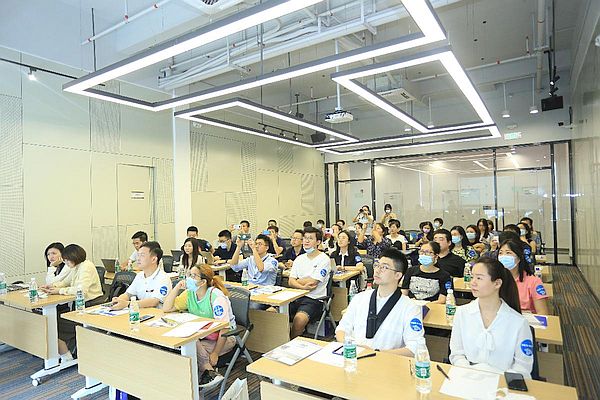
The Greater Bay Area / GBA Youth Entrepreneurship (Employment) Camp, open for only three months, proudly announces success in helping overseas students find jobs and start their own businesses. More than 50 job seekers and entrepreneurs have joined the Camp for consultation and classes, while 16 entrepreneurial teams have settled in. The Camp held activities during this first quarter, talent, entrepreneurship and policy meetings, lectures on intellectual property (IP) and legal ownership, and courses to help prepare graduates and resident teams to solve issues they will encounter as entrepreneurs. At the same time, Hangcheng GBA Youth Entrepreneurship (Employment) Camp has published articles addressing policies, questions and apprehensions, empowering overseas students returnees.
The Coronavirus outbreak of 2020 brought challenges to all countries; an International Labor Organization survey suggested that one-sixth of the world’s young people remain unemployed. The pandemic isn’t subsiding, and entrepreneurship and employment are tested to their limits. The employment situation for overseas students is even more worrying: these students cannot return to China and can only stay abroad; all the major enterprises have laid-off workers or reduced their salaries, making it difficult for the most competitive international students to find jobs, or face unemployment. The pandemic has impacted the original supply chain and capital chain for entrepreneurs, dealing many entrepreneurial teams fatal blows.
To reverse the social impact of the epidemic, the Chinese government has made employment and entrepreneurship a major task over this and the next few years. Various parts of China have issued favorable policies on employment and entrepreneurship, tried every possible means to stabilize and expand employment, and actively supported the masses’ Entrepreneurship and innovation. In terms of talent recruitment, Shenzhen Special Economic Zone has been at the forefront of the country. To help returning overseas students find jobs, and provide an entrepreneurial environment free of worries for returnees, the Hangcheng Sub-district, Bao’an District, Shenzhen, established the Hangcheng GBA Youth Entrepreneurship (Employment) Camp.
Bao’an District of Shenzhen is the heartland of the Guangdong-Hong Kong-Macao Greater Bay Area, close to the airport wharf and Bao’an International Airport. Bao’an is an important place of industry and innovation in Shenzhen and Guangdong Province. Bao’an District was selected eighth of the top 100 districts in China, In 2018; on March 4, 2020, Bao’an District ranked in the National Demonstration Base of New Industrialization by the Ministry of Industry and Information Technology. This is where the Hangcheng GBA Youth Entrepreneurship (Employment) Camp was founded.
Bao’an’s unique geographical and economic advantages will likely provide even more help for the entrepreneur. For overseas students, the main causes of employment difficulties are the lag of domestic employment news, maladjustment to the domestic environment, and lack of work experience. To assist with these issues, the Hangcheng GBA Youth Entrepreneurship (Employment) Camp, with it’s well established services system, provides the following:
– Help returning overseas students with an academic degree certification, in the form of settlement introductions, subsidy applications, and other guides; – Resume optimization, interview guidance, career planning, and other help in updating the latest recruitment information in Bao’an District; – Organizing enterprise introductory activities for overseas students to visit key enterprises in Bao’an, so as to help them better integrate into the domestic environment. – Professional policy consultants and senior HR to solve overseas students’ employment problems.
As for returnee entrepreneurial teams, Hangcheng GBA Youth Entrepreneurship (Employment) Camp will surely become a leading choice to start a business back home. In addition to its Greater Bay Area location, the Hangcheng GBA Youth Entrepreneurship (Employment) Camp can provide 3-6 months of free office space for an entrepreneurial team. The space features a beautiful environment with complete support facilities: Additional to the office area are a reception area, roadshow hall, conference room, multi-function room, and other features. At the same time, it is equipped with a cafe, book bar, gym, and shower room, providing leisure space for entrepreneurs.
Free venues for entrepreneurs are provided in the early stage of entrepreneurship. Lectures on policy, business, finance, taxation, and legal affairs and invite experts to answer questions and doubts for entrepreneurs will be held time to time. Cooperation with investment institutions to provide financial support for entrepreneurs’ one-on-one investment in the middle stage of entrepreneurship, and match the appropriate follow-up incubation resources for entrepreneurs when the team matures.
To know more, please send a CV and project introduction to: bella@hexcubes.com
Contact: Eve@hexcubes.com Telephone: +86 17603014024 Website: https://www.hexcubes.com Address: Floor 2, Building 2, Baoxing Widsom City, Qianjin No.2 Road, Baoan District, Shenzhen, China
Looks to help local SMEs navigate regional trade through ASEAN-China supply chain networks
Asia’s leading B2B e-commerce group, ZALL Smart Commerce Group (ZALL), announced that it will be expanding the scale of its operations and investments in Singapore. ZALL will invest in its Singapore business, including Commodities Intelligence Centre (CIC), a Joint Venture between ZALL, the Singapore Exchange (SGX) and Global eTrade Services (GeTS). It has increased its recruitment efforts, with a number of open roles for its operations and trading teams in Singapore. ZALL is also investing into technology to further enable Singapore SMEs to trade more freely across Asia.
ZALL is one of the nine bidders who made the shortlist for the Singapore wholesale digital banking license with only three licenses will be awarded by end-2020. The digital bank foray will mark ZALL’s fourth major project in Singapore as it aims to bridge the funding gap and support the expansion of local SMEs and micro-SMEs into Asia.
ZALL’s Chairman, Yan Zhi believes that the pandemic has highlighted the importance of leveraging cross-border growth opportunities, especially between ASEAN and China to build more resilient supply chains. Mr. Yan’s comments were shared at the recent FutureChina Global Forum 2020 (FCGF) that was attended by over 1,300 regional delegates who discussed the latest development trends and growth opportunities between China and ASEAN. From Singapore, the event was graced by Minister for Trade and Industry Mr Chan Chun Sing.
“While it is business as usual in China now, the rest of the world is still affected by the pandemic that has disrupted supply chains, cratering economies. Today, most of the trading and transactions have to be done online, creating an urgency for traditional businesses to leverage on digital platforms and digitally transform as soon as possible in order to survive,” emphasized Mr. Yan Zhi, Chairman of ZALL.
“With confidence, we will eventually go through the difficulties, through the epidemic and fog before us, and the world in three years will only be better,” said Mr Yan.
The pandemic has amplified Singapore’s importance in driving ASEAN-China trade, a valuable proof point around ZALL’s decision to establish its international headquarters in Singapore by launching Commodities Intelligence Centre (CIC) two years ago (2018). CIC is Singapore’s first B2B e-trading platform for physical commodities powered by blockchain technology. It offers a global intelligent trading platform to more than a dozen countries, helping companies to reduce transaction costs, optimise the efficiency of their supply chains across cross-border trading, financing, logistics, compliance and risk management; and achieve greater trading synergies globally.
Despite the impact of the Covid-19 pandemic, CIC has seen sales revenues at approximately US$1 billion (S$1.36 billion) during the first half of this year (2020), which exceeded the total revenue throughout last year. Moreover, the number of customers on the CIC platform increased by 20 per cent as compared to 2019, resulting in a surge in the level of activity on the entire platform.
Mr Peter Yu, CEO of Commodities Intelligence Centre, shared, “Singapore has the ideal geographical location when it comes to commodities trading, playing a critical role in supporting regional trade. Singapore’s nation-wide push for digitalisation has created the necessary environment to groom digital-savvy talents, and we look forward to inviting ideal candidates to join our growing team in Singapore.”
“Be it COVID-19 or the recent spike in dengue cases, CIC offers opportunities for businesses of all sizes to mitigate crises by diversifying revenue sources and extending their global reach of their supply chains. In doing so, we are building business resilience against current and future pandemics,” added Mr Yu.
About ZALL Smart Commerce Group
ZALL Smart Commerce Group (ZALL) is a leading Chinese B2B e-commerce group (ranked 139th of Fortune China 500 companies in 2020) with a global footprint across the world and is listed on four exchanges on HKSE, NYSE, SSE and SZSE. ZALL develops and operates Asia’s largest B2B offline-to-online trade ecosystem in China and Southeast Asia, including Singapore, with more than 30 B2B platforms in China, US and Singapore, and a GFA of more than 10 million sqm of wholesale trade centres in China. In 2018, ZALL Group achieved a GMV of more than RMB 600 billion (US$85.2 bn), serving over 1 million SME customers worldwide.
ZALL has also obtained a virtual banking licence and currently operates Z-Bank in China since 2017, one of China’s top 5 digital banks that has supported more than 5.5 million SMEs and individual customers. For more information, please visit http://en.zallcn.com/
About Commodities Intelligence Centre (CIC)
The Commodities Intelligence Centre (CIC) is a global trading platform for physical commodities including Ferrous & Non-Ferrous Metals, Chemicals & Plastics, Oil & Petroleum, and Agri Commodities. Officially launched in Singapore on 12 Oct 2018, CIC is a Joint Venture between China-based ZALL Smart Commerce Group, Global eTrade Services (GeTS) and Singapore Exchange (SGX) to build trade connectivity through digital marketplaces and to grow a vibrant trading ecosystem in Singapore.
CIC aims to revolutionise commodity trading and facilitate cross-border trade through deal matching, trade finance, supply chain logistics, track and trace and global trade compliance. Since its establishment in October 2018, CIC has achieved a GMV (Gross Merchandise Volume) of more than US$13.1 billion (S$17.9 billion), with over 5,000 registered users covering markets including Singapore, Malaysia, Indonesia, India, China, amongst other countries in Asia. For more information, please visit www.cic-tp.com.
Epazz DeskFlex desk booking software receives an influx of new customers in compliance with social distancing policies
Epazz, Inc., DeskFlex (OTC: EPAZ), a mission-critical cloud computing software provider company, confirmed today that DeskFlex desk booking software is signing up about five new customers per week. The company receives strong interest from enterprises, governments, nonprofits, and hospitals. This increase in sales will be seen in the third quarter financials.
DeskFlex meeting room booking software continuously adds new features and functions that help public and private organizations, schools, and enterprises transition to the “new normal” during the COVID-19 pandemic. DeskFlex meeting room scheduling software recently added COVID-compliant features, including the Thermal Scanner, Mask Detection, Social Distancing Survey, Contact Tracing, Automatic Desk Sanitation, Dynamic Scheduling, Capacity Limits, and Visitor Management.
DeskFlex helps offices and schools prevent infection within the vicinity. DeskFlex’s room scheduling system can also quickly facilitate the Contact Tracing process in case of an outbreak. The complementary devices – such as Contactless Room Display, the FlexCube, Bluetooth Beacons, and the Lobby Kiosks – assist in the software’s functionality.
Since June, DeskFlex has received subsequent requests for product demonstrations and software training as well as increased subscriptions. The DeskFlex room booking system ensures that their software features and hardware components comply with COVID-19 measures required by health departments around the world. DeskFlex desk booking software anticipates a rising trend for an interactive business software solution that secures employee health and safety.
Founded in 1997, DeskFlex is a pioneer in desk booking software, conference room booking, and remote working concepts. For over 20 years, DeskFlex continually improves to meet the demands and challenges of various organizations in a different era.
According to Shaun Passley, PhD, CEO of Epazz, Inc., “We are gratified to announce that our team is now working overtime to cater to different organizations that request customized DeskFlex anti-COVID features and help them return to work or back to school safely.”
About DeskFlex.com DeskFlex is a desk booking solution and room reservation software for conference rooms, workspaces, desks, car parking spaces, equipment, hoteling, and HotDesking that helps office managers accommodate the occasional needs of mobile workers while reducing rent and facility costs. DeskFlex lets employees reserve space in advance or claim desks right away. It adjusts the telephone switch (PBX) so calls ring at the “desk du jour.” DeskFlex includes check-in, point-and-click floor maps, a web browser, a local kiosk, Outlook integration, and conference room scheduling.
About Epazz, Inc. (www.epazz.com) Epazz, Inc., is a leading cloud-based software company that specializes in providing customized cloud applications to the corporate world, higher education institutions, and the public sector. Epazz BoxesOS(TM) v3.0 is a complete web-based software package for small- to mid-size businesses, Fortune 500 enterprises, government agencies, and higher education institutions. BoxesOS(TM) provides many of the web-based applications organizations would otherwise need to purchase separately. Epazz’s other products are K9Sky kennel software and the Provitrac applicant tracking system.
SAFE HARBOR This is the Safe Harbor Statement under the Private Securities Litigation Reform Act of 1995: certain statements contained in this press release are “forward-looking statements” within the meaning of the Private Securities Litigation Reform Act of 1995. Forward-looking statements can generally be identified by the use of forward-looking words such as “may,” “expect,” “intend,” “estimate,” “anticipate,” “believe,” and “continue” (or the negation thereof) or similar terminology. Such forward-looking statements are subject to risks, uncertainties, and other factors that could cause actual results to differ materially from future results or those implied by such forward-looking statements. Investors are cautioned that no forward-looking statement is a guarantee of future performance and that actual results may differ materially from those contemplated by such forward-looking statements. Epazz, Inc., assumes no obligation and has no intention of updating these forward-looking statements. It has no obligation to update or correct information prepared by third parties that are not paid for by Epazz, Inc. Investors are encouraged to review Epazz, Inc.’s, public filings on SEC.gov and otcmarkets.com, including its unaudited and audited financial statements and its OTC market filings, which contain general business information about the company’s operations, results of operations, and risks associated with the company and its operations.
Provitrac is an excellent business solution to find the perfect candidate to fill in the job vacancy of an organization
(ACN Newswire) – via NEWMEDIAWIRE — Epazz Inc. (OTC: EPAZ), the parent company of DeskFlex, a leading provider of cloud-based business software solutions, announced today that its Provitrac applicant tracking solution is now developing the Video Interviewing online feature to anticipate the increase in online job applications and work from home applications after COVID-19 lockdowns.
Provitrac is a candidate recruiting software that provides the best features of any other hiring software, including job posting in online media outlets, applicant tracking, candidate ranking, job matching, sorting and scoring, and onboarding management. Provitrac applicant tracking software platform features an integrated client support system, phone system, custom reporting, and the newly added feature of Video Interviewing software.
Hiring managers can use the Provitrac Video Interviewing software to set a job interview with a potential candidate similar to an in-person or phone interview via integration with Zoom videoconferencing. In a large organization that needs massive hiring, Provitrac can also provide an automated video interview that records an applicant’s response to standard preliminary interview questions. With preset screening questions, recruiting officers can immediately filter candidates who do not meet the criteria leaving only the most suitable candidates for a final face-to-face interview.
Provitrac, formerly known as AutoHire software, has been operating in small and large Fortune 500 companies, government agencies, and the private sector since 2002. Epazz, Inc acquired AutoHire Software in 2010 and later renamed it to Provitrac in 2016. The Provitrac applicant tracking system streamlines the hiring process in one web-based platform. It simplifies recruitment, career management, vacancy creation and approval, job posting, job matching, staff acquisition, resume search, resume management, applicant tracking, easy reporting, and communications.
The Provitrac applicant tracking solution integrates well with DeskFlex room scheduling software. With the onset of the COVID pandemic, more organizations allow their employees to work from home and hire remote workers to fill in company vacancies. Reopening the office post-COVID lockdowns can only allow a few staff to come to the office to work. This change in the work dynamics prompts companies to use efficient applicant tracking software to find the best hire and the need for room scheduling software to alternate the schedules between work from home employees and return to office workers to revamp the economy after the economic decline following COVID-19.
According to Shaun Passley, Ph.D., CEO of Epazz, Inc., “We saw the growing need of recruiters to automate the hiring processes. There is a real opportunity to create something more strategic and aligned to the hiring process, especially finding the right candidate for rebuilding the economy after the Coronavirus pandemic.”
About Provitrac.com
Provitrac is a total cloud-based applicant tracking software that supports online job posting, candidate tracking, and interviews. Provitrac software solutions organize candidate management, automate workflow, and open company communication in an online platform. It provides any business in an easily accessible way to manage the recruiting process with the web-based interface. Provitrac applicant tracking software solutions are customizable according to the organization’s needs for new hires and allow organizations to handle their recruitment solutions electronically. Provitrac applicant tracking system is available in different modules covering each element of the recruitment process and HR management.
Epazz, Inc., is a leading cloud-based software company that specializes in providing customized cloud applications to the corporate world, higher-education institutions, and the public sector. Epazz BoxesOS(TM) v3.0 is a complete web-based software package for small- to mid-size businesses, Fortune 500 enterprises, government agencies, and higher education institutions. BoxesOS provides many of the web-based applications organizations would otherwise need to purchase separately. Epazz’s other products are K9Sky.com kennel software and the Provitrac applicant tracking system.
SAFE HARBOR
This is the “Safe Harbor” Statement under the Private Securities Litigation Reform Act of 1995: certain statements contained in this press release are “forward-looking statements” within the meaning of the Private Securities Litigation Reform Act of 1995. Forward-looking statements can generally be identified by the use of forward-looking words such as “may,” “expect,” “intend,” “estimate,” “anticipate,” “believe,” and “continue” (or the negation thereof) or similar terminology. Such forward-looking statements are subject to risks, uncertainties, and other factors that could cause actual results to differ materially from future results or those implied by such forward-looking statements. Investors are cautioned that no forward-looking statement is a guarantee of future performance and that actual results may differ materially from those contemplated by such forward-looking statements. Epazz, Inc. assumes no obligation and has no intention of updating these forward-looking statements. It has no obligation to update or correct information prepared by third parties that are not paid for by Epazz, Inc. Investors are encouraged to review Epazz, Inc.’s public filings on SEC.gov and otcmarkets.com, including its unaudited and audited financial statements and its OTC market filings, which contain general business information about the company’s operations, results of operations, and risks associated with the company and its services.
Futurist sheds light on ‘new normal’ at E-Day seminar
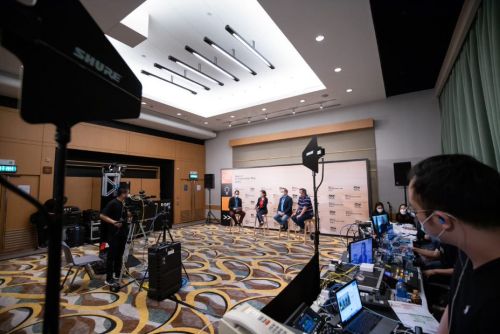
Local start-ups have been rising to the challenges presented by the COVID-19 pandemic with agility and creativity. This year’s HKTDC Entrepreneur Day (E-Day), organised by the Hong Kong Trade Development Council (HKTDC), underwent a transformation in terms of format and content, with a series of seminars broadcast live on 16 and 17 July giving start-ups valuable insights into finding a path forward during this difficult time.
Running under the theme “Revive x Redefine”, the 2020 E-Day invited a high-powered panel of speakers to speak at 19 online seminars.
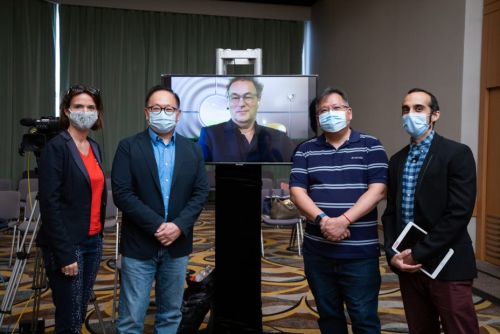
Renowned futurist Gerd Leonhard addressed the “T-Chat: Futurising Your Business: Renaissance from the Age of Digitalisation” seminar and was joined for the discussion by (from left) Karena Belin, CEO & Co-Founder of WHub, Toa Charm, Associate Professor, Business School, the Chinese University of Hong Kong, and Herbert Chia, Venture Partner at Sequoia Capital China.
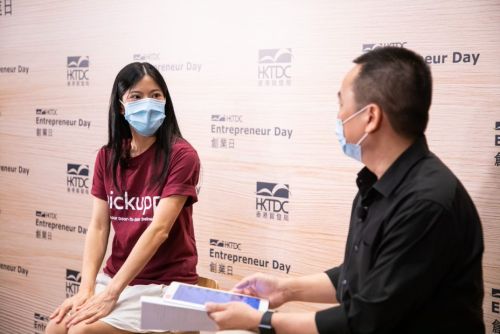
At the “Revive, Redefine” plenary session, Crystal Pang, Co-founder of Pickupp, shared tips on entrepreneurship and their personal experiences of turning creative ideas into viable business ventures.
Running under the theme “Revive, Redefine”, the 2020 E-Day invited a high-powered panel of speakers to speak at 19 online seminars, offering insights into areas such as entrepreneurship, regional opportunities and technological developments to equip start-ups for future challenges. Virtual business matching sessions were also arranged, connecting local start-ups with companies in Japan, Korea, Thailand, Malaysia, Singapore and the United States to help them continue to capture business opportunities amid the current economic adversity.
Insights into the future: four “bigs” and 10 “game changers”
Broadcasting from Switzerland, globally renowned futurist Gerd Leonhard, CEO of The Futures Agency, shared in “T-Chat: Futurising Your Business: Renaissance from the Age of Digitalisation” the trends for entrepreneurship and opportunities for start-ups to thrive in the “new normal”. Mr Leonhard explained that there would not be a post-COVID-19 return to normality, and that the new normal would be very different.
The world is undergoing a Great Transformation, he said, with four “bigs” playing a leading role – Big Tech, Big Media, Big State and Big Health. “Technology is everywhere. Without technology, we wouldn’t be working from home, we couldn’t find new ways to address the crisis. We couldn’t analyse all the data. Without the AI (artificial intelligence), we couldn’t have early warning systems,” Mr Leonhard said. He added that the state helps to figure out how to restart the economy and to support the people, and that healthcare is becoming the number one issue. “We are going to have to put more money, more research into healthcare development and biotechnology,” he said, “We all are addicted to the media now because we are at home. Big media is exploding. These four things together have huge opportunities.” The result, he said, would be “HellVen”, explaining it could be heaven or it could be hell, depending on how it is handled.
The future presents utter uncertainty, Mr Leonhard posited. Businesses needed to abandon traditional, pre-COVID ways of doing things and adapt to the VUCA normal – volatility, uncertainty, complexity and ambiguity. He advised entrepreneurs to flip VUCA and turn around the threats of the pandemic with “velocity, unorthodoxy, co-creation and awesomeness – to respond with speed and come up with new ideas, to work together, and to create solutions that can make a difference.”
Technologies are developing extremely fast, and the COVID-19 pandemic is accelerating this further. The crisis and technological potential would drive extremely rapid and very disruptive change, he said, with more progress over the next decade than the world had seen over the previous century.
Mr Leonhard said 10 game-changers would shape developments over the coming decade, with the COVID-19 pandemic accelerating the impetus for change. The first game-changer would be “data everything” – with data as the “new oil”, businesses need to have the numbers at hand to go forward. “Lots of start-ups in Hong Kong and all over the world are dealing with data,” he said. This leads to the second game-changer – “cloud everything”, with vast amounts of data calling for copious storage space. The next game-changer would be “connected everything” – through the Internet of Things (IoT) not just everyone but everything, be it appliances or vehicles, will be connected through the internet.
Another game-changer would be “compute everything”, with quantum computers that are virtually unlimited in computing power. The next game-changer is “understand anything”, whereby natural language processing will enable us to speak to machines as if they were humans. “Smart everything” will see machine learning greatly increasing the ability of machines and systems to adapt to change. Transactions will join communications as a game-changer, as blockchain technologies greatly expand the scope for, and reliability of, transactions.
Mr Leonhard said another game-changing development that will have great relevance to anyone trading in goods is the distribution of production. Improvements in the scope and quality of 3D printing mean items can be produced anywhere. “We will be able to print anything, from our tennis shoes to our wrist watches,” he explained. Massive increases in the power of media technologies will expand the scope of media offerings, enabling people to “see everything” in the future through technologies such as virtual reality – and the current trend for working from home had given this a big boost. Improvements in genetic engineering mean it will be possible to “change anything” – a development that has massive ethical implications.
Panellists who appeared alongside Mr Leonhard at the seminar included Karena Belin, CEO & Co-founder of WHub; Toa Charm, Associate Professor, Business School, the Chinese University of Hong Kong; and Herbert Chia, Venture Partner at Sequoia Capital China. Mr Charm said that many Asian conglomerates rejected technological innovation in the past, and it was only when faced with growing competition that they began to open their doors to change. Referencing the current rapidly transforming business environment, he said: “All Asian conglomerates are opening up their doors to new technologies. They are thinking: ‘I don’t know about this, but I need it because my shopping malls, my hotels, my properties – nobody goes there to buy now’. I think this presents a golden opportunity for all of us – start-ups and technology companies, and enablers like incubators and accelerators.”
In response to a question about leadership and how human skills are becoming more valuable, Mr Chia, said: “At this moment, when talking to a lot of CEOs in the field, I find there’s a gap between the knowledge they already have and the knowledge needed to translate a business problem into a technology solution. Or, the other way round, where I have a technology solution, but I don’t know what to fix.” He believes successful leaders will be those who can bridge this gap and give their companies a clear direction.
Agility and understanding social norms
At the “Revive, Redefine” plenary session, William Ip, Managing Director of Carousell Hong Kong, and Crystal Pang, Co-founder of Pickupp, shared tips on entrepreneurship and their personal experiences of turning creative ideas into viable business ventures.
Mr Ip shared three tips with the audience: be agile, be a good listener and keep your business alive. Quoting celebrated scientist Stephen Hawking, who said that intelligence is the ability to adapt to change, Mr Ip highlighted the importance of agility for start-ups and entrepreneurs, especially in a challenging climate. He said that business drivers will change, and that development teams must be ready to adapt. “Being a start-up, we need to act very quickly and stay very close to the market. Sometimes you make decisions that seems to be correct at the time, but we also have to be prudent, agile, and humble – if that decision doesn’t turn out to be the right decision, we need to change quickly,” Mr Ip explained.
His second tip was to be a good listener. Businesses have to listen to their target audience and address the needs of the market segment, he said. As the retail sector has been hit hard by the COVID-19 pandemic, Carousell has been leveraging its platform to help small and medium-sized enterprises get online and connect with more customers. Lastly, Mr Ip said the most important goal for start-ups must be to stay alive as a business. Enterprises need to prepare for an uncertain future and think ahead to understand what the world will be like tomorrow.
Ms Pang offered insights into the classic question of how both technology and understanding social norms can be used to improve services. Customers want things cheap, flexible and traceable. She noted that while it is now very inflexible to operate a traditional logistics fleet, crowdsourcing was a viable option. “There is a lot of idle capacity in the city, and a lot of people with downtime,” she said. “Students, maybe they work until 3pm then have four or five hours of downtime. Semi-retirees, they are still very healthy and can run around and do neighbourhood deliveries. Are we able to utilise them effectively, as long as there is good technology to trace and do quality control?”
Ms Pang also explained how advanced computerised systems were necessary when employing a more flexible and dynamic delivery system. For Pickupp’s platform, thousands of deliveries will go out at any given time, all with different weights and dimensions, which need to be bundled together at the lowest cost.
Creating happiness can lead to growth
Katherine Cheung, Chief Marketing Officer at online education platform Snapask, shared on how the start-up has been able to grow its business in a difficult environment at a seminar titled “From Crisis to Chances: Unleashing Opportunities in Challenging Times”. She described online education as “hard to start, harder to win”.
With the goal of offering the best online learning experience, the Snapask team conducted in-depth research and ran numerous surveys to identify what would make users happy. They found that an instant experience and instant support were important for online learners, especially during the COVID-19 pandemic. In response, the start-up made one small product change, to move all the fast-responding and always-online tutors to every single page possible whenever users log in so they can offer immediate support. Ms Cheung said that faster matching of students and tutors has resulted in more referrals and retentions, so “creating happiness means growth,” she said.
The Hong Kong Trade Development Council (HKTDC) is a statutory body established in 1966 to promote, assist and develop Hong Kong’s trade. With 50 offices globally, including 13 in Mainland China, the HKTDC promotes Hong Kong as a two-way global investment and business hub. The HKTDC organises international exhibitions, conferences and business missions to create business opportunities for companies, particularly small and medium-sized enterprises (SMEs), in the mainland and international markets. The HKTDC also provides up-to-date market insights and product information via trade publications, research reports and digital news channels. For more information, please visit: www.hktdc.com/aboutus. Follow us on Twitter @hktdc and LinkedIn
Contact:
Please contact Creative Consulting Group or HKTDC's Communications & Public Affairs Department:

Creative Consulting Group
June Wong
Tel: +852 3159 2909 / +852 6986 5822
Email: june.wong@creativegp.com

Peggy Mak
Tel: +852 3159 2982 / +852 9482 3144
Email: peggy.mak@creativegp.com

HKTDC
Leslie Ng
Tel: +852 2584 4239
Email: leslie.ss.ng@hktdc.org
– Companies want both the collaborative atmosphere the physical office provides and the flexibility to support remote working for their employees – Demand for flexible workspace increasing amid uncertainty as companies look for cost-management solutions
While the pandemic has led many to believe remote work will become the norm, concerns about lagging creativity and loneliness demonstrate that there is still a role for the office in a post Covid-19 world, according to The Executive Centre (TEC).
While there are advantages to working from home, such as reduced commuting times, costs and pollution, there are also disadvantages for businesses and employees. In a video produced in association with Business Reporter, Paul Salnikow, founder and CEO of TEC, discusses what the future of work could look like.
“Being one of Asia’s largest premium flexible workspace operators give us a good insight into how companies have been adapting,” he says. “Once our centres reopened, we found our members were looking forward to coming back as they missed the social interaction their office provided.” Other disadvantages to remote working include a disruption to creative thinking and the additional logistical steps required to ensure business can continue as usual.
The situation has also made it difficult for companies to accurately predict headcount. “What we’re seeing now is a re-evaluation by organisations of their office strategy,” Salnikow says. “The current market uncertainty is creating huge demand for the flexible workspace sector as companies try to manage costs and become less willing to commit to long-term leases.” Vast resources are wasted paying leases for real estate businesses simply don’t need. Flexible working spaces are a vital way of ensuring that no longer happens.
“Every healthy business needs to consider what mix of traditional and flexible is right for its teams and their work,” says Senior Development Director of TEC, Todd Liipfert. “Sales teams who need to work both remotely and in different places will benefit from flexible access to broad networks. Creative teams that use the office as a place to spark ideas need more permanent and fixed spaces.”
The workspace of the future must be agile and versatile to adapt to unprecedented and unpredictable challenges that are becoming more common in our society. Wherever and however, businesses choose to move forward post Covid-19, there will be a workspace trend where professionals place higher value on their flexibility.
For more details, watch the video on https://bit.ly/3eeD8I7, or by scanning the QR code.
Business Reporter is distributed with The Daily Telegraph, The Sunday Telegraph and City AM, with each publication reaching an average of 1.5 million people.
Content is also published through the Business Reporter and teiss websites, which include video debates, online articles and digital magazines, delivering news and analysis on the issues affecting businesses to a global audience.
Business Reporter also hosts conferences, breakfast meetings and exclusive summits, events which bring together some of the most influential decision makers and innovators in modern business. These exclusive events for business leaders give Business Reporter direct contact with readers and help to inform the content and direction of its editorial projects.
Business Reporter is committed to the UN Sustainable Development Goals, and was the first UK member of the UN SDG Media Compact. We have launched a website dedicated to showcasing the work of companies towards these goals at 17globalgoals.com.
Business Reporter is committed to providing meaningful analysis to everyone in business. Whether you’re running a small business, the head of a local company or an executive in a multinational corporation, there’s something for you at Business Reporter.
The Executive Centre (TEC) opened its doors in Hong Kong in 1994 and today boasts over 135+ centres in 32 cities and 14 countries. It is the third largest serviced office business in Asia with annual turnover in excess of US$275 million.
The Executive Centre caters to ambitious professionals and industry leaders looking for more than just an office space – they are looking for a place for their organization to thrive. TEC has cultivated an environment designed for success with a global network spanning Greater China, Southeast Asia, North Asia, India, Sri Lanka, the Middle East, and Australia, with sights to go further and grow faster. Each Executive Centre offers a prestigious address with the advanced infrastructure to pre-empt, meet, and exceed the needs of its Members. Walking with Members through every milestone and achievement, The Executive Centre empowers ambitious professionals and organizations to succeed.
Privately owned and headquartered in Hong Kong, TEC provides first class Private and Shared Workspaces, Business Concierge Services, and Meeting & Conference facilities to suit any business’ needs.