
Bringing the Green Revolution to Electronics

Tsukuba, Japan – (ACN Newswire) – Researchers are investigating how to make electronic components from eco-friendly, biodegradable materials to help address a growing public health and environmental problem: around 50 million tonnes of electronic waste are produced every year.

Less than 20% of the e-waste we produce is formally recycled. Much of the rest ends up in landfills, contaminating soil and groundwater, or is informally recycled, exposing workers to hazardous substances like mercury, lead and cadmium. Improper e-waste management also leads to a significant loss of scarce and valuable raw materials, like gold, platinum and cobalt. According to a UN report, there is 100 times more gold in a tonne of e-waste than in a tonne of gold ore.

While natural biomaterials are flexible, cheap and biocompatible, they do not conduct an electric current very well. Researchers are exploring combinations with other materials to form viable biocomposite electronics, explain Ye Zhou of China’s Shenzhen University and colleagues in the journal Science and Technology of Advanced Materials.

The scientists expect that including biocomposite materials in the design of electronic devices could lead to vast cost saving, open the door for new types of electronics due to the unique material properties, and find applications in implantable electronics due to their biodegradability.

For example, there is widespread interest in developing organic field effect transistors (FET), which use an electric field to control the flow of electric current and could be used in sensors and flexible flat-panel displays.

Flash memory devices and biosensor components made with biocomposites are also being studied. For example, one FET biosensor incorporated a calmodulin-modified nanowire transistor. Calmodulin is an acidic protein that can bind to different molecules, so the biosensor could be used for detecting calcium ions.

Researchers are especially keen to find biocomposite materials that work well in resistive random access memory (RRAM) devices. These devices have non-volatile memory: they can continue to store data even after the power switch is turned off. Biocomposite materials are used for the insulating layer sandwiched between two conductive layers. Researchers have experimented with dispersing different types of nanoparticles and quantum dots within natural materials, such as silk, gelatin and chitosan, to improve electron transfer. An RRAM made with cetyltrimethylammonium-treated DNA embedded with silver nanoparticles has also shown excellent performance.

“We believe that functional devices made with these fascinating materials will become promising candidates for commercial applications in the near future with the development of materials science and advances in device manufacturing and optimization technology,” the researchers conclude.

Further information

Ye Zhou

Shenzhen University

yezhou@szu.edu.cn

Paper

https://doi.org/10.1080/14686996.2020.1725395

About Science and Technology of Advanced Materials Journal

Open access journal STAM publishes outstanding research articles across all aspects of materials science, including functional and structural materials, theoretical analyses, and properties of materials.

Shunichi Hishita

STAM Publishing Director

HISHITA.Shunichi@nims.go.jp

Press release distributed by ResearchSEA for Science and Technology of Advanced Materials.
Using Bone’s Natural Electricity to Promote Regeneration

Tsukuba, Japan – (ACN Newswire) – Some materials show promise promoting bone regeneration by enhancing its natural electrical properties, according to a review in the journal Science and Technology of Advanced Materials.

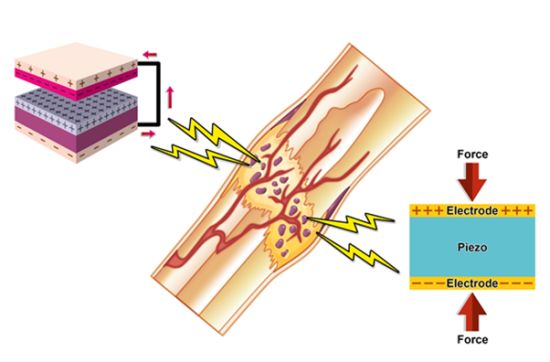
Some solids, including bone, enamel and quartz, form an electric field when deformed. This property, called the piezoelectric effect, happens when a mechanical force pushes atoms closer together or further apart, upsetting the electric balance and causing positive and negative charges to appear on opposite sides of a material.

Scientists discovered that bone was a piezoelectric material in 1957. Since then, they have found that piezoelectricity occurs when bone collagen fibres slide against each other. This leads to the accumulation of charges and the generation of a tiny current, which opens up calcium ion channels in bone cells called osteocytes. This triggers a cascade of signalling pathways that ultimately promote bone formation.

“Piezoelectricity is one of several mechanical responses of the bone matrix that allows bone cells to react to changes in their environment,” explain biomedical engineer Zong-Hong Lin of Taiwan’s National Tsing Hua University and medical doctor Fu-Cheng Kao of Taiwan’s Chang Gung Memorial Hospital, who led the review.

Researchers are seeking to leverage this property to improve bone regeneration and repair. For example, they are exploring materials to fabricate tiny, self-powered electric generators that can be implanted inside or outside bone to stimulate its natural healing processes.

Some teams have significantly accelerated the proliferation and differentiation of mouse embryonic bone-forming cells when using a so-called triboelectric nanogenerator. An electric current is generated when two materials are separated and then brought back into contact. These nanogenerators have been tested with materials such as polydimethylsiloxane, indiumtin oxide, aluminium, and polytetrafluoroethylene. They are showing potential for treating osteoporosis and osteoporosis-related fractures.

Piezoelectric nanogenerators, on the other hand, are made by connecting an electrode to a piezoelectric material on a flexible substrate, and generate a current when force is applied. These nanogenerators have also been shown to promote the proliferation of human bone-forming cells.

Besides nanogenerators, piezoelectric polymers, which have good biocompatibility with human tissues, are showing promise as absorbable screws and pins in severe bone fractures, helping avoid a second surgery for their removal.

Piezoelectric ceramics provide stronger electric currents compared to polymers, but can be toxic. Non-lead-based ceramics, like barium titanate, hydroxyapatite, and zinc oxide are leading candidates for bone scaffolds that promote bone growth and regeneration and for artificial bone substitutes.

Lin and his colleagues expect further research will lead to piezoelectricity-based applications for tissue engineering and bone regeneration.

Further information

Zong-Hong Lin

Taiwan’s National Tsing Hua University

linzh@mx.nthu.edu.tw

Paper

https://doi.org/10.1080/14686996.2019.1693880

About Science and Technology of Advanced Materials Journal

Open access journal STAM publishes outstanding research articles across all aspects of materials science, including functional and structural materials, theoretical analyses, and properties of materials.

Shunichi Hishita

STAM Publishing Director

HISHITA.Shunichi@nims.go.jp

Press release distributed by ResearchSEA for Science and Technology of Advanced Materials.
Combined Data Approach Could Accelerate Development of New Materials

Researchers in Japan have developed an approach that can better predict the properties of materials by combining high throughput experimental and calculation data together with machine learning. The approach could help hasten the development of new materials, and was published in the journal Science and Technology of Advanced Materials.

Scientists use high throughput experimentation, involving large numbers of parallel experiments, to quickly map the relationships between the compositions, structures, and properties of materials made from varying quantities of the same elements. This helps accelerate new material development, but usually requires expensive equipment.

High throughput calculation, on the other hand, uses computational models to determine a material’s properties based on its electron density, a measure of the probability of an electron occupying an extremely small amount of space. It is faster and cheaper than the physical experiments but much less accurate.

Materials informatics expert Yuma Iwasaki of the Central Research Laboratories of NEC Corporation, together with colleagues in Japan, combined the two high-throughput methods, taking the best of both worlds, and paired them with machine learning to streamline the process.

“Our method has the potential to accurately and quickly predict material properties and thus shorten the development time for various materials,” says Iwasaki.

They tested their approach using a 100 nanometre-thin film made of iron, cobalt and nickel spread on a sapphire substrate. Various possible combinations of the three elements were distributed along the film. These ‘composition spread samples’ are used to test many similar materials in a single sample.

The team first conducted a simple high throughput technique on the sample called combinatorial X-ray diffraction. The resulting X-ray diffraction curves provide detailed information about the crystallographic structure, chemical composition, and physical properties of the sample.

The team then used machine learning to break down this data into individual X-ray diffraction curves for every combination of the three elements. High throughput calculations helped define the magnetic properties of each combination. Finally, calculations were performed to reduce the difference between the experimental and calculation data.

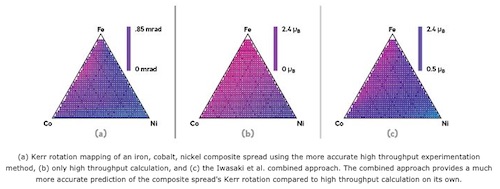
Their approach allowed them to successfully map the ‘Kerr rotation’ of the iron, cobalt, and nickel composition spread, representing the changes that happen to light as it is reflected from its magnetized surface. This property is important for a variety of applications in photonics and semiconductor devices.

The researchers say their approach could still be improved but that, as it stands, it enables mapping the magnetic moments of composition spreads without the need to resort to more difficult and expensive high throughput experiments.

Further information

Yuma Iwasaki

NEC Corporation

y-iwasaki@ih.jp.nec.com

Paper

https://doi.org/10.1080/14686996.2019.1707111

About Science and Technology of Advanced Materials Journal

Open access journal STAM publishes outstanding research articles across all aspects of materials science, including functional and structural materials, theoretical analyses, and properties of materials.

Shunichi Hishita

STAM Publishing Director

HISHITA.Shunichi@nims.go.jp

Press release distributed by ResearchSEA for Science and Technology of Advanced Materials.