HKTDC & UOB Research: 85% of GBA businesses prioritise ASEAN sales

  • Malaysia, Singapore, Thailand and Vietnam are top target markets

About 85% of businesses in the Guangdong-Hong Kong-Macao Greater Bay Area (GBA) plan to maintain or grow their sales to the ASEAN bloc of countries in the next three years, according to a research report released by the Hong Kong Trade Development Council (HKTDC) and UOB today. The report – Navigating Connectivity: Exploring ASEAN Opportunities for the Greater Bay Area – also indicated that Malaysia, Singapore, Thailand and Vietnam were the top sales markets for expansion-minded GBA businesses, while Vietnam remained top choice for procurement and production outsourcing.

Overall, the report shed some light on why GBA businesses found ASEAN appealing. The sheer scale of the ASEAN market was singled out by 55.9% of research respondents as a key catalyst for their expansion plans. Scale was ahead of the 49.6% accorded to government incentives and investment policies and 32.8% which cited enhanced e-commerce access.

The HKTDC-UOB survey conducted in the third quarter of last year took the form of a questionnaire completed by 671 GBA enterprises, supplemented by in-depth interviews with a representative number of GBA businesses.

More GBA companies plan to expand into ASEAN markets
The survey found more than 70% of respondents planned to expand to ASEAN in the next three years, compared with 60% in a similar survey conducted in 2021. The number is even higher for those already established in ASEAN, with 96% of such businesses planning to maintain or expand operations in the next three years.

GBA companies across the four surveyed sectors – consumer goods; business, professional and financial services; real estate, hospitality and construction; and technology, media and telecommunications – all saw Malaysia, Singapore and Thailand as having the greatest potential to thrive in. In terms of industrial goods, GBA businesses considered Malaysia, Singapore and Vietnam their priority markets. Malaysia’s popularity across companies in the four sectors was considerably higher than in the 2021 survey.

Key challenges
GBA businesses regarded navigating local government policies and regulations (48.6%) as the key challenge to expanding their market share within ASEAN, followed by cultural or language barriers (38.7%) and difficulties in obtaining talent (26.4%). This differs notably from the 2021 survey, which identified inadequate infrastructure, difficulties in finding the right local partners and the increasing cost of doing business as the top three challenges.   

Mrs Christine Ip, CEO – Greater China, UOB, said: “UOB is dedicated to driving business connectivity between ASEAN and China. We see the a strong trend among GBA enterprises to spread their wings abroad and boost long-term growth. With our cross-border and customised financial solutions, foreign direct investment advisory services and a deep understanding of local markets, sector knowledge and partnership ecosystem, we help to reduce barriers of cross-border expansion, address supply chain risks and minimise financing costs for customers. Since the inception of the UOB Foreign Direct Investment Advisory unit in 2011, we have supported nearly 4,000 companies to successfully enter ASEAN markets. This success underscores the Bank’s commitment to doing right by our customers.”

Hong Kong’s connectivity with GBA and ASEAN
In another key finding, most GBA businesses had a particularly high regard for Hong Kong’s strong connectivity with both the GBA and ASEAN bloc – more than 70% of respondents accorded the city a score of seven or more out of 10. Hong Kong’s expertise in service provision was seen as essential for sustained success in the ASEAN market and also its most admired asset. Hong Kong scored highly for its expertise in legal compliance, cross-border infrastructure finance and logistics. This was seen as an endorsement of the quality of services the city provides and an indication of the massive contribution Hong Kong is set to make as the GBA continues to prosper.

Commenting on the findings, Mr Louis Chan, Deputy Director of HKTDC Research, said: “This survey confirms both the bold and outward-looking nature of the GBA’s overall development strategy, while highlighting the essential role Hong Kong can play in ensuring this initiative reaches its full potential. It shows beyond doubt that synergy between the GBA members assures them of a better future than they could have achieved alone.”

Mrs Ip added: “In tandem with the promotion of free trade agreements, technology empowerment and higher business plans, the findings show we stand at the crossroads of burgeoning investment opportunities between Greater China and ASEAN. Hong Kong has a unique position as a super connector and value-adder, driving financial innovation, facilitating cross-border trade and nurturing economic prosperity to shape a future where business connectivity in this dynamic region knows no boundaries.”

Regional integration, digitalisation and cost management essential for ASEAN success
Overall, 53.7% of GBA companies noted that geographic economic integration initiatives, particularly the Regional Comprehensive Economic Partnership (RCEP), were likely to boost their chances of success within ASEAN, followed by digitalisation (51.9%) and cost management, including moving production to lower-cost locations (40.8%).

Most respondents credited the effectiveness of RCEP at streamlining and accelerating trade between the region’s most dynamic economies – including Mainland China, Indonesia, Malaysia, Singapore, Thailand and Vietnam – as the main reason for its success.

Surveyed enterprises also believed digitalisation had been crucial for the maintenance of economic and supply chain resilience amid the unprecedented impact of the pandemic. They also viewed digitalisation as a key productivity driver, reducing operational costs and facilitating business and investment expansion in the region. In all, 23.2% of companies saw digitalisation as a priority for their business which was likely to boost their chances of successfully entering the ASEAN market.

Related materials

  • HKTDC Research: https://research.hktdc.com/en
  • The report in Chinese – Navigating Connectivity: Exploring ASEAN Opportunities for the Greater Bay Area can be downloaded from the websites of HKTDC and UOB Hong Kong.

Photos Download: https://bit.ly/48CTRkg

Christine Ip, CEO – Greater China, UOB (right) and Louis Chan, Deputy Director of HKTDC Research (left), release the Navigating Connectivity: Exploring ASEAN Opportunities for the Greater Bay Area research report
Louis Chan, Deputy Director of HKTDC Research
Christine Ip, CEO – Greater China, UOB

Media enquires
HKTDC’s Communications & Public Affairs Department:
Frankie Leung, Tel: (852) 2584 4298, Email: frankie.cy.leung@hktdc.org
Clayton Lauw, Tel: (852) 2584 4472, Email: clayton.y.lauw@hktdc.org

UOB Hong Kong:
Susanna Liu, Tel: (852) 2123 7537, Email: susanna.liuwy@uobgroup.com
Sarah Tsang, Tel: (852) 2123 7536, Email: sarah.tsangsw@uobgroup.com

Yuan Tung Financial Relations:
Agnes Yiu, Tel: (852) 3428 5690, Email: ayiu@yuantung.com.hk
Hing-fung Wong, Tel: (852) 3428 3122, Email: hfwong@yuantung.com.hk

About HKTDC
The Hong Kong Trade Development Council (HKTDC) is a statutory body established in 1966 to promote, assist and develop Hong Kong’s trade. With 50 offices globally, including 13 in Mainland China, the HKTDC promotes Hong Kong as a two-way global investment and business hub. The HKTDC organises international exhibitionsconferences and business missions to create business opportunities for companies, particularly small and medium-sized enterprises (SMEs), in the mainland and international markets. The HKTDC also provides up-to-date market insights and product information via research reports and digital news channels. For more information, please visit: www.hktdc.com/aboutus. Follow us on Twitter @hktdc and LinkedIn

About UOB
UOB is a leading bank in Asia. Operating through its head office in Singapore and banking subsidiaries in China, Indonesia, Malaysia, Thailand and Vietnam, UOB has a global network of around 500 offices in 19 countries and territories in Asia Pacific, Europe and North America. Since its incorporation in 1935, UOB has grown organically and through a series of strategic acquisitions. Today, UOB is rated among the world’s top banks: Aa1 by Moody’s Investors Service and AA- by both S&P Global Ratings and Fitch Ratings.

For nearly nine decades, UOB has adopted a customer-centric approach to create long-term value by staying relevant through its enterprising spirit and doing right by its customers. UOB is focused on building the future of ASEAN – for the people and businesses within and connecting to ASEAN.

The Bank connects businesses to opportunities in the region with its unparalleled regional footprint and leverages data and insights to innovate and create personalised banking experiences and solutions catering to each customer’s unique needs and evolving preferences. UOB is also committed to helping businesses forge a sustainable future, by fostering social inclusiveness, creating positive environmental impact and pursuing economic progress. UOB believes in being a responsible financial services provider and is steadfast in its support of art, social development of children and education, doing right by its communities and stakeholders. 

HKTDC & UOB Research: Two-thirds of GBA firms adopt sustainable development

About 70% of enterprises consider using more Hong Kong green solutions in next two years

About 65% of enterprises in the Guangdong-Hong Kong-Macao Greater Bay Area (GBA) have adopted green and sustainable development practices in business operations, and about 70% said they would consider using more of Hong Kong’s green products and services over the next two years, a research report by the Hong Kong Trade Development Council (HKTDC) and UOB revealed.

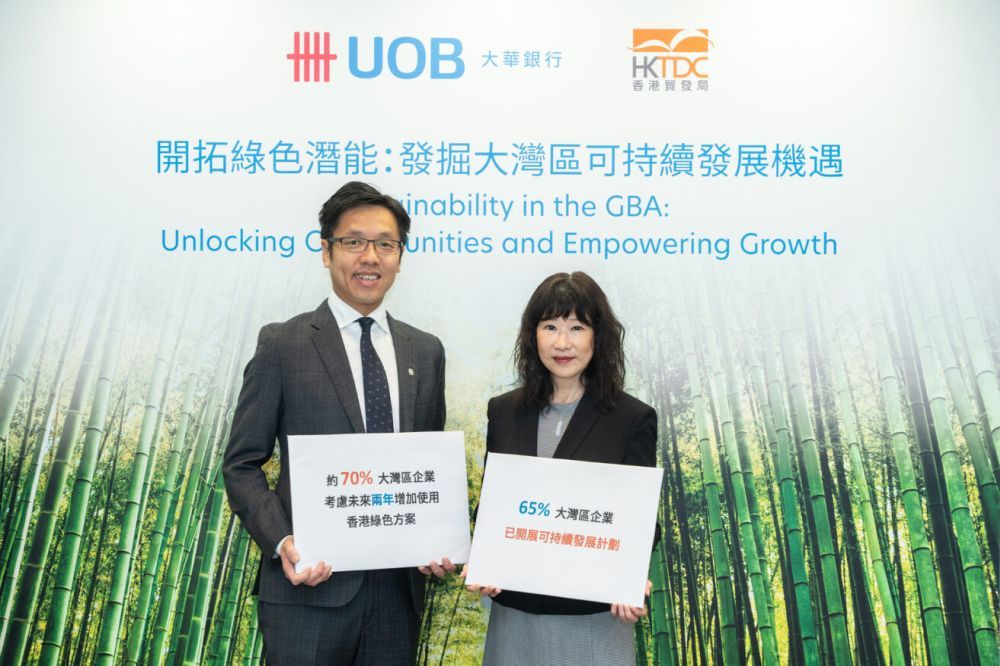
The HKTDC and UOB have jointly released a research report titled Sustainability in the GBA: Unlocking Opportunities and Empowering Growth. Photo shows Irina Fan (right), Director of HKTDC Research, and Brian Lam (left), Chief Financial Officer and Chief Sustainability Officer, UOB Hong Kong

The report, Sustainability in the GBA: Unlocking Opportunities and Empowering Growth, revealed that the top three green practices adopted by GBA enterprises include resource recycling, clean energy adoption and green office practices (notably the use of energy-efficient office equipment, paperless offices and online office systems). Among these enterprises which have adopted green practices, 98% reported positive impact on their businesses, in particular increased brand reputation and brand recognition as well as improved energy efficiency and cost reduction. Other positive impacts include improved governance of corporate compliance and risk control, as well as better chances of securing market and business opportunities.

The report also highlighted that GBA enterprises acknowledge Hong Kong’s significant advantages in green building technologies, green consulting services, green financial services and expertise in green sectors and advanced technology. The firms expressed a strong willingness to explore and adopt sustainable development services offered by Hong Kong.

Huge opportunities from growing green and sustainable practices in the GBA
HKTDC Research Director Irina Fan said: “As sustainable development has become increasingly important, GBA-based businesses have become ever more committed to implementing ESG-related strategies. Nearly all GBA business are looking to incorporate ESG into various business aspects, which translates into an average spend of HK$370,000 (US$47,000) per company in the next two years. Now, there are about 3 million enterprises in the GBA, this could mean a scenario of HK$1 trillion ESG investment. Much of which will likely be channelled into Hong Kong-based green partner businesses.

“With high regard for the sustainable solutions offered in Hong Kong (average desirability score of 8.9 out of 10), GBA enterprises are keen to look to Hong Kong-based green partner businesses to accelerate their sustainable practices.” She added: “About 70% of surveyed respondents considered to use or increase usage of Hong Kong’s green and sustainable solutions. This is a real vote of confidence in the strength and breadth of Hong Kong’s green resources.”

Brian Lam, Chief Financial Officer and Chief Sustainability Officer, UOB Hong Kong, said: “We recognise the imperative need for GBA enterprises to incorporate sustainability practices into their business strategies. The report highlights the current insufficiency of resources, funds and unified standards towards sustainable development, which poses a challenge to the successful implementation of green transformation plans and achieving decarbonisation targets.

“UOB takes our responsibility to provide and channel capital to facilitate continued investments in sectors that are critical to the energy transition very seriously. With the growing demand for sustainable finance, our aim is to simplify access to sustainable financing for clients, strengthen their ESG capabilities and support them in the crucial task of transitioning their business models to reduce carbon emissions and seize new business opportunities. Together, we create a greater positive impact and drive sustainable progress.”

Growing emphasis on GBA green sustainable development
The report revealed that almost all (99.7%) of surveyed GBA enterprises planned to incorporate or increase the level of ESG elements in their operations over the next two years, demonstrating commitment to ESG practices. Moreover, more than 90% of GBA enterprises intended to increase or maintain ESG-based investments over the next two years, with 30% planning an increase and 64% maintaining current investment levels. GBA enterprises expected to allocate an average budget of HK$370,000 (US$47,000) to ESG initiatives over the next two years.

Insufficient experience, funding pose obstacles
However, GBA enterprises generally believed that a lack of experience (77%), cost pressures (67%) and an absence of unified standards (61%) were the key obstacles hindering the implementation of green sustainable development. Surveyed enterprises said the market lacked standardised guidelines and success stories. Many enterprises were concerned about significant upfront investments or difficulty in achieving short-term returns. Existing green standards were also relatively fragmented, with different standards in domestic and international markets, as well as significant industry differences, which discouraged enterprises interested in green transformation.

GBA enterprises look to Hong Kong’s green services

A majority of respondents saw Hong Kong as likely to provide a higher level of green-related services than many comparable mainland cities. Among the areas where Hong Kong was seen as a particularly strong performer were green construction technology, climate risk assessment to a global standard, design consultancy services, green financial services, and the provision of green technology. Most respondents felt that Hong Kong was home to a substantial pool of environmentally aware professionals.

In specific terms, about 70% of surveyed respondents considered to use or increase usage of Hong Kong’s green and sustainable solutions in next two years. More than 90% believed the city could help effectively accelerate green sustainable development within the region through the deployment of green technology (especially with regard to construction, energy efficiency and recycling) as well as via the greater availability of a variety of green financial products and services. A substantial number of respondents also indicated they were likely to use of a range of Hong Kong’s other green-related services, including green certification and carbon emission measurement (89%), green financial services (88%) and energy transition programmes (86%).

GBA enterprises are very keen to learn more with regard to the sustainable development services offered in Hong Kong, with an average desirability score of 8.9 out of 10. The top five preferred green products and services include utilising green applications provided by Hong Kong; engaging sustainable development roadmap planning and consultancy services; accessing green-focused professional talents/services and advanced technology; benefiting from ESG reporting, due diligence, ESG ratings and green asset valuation services offered by Hong Kong; and utilising green financial products and services.

The HKTDC-UOB survey was conducted in July and August this year through an online questionnaire completed by 300 leading enterprises in the 11 GBA cities. In addition, a series of in-depth interviews saw a broad cross-section of GBA industry professionals outline their views on Hong Kong’s green development capabilities and their own ESG implementation strategies.

About HKTDC
The Hong Kong Trade Development Council (HKTDC) is a statutory body established in 1966 to promote, assist and develop Hong Kong’s trade. With 50 offices globally, including 13 in Mainland China, the HKTDC promotes Hong Kong as a two-way global investment and business hub. The HKTDC organises international exhibitionsconferences and business missions to create business opportunities for companies, particularly small and medium-sized enterprises (SMEs), in the mainland and international markets. The HKTDC also provides up-to-date market insights and product information via research reports and digital news channels. For more information, please visit: www.hktdc.com/aboutus. Follow us on Twitter @hktdc and LinkedIn

About UOB
UOB is a leading bank in Asia. Operating through its head office in Singapore and banking subsidiaries in China, Indonesia, Malaysia, Thailand and Vietnam, UOB has a global network of around 500 offices in 19 countries and territories in Asia Pacific, Europe and North America. Since its incorporation in 1935, UOB has grown organically and through a series of strategic acquisitions. Today, UOB is rated among the world’s top banks: Aa1 by Moody’s Investors Service and AA- by both S&P Global Ratings and Fitch Ratings.

For nearly nine decades, UOB has adopted a customer-centric approach to create long-term value by staying relevant through its enterprising spirit and doing right by its customers. UOB is focused on building the future of ASEAN – for the people and businesses within, and connecting with ASEAN.

The Bank connects businesses to opportunities in the region with its unparalleled regional footprint and leverages data and insights to innovate and create personalised banking experiences and solutions catering to each customer’s unique needs and evolving preferences. UOB is also committed to helping businesses forge a sustainable future, by fostering social inclusiveness, creating positive environmental impact and pursuing economic progress. UOB believes in being a responsible financial services provider and is steadfast in its support of art, social development of children and education, doing right by its communities and stakeholders.
Media enquires
HKTDC’s Communications & Public Affairs Department:
Frankie Leung, Tel: (852) 2584 4298, Email: frankie.cy.leung@hktdc.org
Clayton Lauw, Tel: (852) 2584 4472, Email: clayton.y.lauw@hktdc.org 

UOB Hong Kong:
Susanna Liu, Tel: (852) 2123 7537, Email: susanna.liwy@uobgroup.com
Sarah Tsang, Tel: (852) 2123 7536, Email: sarah.tsangsw@uobgroup.com 

Yuan Tung Financial Relations:
Agnes Yiu, Tel: (852) 3428 5690, Email: ayiu@yuantung.com.hk
Hing-fung Wong, Tel: (852) 3428 3122, Email: hfwong@yuantung.com.hk

Photos Download: https://bit.ly/45QTMHE