Azabu Insights: Update on Temperature’s Impact on the Coronavirus

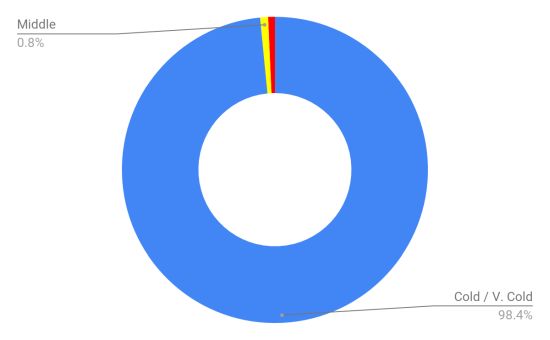
TOKYO – (ACN Newswire) – On March 6th Azabu Insights proposed a theory that coronavirus seemed to be spreading faster in cold countries than in warm countries. We followed this up with an update on March 11th showing that at that time the data was showing ninety-eight percent of the cases were all in cold countries.

Since then we have had many comments from different people. One very respected business person who works in life sciences, told us he thought it was a, “multivariate problem,” and suggested that, “It’s possible, for example, that infection rate would be strongly correlated with people meeting in enclosed areas will less have outside air circulation.” He was saying that our analysis might be true but it might not be, “because of the temperature,” but because of something that “relates to temperature.”

Another doctor said he thought it was because in spring people go outside more and they are less impacted by the dry air of air conditioning systems.

One hospital vice president, whom we highly respect, responded politely, “I do not think that COVID-19 relates to temperature.”

Our conclusion on March 11th was: “As previously, we conclude that COVID-19 can spread in warm regions but seems to spread much more quickly in colder regions. We hope that countries and regions around the world will aggressively work to keep the virus at bay until the summer months and hope that the warm temperatures will support further containment.”

You can see, then as now, we were certainly not 100% convinced that temperature was the driver or that temperature would save the day. But we do remain optimistic.

As recently as March 21, a virologist, Christian Drosten, who advises the German government in their so-far successful tackling of the coronavirus crisis, expressed some optimism that in the coming months we may have some success beating the virus. When asked about the effect of temperature, he responded: “This effect isn’t likely to be particularly pronounced. It won’t be able to stop the outbreak, but it may help a bit. And combined with the isolation measures, I strongly expect that we will see an impact in a month.” It seems he also was not 100% convinced that higher temperature in summer months would solve things, but he thought it could help and envisioned more success at beating the virus spread in weeks ahead.

Updating Data on Temperature vs. Case Statistics – The Situation Now (March 23rd)

On the other hand, we have had people recently coming to us and saying that they’ve heard that there are more outbreaks in warm countries, like Malaysia and Brazil recently. They ask, “doesn’t this prove the theory wrong?” So, we wanted to take a third look at the data and see what it says now and try to figure out what it means. Here are the results.

First off, the cold countries have moved more to the top of the cases list. The top fifteen countries are now all cold countries, as are twenty-two of the top twenty-five countries by case count.

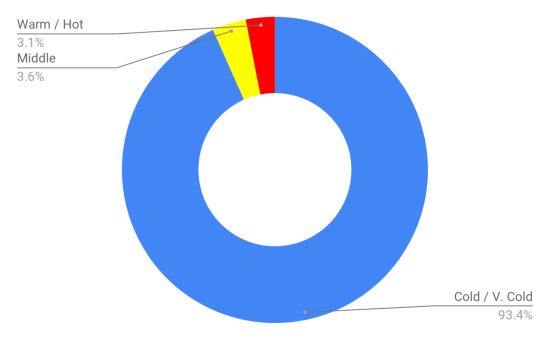
On a percentage basis, today still ninety-six percent of cases have been in cold countries with only four percent in warm countries.

Our definition of cold countries remains unchanged, with a February temperature below fifteen degrees Celsius defining a cold country and above fifteen degrees delineating a warm country. This is because we found the average temperature in Okinawa in February was sixteen degrees Celsius. At this temperature you can go out wearing shorts during the days but need a light jacket or sweatshirt in the evening.

On the other hand, what the people have said to us is certainly true. Some warm countries have seen outbreaks that are hard to ignore. Brazil (1,546 cases), Australia (1,353 cases), Malaysia (1,306 cases) are the leaders in the warm countries right now. Still this is much lower than the leaders in cold countries, China (81,054 cases), Italy (59,138 cases), and USA (32,783 cases).

Countries and Regions That Have Beaten The Virus

The warm countries of Singapore and Hong Kong, had initially had high case counts, ranking number 17 and 18 for most cases as of March 8th. Countries like these have shown that the virus can essentially be stopped. Singapore now has the 40th most cases and Hong Kong has the 50th most cases. But we feel that they probably beat the virus as much because they dealt very aggressively with it as because of the warm weather there.

After all, China and Korea are cold countries and they’ve shown that by dealing aggressively with COVID-19, they could slow or stop the virus too. China has shown very few cases recently despite it seeming out of control at one point. Korea, which does have a high case count, (probably influenced by aggressive testing), has shown a very low death rate.

The Effect of Testing

What about the effect of testing? There is some thinking that the second order things we?ve talked about are also important. For instance, it might be possible that there is more testing in cold countries than warm countries. We haven’t found reliable data on this for all countries, which would be required, but it is a reasonable thing to consider. Note that we did show a consideration for this by doing a per capita GDP analysis, below.

Cold vs. Warm Country Populations

One reader told us they thought there might be more cold countries in the world or more people living in cold countries. We looked at that but concluded that there are only forty-seven percent of the people living in cold countries, whereas fifty-three percent of the people live in warm countries. So, if anything, this should have counteracted the high percentage of cases in cold countries.

Northern Hemisphere vs. Southern Hemisphere Populations

Another reader asked us about what will happen to the Southern hemisphere in July and August. So, we decided to do that analysis as well. Australia concerns us a lot because it has 1,353 cases and will be heading into winter shortly. In Australia most of the population lives in areas where the temperature will be below our fifteen-degree threshold in its coldest month of July.

However, on a further analysis we found that much of the rest of the southern hemisphere population will actually be defined as warm even in the months of July and August. To wit, only nine southern hemisphere countries, representing 2.7% of the world’s population will be colder than fifteen degrees, and classified as a cold country in the month of July. July is typically the coldest month of the year in the Southern Hemisphere. If we were to include northern hemisphere countries that will still be below fifteen degrees in July, such as Russia and Iceland, then we can see that 6.9 percent of the world’s population will be cold in July.

The Effect of Per Capita GDP on Case Counts

Further thinking about “second order considerations” we wanted to look at GDP to see if maybe the colder countries had higher per capita GDP and this was leading to higher COVID-19 case counts. One might argue that this would have led to more travelers to the cold countries, a situation where better healthcare exists, and a situation where more tests have been conducted.

All of these are certainly possible and would push against the idea that temperature itself, or some corollary of temperature is supporting the lower case counts in warm countries.

We looked at GDP in cold and warm countries and found that cold countries have a higher average per capita GDP. In fact, sixty-seven percent of the world’s per capita GDP is in cold countries and thirty-three percent is in warm countries. So, this GDP factor is certainly one that cannot be completely ignored.

It is indeed a possibility that the virus simply spread “first” in cold countries and it will spread in warm countries next.

Still, we feel that 96.0% of all cases being in cold countries can’t be seen as insignificant at this point.

Conclusions

So, what does all of this mean? Does it show that the virus only spreads in cold countries? Does it show that the summer will stop the spread in Europe and North America? Is anything conclusive?

We think that the numbers are telling us four things

A. The spread seems to be faster in colder weather (for whatever reason),

B. The virus can spread in warm countries but seems to spread slower (for whatever reason),

C. The virus can be “beaten” in both warm and cold countries with the right intervention,

D. The summer months are likely to “help” the slow of the spread at least for a few months in Europe and North America, but it will certainly help if Europe and North America continue to take aggressive containment measures.

Separately we think that data is showing that countries that test and treat coronavirus patients in separate “coronavirus only” facilities do much better at containment. Protecting elderly in hospitals and in retirement homes is vitally important to success. This is a topic for another article.

Comments about our analysis are welcome at the email below.

About Azabu Insights

Azabu Insights is a boutique strategic consulting company based in Azabu Juban, Tokyo, Japan. Our teams work collaboratively with clients to build strategies that lead to positive change. Our multilingual team members have top tier academic backgrounds and deep industry experience that we leverage to provide first class, fully engaged, strategic consulting. Core specializations include life sciences, finance, electronics, automotive, aerospace and other industries. For more information contact: info@azabuinsights.com.
The Impact of Hospitals on Accelerating the Spread of Coronavirus

TOKYO – (JCN Newswire) – Consultants at Azabu Insights wanted to understand the stark differences between mortality rates in Korea (currently 1.1%) and Italy (8.3%). We felt that current explanations suggested by virologists, while making a number of valid points, have ultimately been unsatisfactory.

Azabu Insights presents the hypothesis that hospitals may have been one of the breeding grounds for virus infection in Italy and this may have been one of the causes of the high mortality rates. This is a major concern, going forward, for other countries including the United States.

Azabu Insights recommends that policy experts and hospital management carefully consider existing practices to ensure that potential carriers of coronavirus can access to testing and appropriate treatment without spreading the virus to other persons in the healthcare facility. We think that the highly contagious nature of COVID-19 suggests a need for more isolated facilities and stricter measures than have been implemented, in many cases, thus far.

We urge that the successful policies implemented to curb the early outbreaks in China and Korea, including those around hospital isolation and safe testing, should be examined and implemented when appropriate.

Exploring Macro Drivers Behind Infection and Mortality

Previous articles have noted that many of those who died in Italy were older, male, and often smokers. Experts agree that these traits are key risk factors in severe COVID-19 infections (as they are for many other respiratory diseases). It has been argued that these attributes are reflective of broader Italian society, particularly citing Italy’s age profile, and by extension proving why Italy’s outbreak has been so deadly. We contrasted this with Japan and Korea, which share Italy’s characteristics of aging populations with high smoking rates and have also seen coronavirus outbreaks in recent weeks.

Firstly, we examined the key macro data. According to the World Bank, 23% of Italians are over the age of 65, making it the oldest nation in Europe. Note however, there are 16 European countries where at least 20% of the population is over 65, so Italy is by no means a large outlier. Compared with Italy, Korea is a little younger with 18% of its citizens over 65 however Japan is significantly older with 27% of its populace 65 or older. Digging a little further we see that in Cremona, one of the areas hit hard by the northern Italy outbreak, almost 33% of people were over the age of 60 compared with 38% over 60 in Japans Kitami, the site of Japans main outbeak. With regards to smoking, overall smoking rates are higher in Korea (24%) and Italy (22%) than in Japan (18%). However in Korea, men’s smoking rates are much higher at 34% than the 27% of Japanese males and the 23% of Italian men who currently smoke.

These numbers suggest that Japan and Korea, at best, both share similar risk factors to Italy and arguably look much poorer than their European counterpart. Given this, Azabu Insights asserts there are other factors that are driving the speed and intensity of the Italian outbreak.

Partly Result of Tested Populations

Part of the effect of the disparity can be accounted for by the disparity in tested populations. Korea has tested aggressively, with over 286 thousand people (second only to China’s 320 thousand) tested and 3% testing positive. They tested broadly across all age groups with 28% of test subjects 20-29 years old and 58% under the age of 50. In turn many of the younger Koreans tested positive for COVID-19. It should come as no surprise that the mortality rate would be lower amongst this group of younger people because younger people have a lower mortality risk from the outset.

Italians have conversely seen a high 21% of those tested, return positive COVID-19 results (seven times higher than Korea). This says to us that the people who received the tests may have been chosen differently. Perhaps, in Italy, they prioritized (as would make sense) testing of the old, those at risk and those with severe symptoms. We know that the survival rates decrease significantly over 70 and further after 80, so the widespread reports that most people who died were over 70 did not surprise us.

To state it simply: if you find a large number of positive cases among young people, who are not at risk, you would expect few of them to die. If you find a large number of positive cases amongst older at-risk people, you would expect more of them to die. It is an example of Bayess theorem.

But testing differences alone, likely do not account for the sheer numbers of deaths in Italy, which have now surpassed those in China.

Risk of Infection at Hospitals

At Azabu Insights we have interviewed hundreds of doctors face to face over the last five years. We travel to all corners of Japan to meet directly with doctors in their hospitals. A key observation, something that nearly everyone who visits a hospital should know by gut intuition: the primary demographic in a hospital is the elderly. Confirming the data we see that in Japan, 73% of all people in hospitals are 65 or above and 53% are 75 or above. We are confident that these percentages are likely similar in demographically comparable Italy and in many other parts of the world.

This leads to examination of testing procedures for highly infectious diseases. Korea’s testing regime, discussed earlier, has seen a number of novel and innovative solutions. It is possible to be tested for coronavirus in a drive through in just a few minutes. Other than the obvious convenience, this has the core benefit of not needing to walk through a hospital waiting room and risk infecting the other patients and the hospital staff.

In Japan interviews with the president and vice president of two major Japanese hospitals highlighted similar concerns. The first doctor was actively sending people with symptoms away from the hospital to get treated elsewhere. The second doctor had temporarily refused to see measles patients at his hospital. Both of these health practitioners did this to protect their own patients from in hospital spread.

In contrast we see that 10% of healthcare workers in the Lombardy region of Italy have contracted coronavirus. In one region, 20% of all GPs are confirmed to have coronavirus. In both cases, many of them are continuing to work given the well documented shortage of healthcare workers in Italy right now. On top of this, a study of 138 patients in Wuhan, China, suggests 41% of patients may have been victims of hospital-related transmission. This further suggests to us that hospitals are perhaps the worst place to be during a viral epidemic. Yet hospitals are hard to avoid for people in need of medical care. This is especially challenging for the elderly (age 75) who are 6.5 times more likely to be in a hospital than younger adults (age 35).

The SARS Effect on Treatment Patterns

We have extensively reviewed published data and studies, looked at various government recommendations, as well as examining popular published media outlets. In past outbreaks such as SARS, cases of asymptomatic spread were low and in-hospital spread was considered controllable through the use of masks and other standard procedures. In the case of coronavirus however we see clear evidence of both asymptomatic spread and spread from within the hospital system. However we believe that the role of asymptomatic spread and from within the hospital system remains significantly underestimated.

We believe that public policy and messaging in many countries is still largely based on previous outbreaks such as SARS and has failed to keep pace with the reality of how the coronavirus is spread. In contrast, China and Korea have adapted quickly and changed how they approach the management of this pandemic. In particular, they have shown that aggressive isolation of patients from the regular hospital system, including preventing congregation at test centers and separating coronavirus patients from regular patients in completely separate hospitals, can be an effective tool in controlling the spread of the coronavirus. We encourage policy makers in other countries, such as the US, to look to their example for ways to update their approach to better manage the current crisis.

Available Beds and Isolated Treatment Facilities

For patients that require treatment due to more severe coronavirus symptoms, the availability of physically separated treatment or in hospital isolation facilities is key to limit the hospital related transmission alluded to in the above paragraphs. We believe that China for example, did this very effectively by building two hospitals and acquiring gyms just to treat COVID-19 patients.

We examined available hospital capacity, with a focus on the ability to isolate and treat infectious disease. For standard hospital treatment, research shows that Japan is the most equipped globally with 13.4 beds per thousand people, followed by Korea with 11.5 beds per thousand people. This contrasts with most other developed countries which typically have anywhere from two to eight beds (2.9 in USA, 2.8 in UK, 3.4 in Italy) per thousand people. The real concern however is the number of beds that are available to treat highly infectious diseases. Taking conservative Japan as our baseline, we found that only 0.12% of all of Japan’s beds are set up for infectious diseases and 0.32% are tuberculosis certified.

We know from reports that 16% of people in Lombardy hospitals had coronavirus. We believe that its very likely that small hospitals in the countryside of Italy were over run with too many people that had the virus. Despite reports of operating rooms being turned into seclusion units on a best effort basis, we have serious concerns about the ability of the hospitals to limit the spread of coronavirus within their institutions. This can lead to the worst case scenario where the infected patients spread the disease both to healthcare workers and to other patients resulting in the deaths of the already at-risk patients. From this perspective we think that the typical concern of running out of respirators, though important, the earlier measures of keeping the patients from spreading the virus may be more important.

Next Steps and Best Practices

We believe that the risk of testing and of treating people in regular hospitals is being fully underestimated. We feel that hospitals overestimate their ability to keep the virus from spreading in their hospitals.

Our suggestion is that as the United States begins its testing and particularly as it ramps up, they should be extremely careful and learn from the experience of countries such as China and Korea. All testing should be conducted at designated locations that are not physically connected to hospitals where there are other patients. No patients should be allowed to congregate or wait.

An ideal situation would be one in which coronavirus patients could be treated in their own, completely separate hospitals, as has begun to happen in Northern Italy, and in parts of the United States, but, we feel, not broadly enough.

Further, the major hospitals must immediately decrease the number of people they treat. This goes for Japan as well, no longer should hospitals allow large waiting rooms filled with people. All non-essential procedures should be delayed. Again we have heard anecdotal reports of this occurring in the US and other countries already, but not universally.

In addition we recommend that any worker at a major hospital should be tested, at least for temperature, before going into hospitals and aged care facilities. Visitation, by people who may be asymptomatic carriers, should be severely limited. Everyone who goes into hospitals should wear masks, minimize touching and speaking, and should not be waiting in centers together.

Azabu Insights believes that these best practices should be implemented in conjunction with existing recommendations for limiting community spread including, but not limited to, hygiene and hand washing, wearing masks in public places if available, avoiding crowded places and working from home where possible.

About Azabu Insights

Azabu Insights is a boutique strategic consulting company based in Azabu Juban, Tokyo, Japan. Our teams work collaboratively with clients to build strategies that lead to positive change. Our multilingual team members have top tier academic backgrounds and deep industry experience that we leverage to provide first class, fully engaged, strategic consulting. Core specializations include life sciences, finance, electronics, automotive, aerospace and other industries. For more information contact: info@azabuinsights.com

Further Analyzing Coronavirus Cases against Average Temperatures

TOKYO – (ACN Newswire) – A group of consultants at Azabu Insights Inc., a strategic consulting company in Azabu Juban Tokyo, have been analyzing data to understand the correlation between air temperature and spread of the coronavirus (Covid-19).

Last week we made the case that coronavirus seems to be spreading more in colder countries than in warmer countries and that there might be some respite for the Northern Hemisphere countries if we can make it to the warmer part of spring without numbers jumping up too aggressively.

This weekend we analyzed more data, more carefully, in two geographic models. First, we analyzed the number of cases in each of Japan’s forty-seven prefectures (akin to States in the US). Second, we looked at countries and their mean monthly temperatures. Lastly, we looked at velocity of growth.

Japan Cases Overrepresented in Colder Prefectures

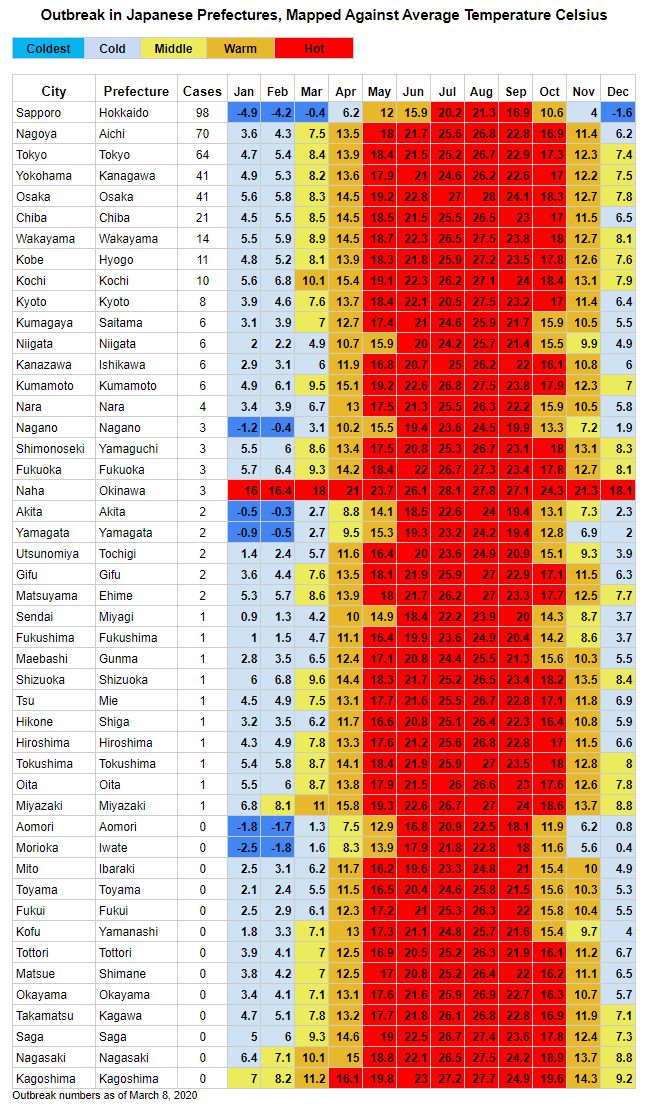
Japan is interesting to look at. Despite having only 126 million people living in 377,900 square kilometers (about the size of Montana), it spreads North and South from latitudes in line with Maine and Florida. The temperature dispersion is, not surprisingly, significant. Okinawa, which has about the same latitude as Miami, Florida, had an average February temperature of 16 degrees celsius (61 fahrenheit), whereas Sapporo, which has a latitude similar to Portland, Maine, had an average temperature of minus 4.2 degree celsius (24.4 fahrenheit).

In the below chart we included all of the prefectures of Japan, sorting them with the most Coronavirus infections at the top and going all the way down to zero infections at the bottom. An analysis of the prefectures below shows a number of interesting insights. First off we see that all of the areas with significant infection counts are considered either cold or very cold in February. Okinawa, as mentioned, is a warmer prefecture and had only three cases despite being one of the areas with many Chinese tourists.

We color coded the average temperatures across prefectures for every month of the year (the average of low and high temperature) into five categories, as below. The next insight is that most of the prefectures will need to wait until April or May to reach the February temperatures of Okinawa; temperatures will remain high through October.

1. Outbreak in Japanese Prefectures, Mapped Against Average Temperature Celsius
http://www.acnnewswire.com/topimg/Low_Azabu20200310-1.jpg

International Outbreak vs Temperature: 94-98% of Cases in Cold Regions

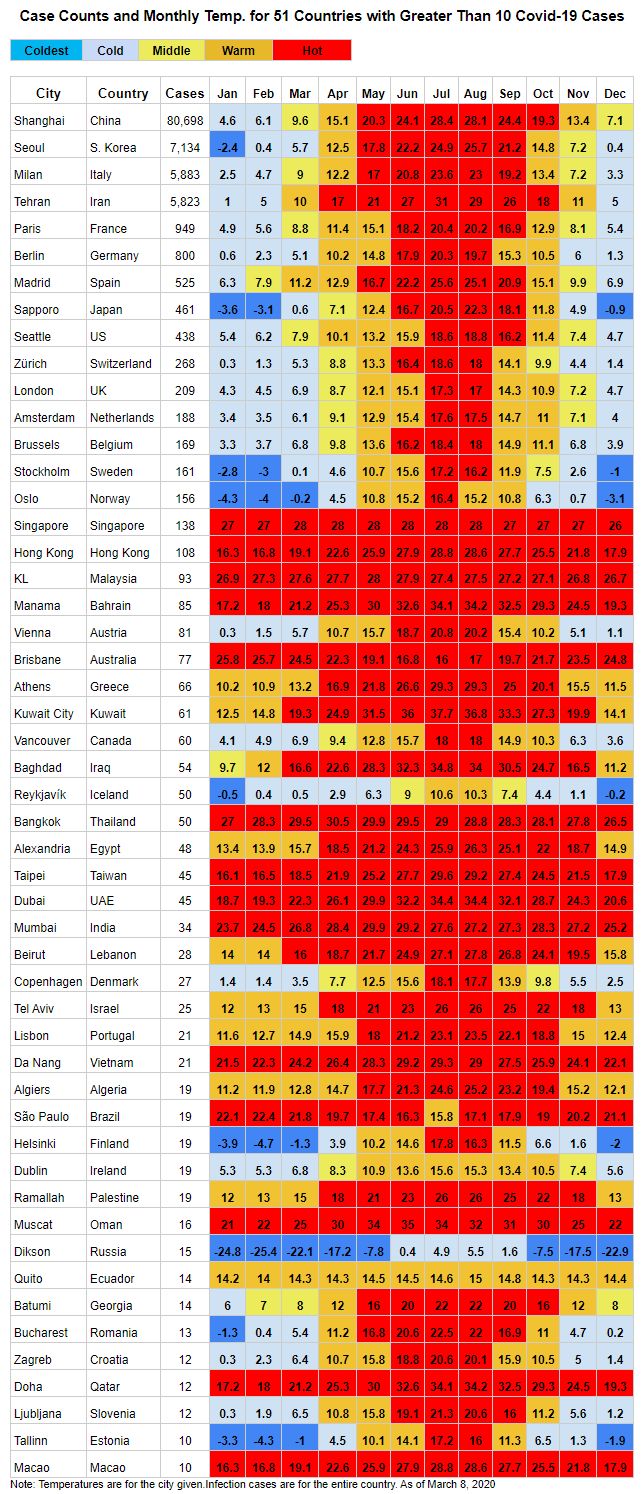
We next analyzed the international outbreak vs. temperature. Again, some interesting insights come through. First off we noticed that fourteen of the top fifteen countries were all “very cold” or “cold” in February. One country, Spain, was classified as “middle” temperature; it has the seventh most cases (as of March 8, 2020). Spain had an average temperature of eight degrees in February which, while certainly not hot, was somewhat warmer than the average of three degrees across the top fifteen countries.

Further, we noted that there are currently fifty-one countries with at least ten cases. Of the total number of cases 22,967 or roughly 93 percent were in “cold” or “very cold” regions, excluding China. This number would be 103,655 or roughly 98 percent of cases including China. There were 880 cases in warm and middle regions and 753 in hot regions.

2. Total Infection Cases, Countries with greater than ten Covid-19 cases (excl. China)
http://www.acnnewswire.com/topimg/Low_Azabu20200310-2.jpg

3. Total Infection Cases, Countries with greater than ten Covid-19 cases (incl. China)
http://www.acnnewswire.com/topimg/Low_Azabu20200310-3.jpg

Looking at it on a country basis, just over half of the top fifty-one countries were in cold or very cold regions. Again, we caution not to read too much into this, since the aggregate numbers are skewed so high to cold regions. Cases do exist in many warm countries, but there are less of them and they seem to be spreading less quickly.

Further drilling down we see that Singapore and Hong Kong had 138 and 108 cases respectively, a large number amongst hot countries. These countries have a huge number of Chinese visitors but had surprisingly low outbreak rates. They are also interesting because they are very much “indoor” cities, where many people spend their time in large air conditioned buildings and indoor pedestrian walkways and shopping malls. From our discussions with people in Hong Kong and Singapore and from media reports we know that both cities have worked very aggressively to combat the outbreak. It is unclear whether their success is due to their hard work in combating it or due the temperature support or a combination.

4. Percentage of Top 51 Countries with Outbreaks
http://www.acnnewswire.com/topimg/Low_Azabu20200310-4.jpg

Upcoming Winter in the Southern Hemisphere

One concern that we identified was, as the northern hemisphere warms in May and June, that the Southern Hemisphere would be entering their colder winter months and, as such, potentially see an increase in outbreaks and the speed of spread of coronavirus.

On closer examination however we see that Southern Hemisphere winters are milder than many places in the Northern Hemisphere. For example, Hobart is Australia’s coldest city and has an average temperature of 8.2 degrees celsius in July which would be classified as “middle” temperature. Similarly Bloemfontein in South Africa (7.2 degrees) and Santiago in Chile (8.2 degrees) are mild. Note, some smaller cities in the Southern and mountainous areas of South America, have colder temperatures, such as Punta Arenas in Chile with a July temperature of 1.5 degrees.

Overall we are hopeful that the milder Southern Hemisphere winters will result in slower spread and less outbreaks through the middle of 2020.

Long Summers in Many Countries

We see that many countries are clustered closer to the equator. This includes South East Asia, much of South Asia, the Middle East, the majority of Africa and much of South and Central america. Of the 51 countries where we have seen at least 10 cases, 23 of them have 6 months or more classified as “hot”, with 13 of these countries “hot” all year round. Following the assertion that coronavirus spread is slower in hotter environments, this high number of hot months bodes well for a slowing of the spread of the virus over the ensuing months.

Conversely, we hold concerns for countries with very short summer seasons, particularly in Northern Europe. Global financial center London in the UK for example, only has 2 hot months for the year as does Amsterdam in the Netherlands. While Russia may see less inflow and outflow of people than London it is an outlier with every month of the year either cold or very cold. The potential for outbreaks and continued spread in these countries remains and should be continue to be monitored closely.

Velocity of Spread

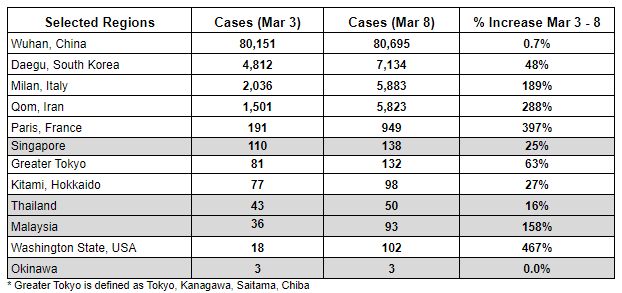
A final insight from the data comes from an analysis of the velocity of growth in warm versus cold regions. We found, when analyzing the ten regions we had previously looked at, that the rate of growth of the cases between March 3 and March 8th was faster in the colder regions (average growth of 185%) than in the warmer regions (average growth of 50%). This is to say, while Singapore had a fair number of cases early, their growth from March 3rd to 8th has been slow (only 25%). Cases for countries, such as Washington State (467%) France (397%), Iran (288%), and Italy (189%) all grew very quickly, during the same period. Amongst warm regions we had reviewed, one concern was Malaysia, which had cases jump 158%.

5. Increase in cases by region
http://www.acnnewswire.com/topimg/Low_Azabu20200310-5.jpg

Within Japan we also looked at velocity and found a major jump in Japan’s second largest city, Osaka. Osaka is another cold populous city (8.8 million people) with lots of train travel and public gatherings. Numbers jumped to fifty-five cases from eight cases, a growth of 412%. Local media is reporting that this is connected to a cluster around live music events. Japan has also faced a shortage of masks in the past week, with many convenience stores receiving shipments of only two or three masks at a time. Rough counts on the street seem to show less people wearing masks than a week ago, when they were more available.

Osaka is Japan’s second largest city and is home to a number of very famous listed companies, which may be further affected by the outbreak. These include: Takashimaya (TSE1: 8233), Capcom (TSE1: 9697), Teijin (TSE1: 3401), Panasonic (TSE1: 6752), Daikin Industries (TSE1: 6367).

Refer to the table below to view the cases and average temperatures in the fifty-one countries with ten or more cases. Looking at the pattern of temperature rise across the most affected countries, we see that most will need to wait at least until April or May (and some as late as June) to be classified as “warm” or “hot”. There is then a respite until about October when temperatures will drop and be very supportive of the virus spread again.

6. Case Counts and Monthly Temperatures for 51 Countries with greater than ten Covid-19 cases
http://www.acnnewswire.com/topimg/Low_Azabu20200310-6.jpg

Conclusions

As with our previous article, we conclude that Covid-19 can spread in warm regions but seems to spread much more quickly in colder regions. We hope that countries and regions around the world will aggressively work to keep the virus at bay until the summer months and hope that the warm temperatures will support further containment.

Comments on our analysis are welcome at the email below.

About Azabu Insights

Azabu Insights is a boutique strategic consulting company based in Azabu Juban, Tokyo, Japan. Our teams work collaboratively with clients to build strategies that lead to positive change. Our multilingual team members have top tier academic backgrounds and deep industry experience that we leverage to provide first class, fully engaged, strategic consulting. Core specializations include life sciences, finance, electronics, automotive, aerospace and other industries. For more information contact: info@azabuinsights.com.