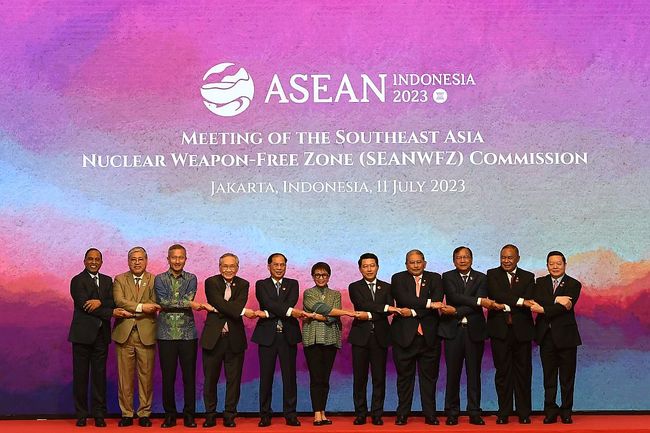
Indonesia has completed a series of the 56th ASEAN Foreign Ministers’ Meeting (AMM) and related meetings from 10 – 15 July 2023 in Jakarta, which emphasized Southeast Asian region is the epicentrum of growth and that economy and stability cooperations must be maintained by member countries and partners.
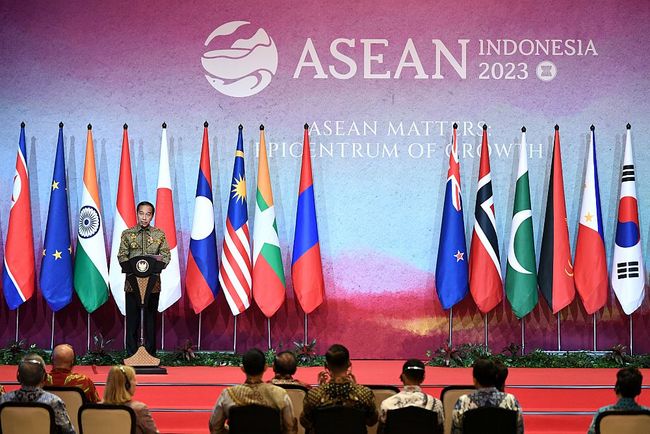
On his courtesy call at the 56th ASEAN Foreign Ministers’ Meeting (AMM) here on Friday (July 14), Indonesian President Joko Widodo said ASEAN must not become a battleground of rivalry and a proxy of any country.
“We, in ASEAN, are committed to continuously bolstering unity and solidarity as well as strengthening ASEAN’s centrality in maintaining peace and stability in the region,” the president said.
Indonesia stressed that ASEAN has excellent opportunities as the epicenter of growth as the region has abundant natural resources and a productive age population.
The 56th AMM plenary – retreat sessions were held on 11-12 July and linked to other meetings, including a meeting of the commission of the Southeast Asia Nuclear-Weapon-Free Zone (SEANWFZ), a meeting with the ASEAN Intergovernmental Commission on Human Rights (AICHR).
A number of post-ministerial conferences (PMC) and multilateral meetings have also been held with ASEAN dialogue partners: the ASEAN Plus Three (APT) Foreign Ministers’ Meeting, the East Asia Summit (EAS) Foreign Ministers’ Meeting, and the ASEAN Regional Forum (ARF), India, New Zealand, Russia, Australia, China, Japan, South Korea, the European Union, the United Kingdom, Canada, the United States, and Turkiye.
The meetings discussed several cooperations, including South China Sea, Myanmar, and Indo-Pacific issues, food security, energy transition, health, financial stability, and nuclear proliferation.
“This showed that amid the current situation, Indonesia’s chairmanship remains strong in its efforts to make Southeast Asia the epicenter of growth … and this is also supported by all of our partner countries,” Indonesian Foreign Minister Retno Marsudi said during a press conference after the 56th AMM on Friday.
Regarding regional issues, ASEAN intensifies efforts to involve all stakeholders in Myanmar to reduce conflict. The organization reaffirms that the Five Point Consensus remains the primary reference to overcome the political crisis in Myanmar.
To maintain peace and stability in the South China Sea, ASEAN stressed the importance of undertaking confidence-building and preventive measures to enhance trust and confidence amongst parties and uphold international law, including the 1982 UNCLOS.
The joint statement of the ASEAN Foreign Ministers stated the organization looked forward to the adoption of the Guidelines for Accelerating the Early Conclusion of an Effective and Substantive Code of Conduct in the South China Sea at the PMC Plus One Session with China on July 13 and encouraged efforts to make full use of the Guidelines.
Meanwhile, during the ASEAN meeting with counterpart states and multilateral fora, the organization reiterated several agenda related to the region.
ASEAN reiterated that all related parties must make all-out efforts to preserve the Southeast Asian Region as a nuclear-weapon-free zone.
Besides convincing Russia and the United Kingdom to approve the Treaty of Southeast Asia Nuclear Weapon Free Zone (SEANWFZ), Marsudi stated that ASEAN would review the treaty, so all nuclear-weapon states want to sign and adopt the SEANWFZ Protocol.
ASEAN and its counterparts also discussed food security issues. Indonesia highlighted the need for investment, education, and agricultural technology to ensure food availability, accessibility, and affordability in times of crisis during meetings with India and Canada.
ASEAN also conveyed to the European Union that the trade barriers policies, such as the European Union Deforestation Regulation (EUDR) and the European Union Enforcement Regulation (EUER), should not disrupt potential economic relations potential between the two regions. Thus both parties must find a joint solution through ASEAN-EU mechanisms.
During the meeting with the Japanese counterpart, Marsudi highlighted the potential development of electric vehicles (EV) in the region with Japan. ASEAN is well-positioned to partner with Japan in developing the ecosystem for EV batteries, while Japan can support this goal through the Green Innovation Fund.
The implementation of these cooperations would be discussed in greater detail and with more concrete plans by ASEAN sectoral ministers responsible for the economic field.
ASEAN reiterated that the member states need support from developed and friendly nations to leave the zero-sum approach and adopt a win-win strategy.
Source: Antara News Agency